Press Release 26/06/2020
PUBLIC SECTOR BUDGETARY STATISTICS 2018
In 2018 the income of the Basque Administrations rose by 4.9% and expenditure increased by 3.2%
The outstanding debt at 31 December 2018 stood at 11,558 million euros, 15% of GDP
The total consolidated income of the Basque Administrations (made up of the Basque Government, the Provincial Councils and Municipal Administrations, together with their corresponding Autonomous Bodies and supra and infra-municipal Entities) rose to 19,048 million euros in 2018, which was a rise of 4.9% compared to the previous year, according to Eustat data. Expenditure increased to 18,064 million, up 3.2%.
Focusing on non-financial operations, income also rose more than expenditure, with non-financial income posting a 3.5% rise and non-financial expenditure posting a 0.2% rise, and so the non-financial budgetary balance went from 599 million euros in 2017 to 1,164 million in 2018.
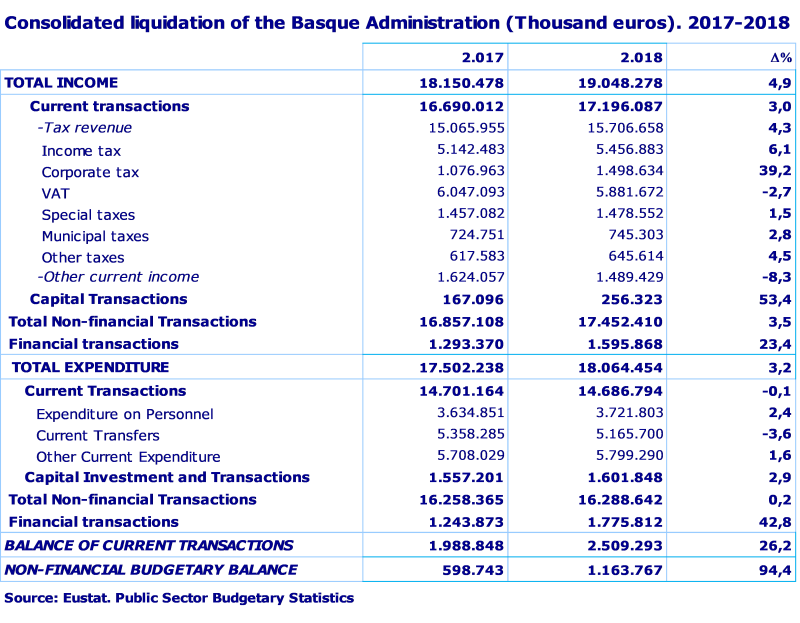
Income and expenditure from financial operations both increased in 2018. Income rose by 23.4% to stand at 1,596 million euros, whereas financial expenditure saw a higher percentage increase, reaching1,776 million euros, which represented a rise of 42.8%.
The growth in non-financial income was the result of the positive trend in current income (3.0%), which further accounted for 92% of total income. Income from capital operations, with much less weight, registered a rise of 53.4%.
Tax revenues in 2018, which accounted for 82.5% of total income, practically all performed positively compared with the previous year with, as a whole, a growth rate of 4.3%. Only VAT posted a negative rate, of 2.7%, but this is explained by an extraordinary element that conditioned the comparison: in 2017, 599.9 million euros (derived from the Joint Commission on Economic Agreement) were allocated to the tax year, which already showed an unexpected rise of 17.1% in the 2017 tax year on the previous year and, in turn, caused the drop in 2018. The increase, in homogeneous terms, stood at 8%.
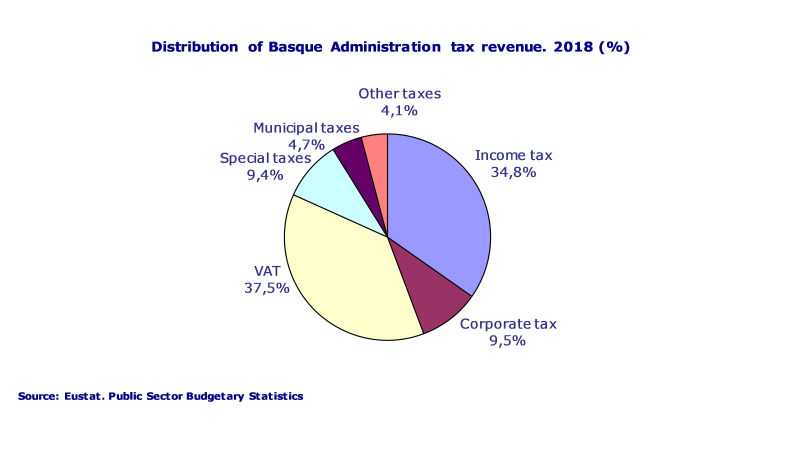
Income Tax and VAT, are the tax figures with most weight within tax revenues and provide 37.5% and 34.7%, respectively, to the totality of the same.
As regards income tax, there was a 6.1% increase in respect of 2017, and it was the source of income that posted the second highest growth, after Companies. Although Corporate Tax only accounted for 9.5% of taxes, it registered growth of 39.2%. Special Taxes, representing 9.4% of tax revenues, increased by 1.5% Finally, Municipal Taxes and Other Taxes also posted increases, which totalled 2.8% and 4.5%, respectively.
Other Current Income, which includes taxes, transfers and equity income, accounted for 8.7% of total income from current operations and registered an 8.3% decrease.
Current expenditure registered a decrease of 0.1%. This fall was primarily caused by Current Transfers, which represents 28.6% of total expenditure and fell by 3.6% in respect of 2017. Staff Expenditure performed positively, accumulating 20.6% of total expenditure and increasing by 2.4%. Finally, other current expenditure was up 1.6%.
Expenditure on Investments and Capital Transfers, however, which represented 8.9% of the total, rose by 2.9% compared with 2017, i.e. by 45 million euros.
By institutions, both the Basque Government and the provincial administrations (Provincial Councils and Local Entities) registered positive non-financial budgetary balances. Specifically, the Basque Government posted a positive balance of 447 million euros, an improvement of 211 million euros on the 2017 figure. The three provinces maintained positive balances, which were more favourable than those of the previous year.
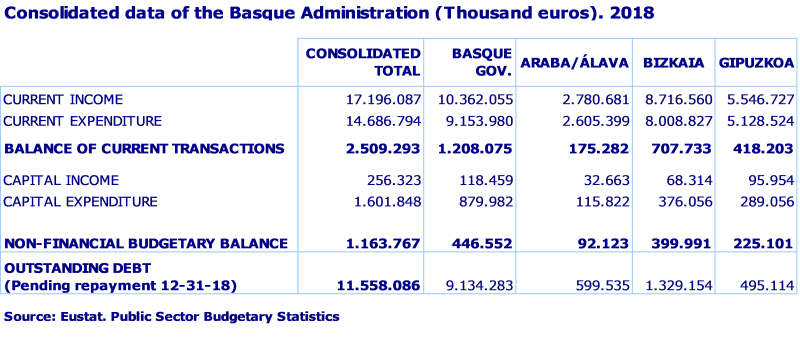
The outstanding debt of the Basque Administrations stood at 11,558.1 million euros on 31 December 2018, 15% of GDP. The new liabilities acquired in 2018 increased to 1,551.3 million, while depreciations amounted to 1,646.5 million.
The total outstanding debt of the Basque Government at the end of 2018 accounted for 79% of total outstanding debt, followed by Bizkaia (11.5%), Gipuzkoa (4.3%) and lastly Álava with the remaining 5.2%.
For further information:
Eustat - Euskal Estatistika Erakundea / Basque Statistics Institute
C/ Donostia-San Sebastián, 1 01010 Vitoria-Gasteiz
Press service: servicioprensa@eustat.es Tel: 945 01 75 62