Press Release 21/07/2020
SURVEY ON POPULATION IN RELATION TO ACTIVITY. II/2020
The unemployment rate stood at 10.8%, and the employed population was down 3.4% in the second quarter of 2020 in the Basque Country
There was a significant increase in the inactive population, amongst which there were 19,600 more people not seeking work and a further 8,500 who were not taking active steps to seek work
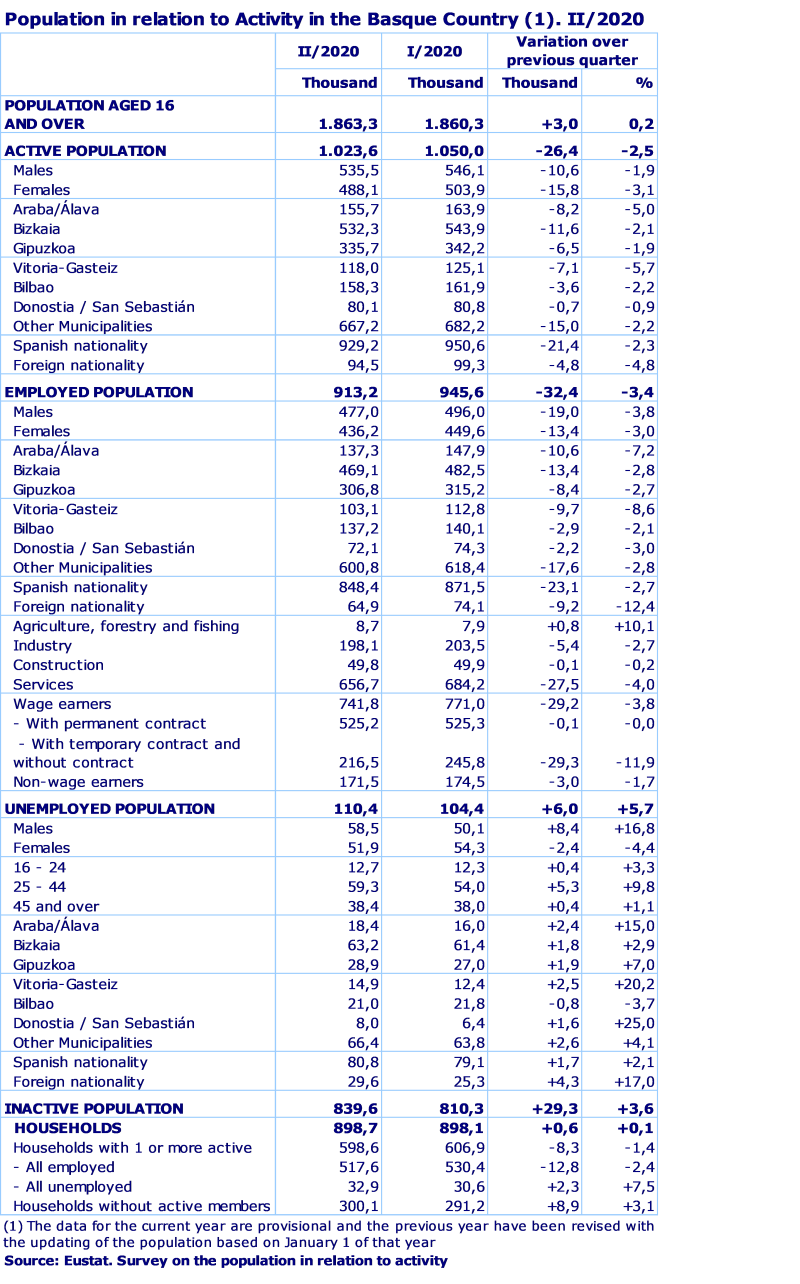
Basque Country labour market data for the second quarter of 2020 showed a figure of 913,200 people in work, which is a decrease of 32,400 compared to the previous quarter (-3.4%), according to Eustat data. There were an estimated 110,400 people out of work in the Basque Country in the second quarter of the year, 6,000 more than in the previous quarter.
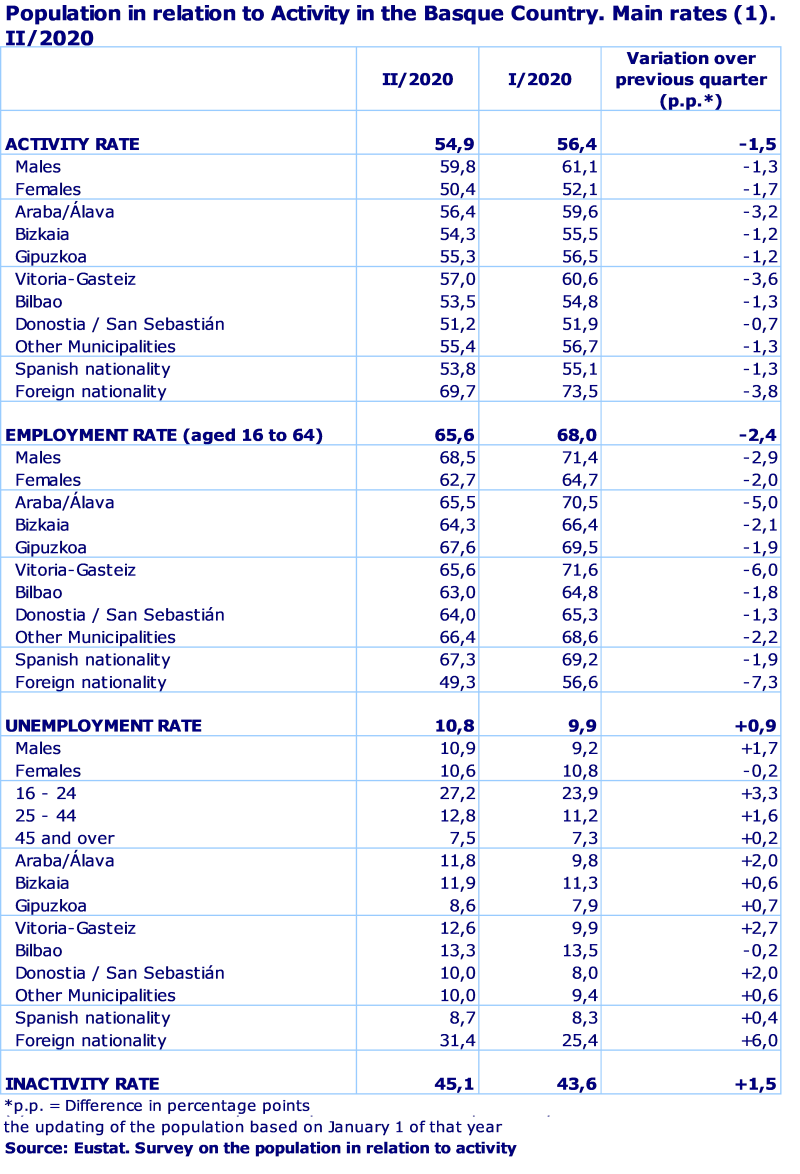
On the other hand, the unemployment rate of the Basque Country stood at 10.8%, 0.9 percentage points up on the first quarter of 2020. As a result of the evolution in the employed and unemployed population, the activity rate stood at 54.9% in the second quarter of 2020, falling 1.5 points in respect of the previous quarter.
By province and compared to the previous quarter, Bizkaia experienced the biggest fall in employment, with 13,400 fewer people in work; followed by Álava, with a decrease of 10,600, whilst in Gipuzkoa there were 8,400 fewer employed people. Regarding the capitals, in Vitoria-Gasteiz there were 9,700 fewer unemployed people, as was the case in Bilbao (-2,900) and in San Sebastián (-2,200).
In terms of gender, the decrease in the number of people in work most affected men, with 19,000 fewer in work than the previous quarter, whilst the number of women in work fell by 13,400.
With regards to nationality, the number of Spanish nationals in work fell by 23,100, whilst the number of foreign nationals in work decreased by 9,200.
Employment fell in all sectors, except for the primary sector
The employed population in the Basque Country decreased by 27,500 in the services sector, 5,400 in Industry and 100 in the construction sector; in contrast, the number of people employed in the primary sector increased by 800.
The employment rate, calculated as the percentage of people in work aged 16 to 64 over the total for these ages, fell by 2.4 percentage points compared to the previous quarter, standing at 65.6%. This figure reached 68.5% for men and 62.7% for women.
With regards to the level of education completed, the employment rate decreased by 4 percentage points among people educated to primary school level or lower, standing at 57.2%; among those who had completed secondary and intermediate education and higher education, the employment rate fell by 1.8 points, standing at 57.1% and 82.1%, respectively.
As regards nationality, the highest employment rate was recorded amongst Spanish nationals, with 67.3%, whereas for foreign nationals it stood at 49.3%.
By province, Gipuzkoa had the highest employment rate, at 67.6%, a decrease of 1.9 percentage points compared to the previous quarter. Álava came second with 65.5% and a decrease of 5 points, and in Bizkaia, the employment rate fell by 2.1 percentage points to stand at 64.3%.
The number of households with all active individuals in work rose by 12,800
In the second quarter of 2020 it was estimated that there were 898,700 households in the Basque Country, of which a third did not have any active individuals. In almost six out of every ten households, all of the active individuals were in work, but with 12,800 fewer families than in the previous quarter; furthermore, households where all active individuals were unemployed stood at 32,900, 2,300 households more than the previous quarter.
The second quarter of 2020 revealed an unemployment rate of 10.8%, 0.9 percentage points more than the previous quarter
The unemployed population in the Basque Country, that is, people who are available for work, actively making enquiries and seeking employment, was estimated to be 110,400 in the first quarter of the year, 6,000 more than in the previous quarter. The number of unemployed men, 58,500, was up by 8,400, whilst the number of unemployed women decreased by 2,400, reaching a total of 51,900 for the quarter.
The data for the second quarter of 2020 revealed an unemployment rate of 10.8%, 9 percentage points up on the previous quarter. The male unemployment rate stood at 10.9% (up 1.7 percentage points) and the female rate was down 0.2 percentage points, reaching 10.6%. By age, the youth unemployment rate continued to be the highest, standing at 27.2%, an increase of 3.3 percentage points compared to the previous quarter.
As regards the level of education, the greatest increase in the unemployment rate was among people whose highest level of education completed was higher education, with an increase of 1.6 percentage points, the unemployment rate standing at 7.2%. For people who had completed secondary or intermediate education and primary education, the unemployment rate rose by 0.4 percentage points, standing at 12.9% and 13.8% respectively.
With regards to nationality, the unemployed population figure increased among foreign nationals by 4,300, standing at 29,600. Among Spanish nationals unemployment increased by 1,700 to stand at 80,800 people out of work.
By province, Álava saw the greatest increase in unemployment, with 2,400 more people out of work and the unemployment rate was up 2 percentage points, reaching 11.8%. In Gipuzkoa, with 28,900 people out of work, the number of unemployed rose by 1,900 and the unemployment rate increased by 0.7 percentage points to 8.6%. In Bizkaia, there were 1,800 more people out of work and the unemployment rate stood at 11.9%, 0.6 percentage points up on the previous quarter.
As regards the capitals, unemployment increased in Vitoria-Gasteiz and San Sebastian by 2,500 and 1,600 people respectively; in Bilbao, on the other hand, there were 800 fewer people out of work.
According to EUROSTAT, the Statistical Office of the European Union, in May 2020 the deseasonalised unemployment rate of the European Union as a whole stood at 6.7% and that of Spain stood at 14.5%.
In the last year, the number of employed people decreased by 3.9% and the unemployment rate rose from 9.8% to 10.8%
The employed population in the Basque Country fell by 36,600 people in relation to the second quarter of 2019, a decrease of 3.9%. The unemployment rate was up one percentage point (from 9.8% to 10.8%), with 7,300 being added to the unemployment figures of the Basque Country, compared to the second quarter of 2019.
98% of average registered workers were in work, according to ILO criteria
It is estimated that there were 861,100 registered workers for the quarter on average in the Basque Country, i.e. the number of people residing in the Basque Country who were registered for Social Security at the time of the survey. Of those, the PRA estimates that 98% were employed, according to criteria from the International Labour Organisation (ILO), a total of 844,200 individuals.
Amongst those employed according to ILO criteria in the PRA, 60,300 people, 6.6%, were not registered in the Social Security system, either because they did not work for companies based in the Basque Country, or they belonged to public mutual societies for civil servants, or are in other situations.
34.8% of those unemployed were not registered as unemployed with the Basque Employment Institute (Lanbide)
It is estimated that there was a quarterly average of 120,700 unemployed people registered with Lanbide, i.e. people residing in the Basque Country who were registered in Lanbide at the time of the survey in any one of the categories designated for registered unemployment. Of those, 55.4% were unemployed according to the ILO definition (66,900 people). 34.8% of people unemployed according to the ILO definition in the PRA were not registered as unemployed with Lanbide (38,400 people), even though they may be registered under other categories of job seekers.
Repercussions of COVID-19 on the labour market in the Basque Country
Population data in relation to activity in the second quarter of 2020 have been conditioned by the appearance of COVID-19 and the measures restricting activity established by the Government.
The figures obtained regarding the working population and the employment rate are conditioned by the massive use of certain resources, such as temporary layoff measures known as ERTEs (Temporary Labour Force Adjustment Plans), which affect the activity, but not necessarily the status of the population in relation to the same. In fact, the majority (97.7%) of people who are subject to an ERTE remain employed because they are expected to return to work in at least 3 months or are continuing to receive more than 50% of their salary. Other palliative mechanisms affect self-employed workers, but equally do not necessarily alter their relationship with the activity.
The PRA is an ongoing survey, which enables an analysis by months and even by the 13 weeks across which our sample is evenly distributed in the second quarter. This, together with the amount of information gathered, allows us to obtain additional information for carrying out a better assessment of the situation of the Basque labour market. The information gathered regarding the work status of every person surveyed refers to the week that by sampling design corresponds to them.
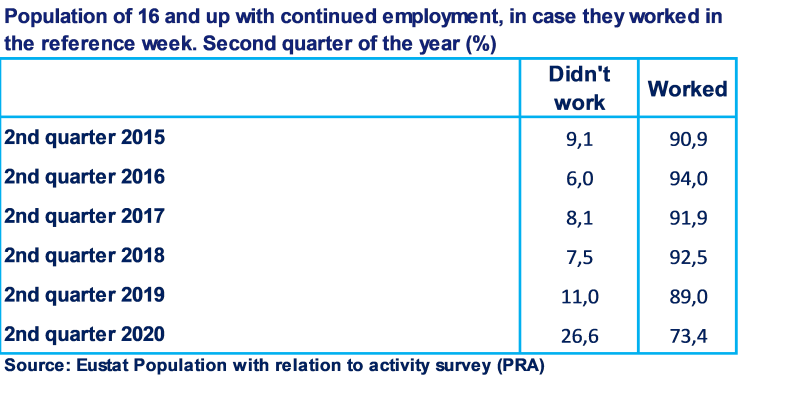
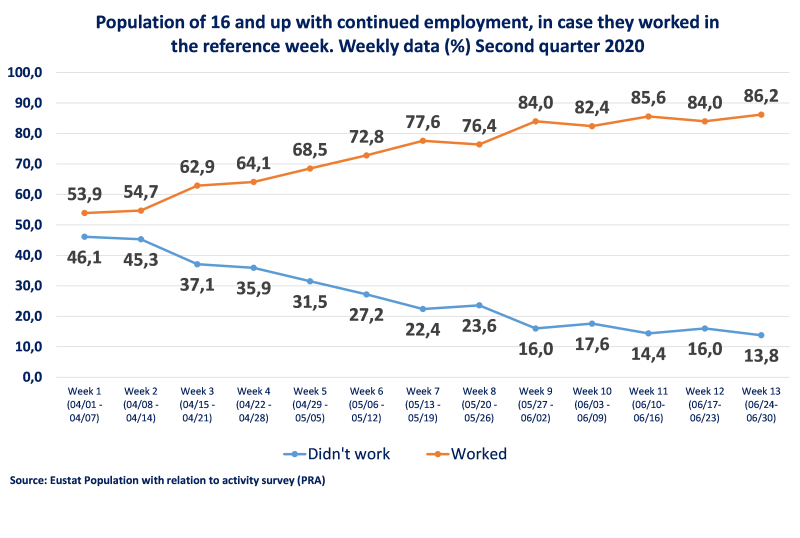
The percentage of the employed population who did not work reduced by 32.3 percentage points throughout the quarter, from 46.1% in the first week of April to 13.8% in the last week of June
The analysis of the evolution of the percentage of employed people who have not worked in the reference week gives relevant results. In this second quarter of the year, the percentage of employed people who have not worked in the reference week is greater than in the second quarters of previous years. If in previous years, for the second quarter, said percentage was between 7.5% and 11%, in the second quarter of 2020, this percentage reaches 26.6%.
If we examine the same data by week we can further see that it starts to progressively decrease from the first week (1-7 April), going from 46.1% this week to 13.8% in the last week of the quarter.
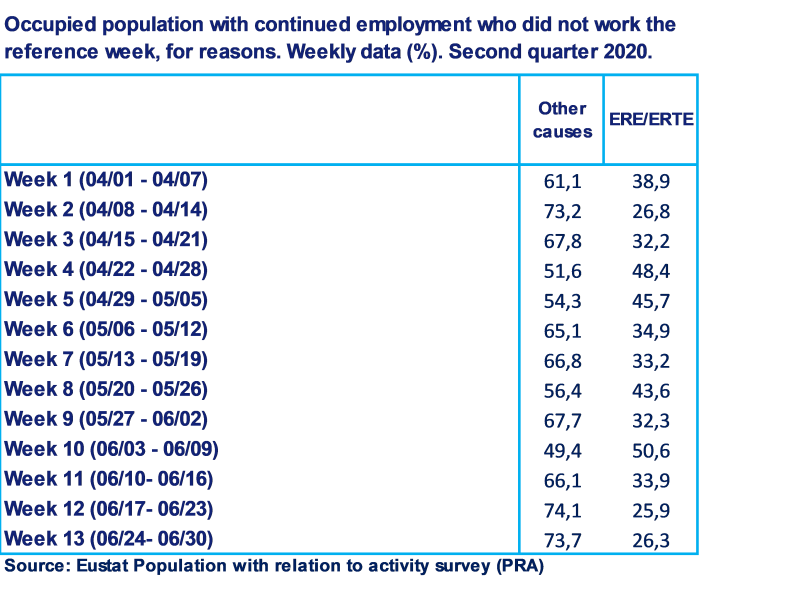
Among the reasons put forward by the working population for not having worked in the reference week, a Labour Force Adjustment Plan (ERE) or Temporary Labour Force Adjustment Plan (ERTE) are the reasons that accounted for a higher percentage throughout practically the whole quarter.
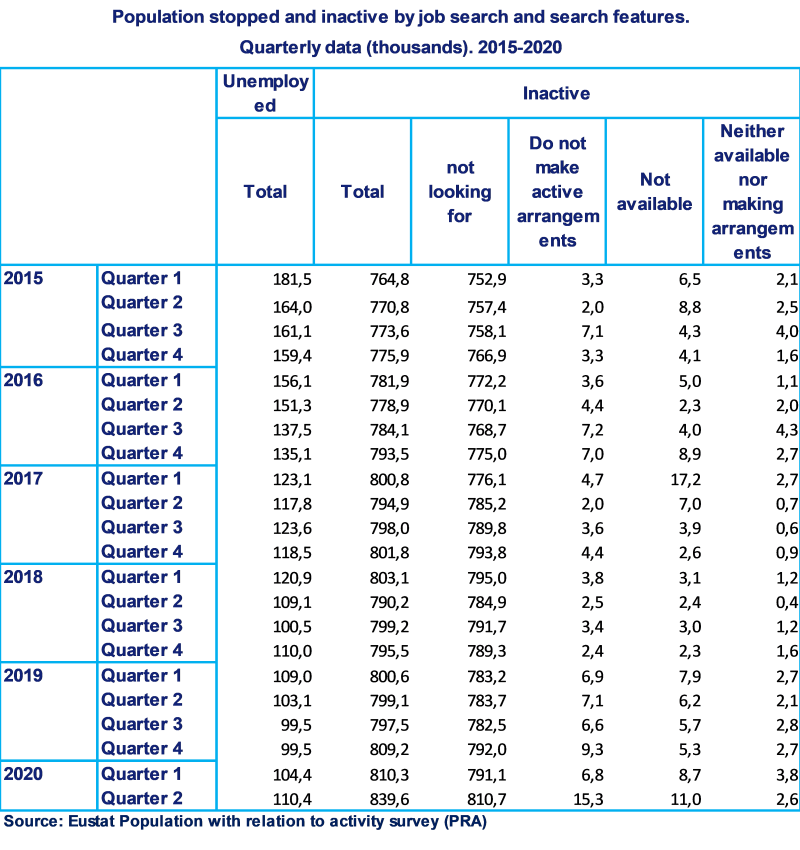
Analysing the evolution of the different characteristics of seeking work that determine whether a person is unemployed or inactive, a notable increase was observed in the number of inactive people who are not seeking work, 19,600 more people than in the previous quarter; there was also a significant increase among those who say they are seeking work but are not taking active steps to seek work (8,500 more), whereas among those who are not available for work, the increase was 2,300 people.
For further information:
Eustat - Euskal Estatistika Erakundea / Basque Statistics Institute
C/ Donostia-San Sebastián, 1 01010 Vitoria-Gasteiz
Press Service: servicioprensa@eustat.es Tel: 945 01 75 62