Press Release 13/05/2020
GENDER EQUALITY INDEX. 2020
The Gender Equality Index of the Basque Country improved for another year running to stand at 71.1 points out of 100
There are only slight differences between provinces, but Gipuzkoa stands out with an index of 72.5, followed by Álava (71.0) and Bizkaia (69.5).
The Gender Equality Index (GEI) in the Basque Country stood at 71.1 points out of 100 in 2017 according to EUSTAT data. Between 2010 and 2017 four measurements were carried out that reflected the successive advances in the value of the GEI in the Basque Country, which went from 68.8 points in 2010 to 71.1 in 2017.
The Gender Equality Index is a synthetic indicator that summarises in a dimensionless scale, on which 1 signifies total inequality and 100 signifies total equality, the inequalities that still exist between men and women in a series of significant aspects that affect their welfare and personal development.
It has been created using the methodology of the European Institute for Gender Equality (EIGE), which enables advances in gender equality in the Basque Country to be compared with advances made in the European Union and its 28 member countries, as well as its evolution over 2010, 2012, 2015 and 2017.
The methodology comprises 31 indicators structured hierarchically into six domains that are in turn divided into 14 sub-domains.
With 92.4 points, the domain of Health came closest to total equality between persons of different genders, although it must be taken into account that, in this case, the slight inequality is the result of the better situation of women. At the other extreme, the greatest inequality was found in the domain of Power, with a partial indicator of 58.0 points out of 100. Specifically, it was the domain relating to economic power that obtained the worst score, 41.3 out of 100.

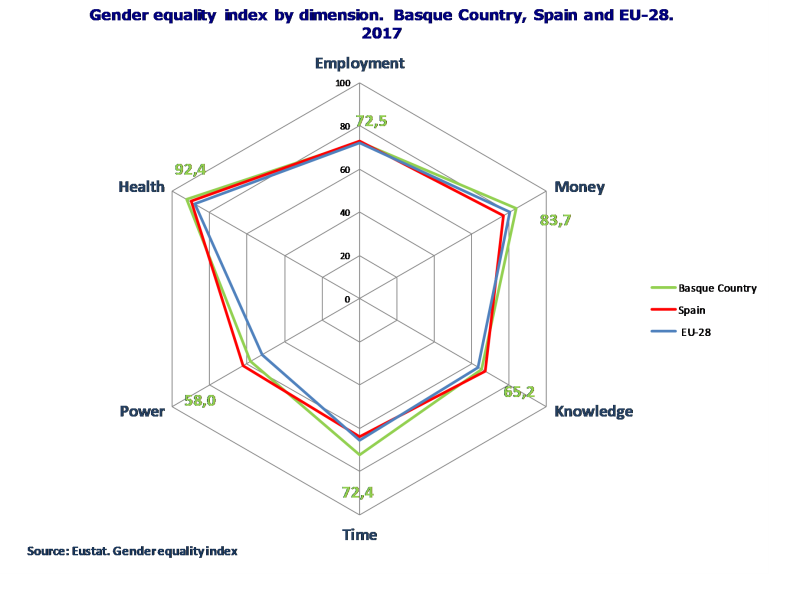
The Basque Country obtained a better score in all of the domains than the EU-28 average and in eleven of the fourteen sub-domains.
The highest values for gender equality in 2017 in the Basque Country were reached in the Health, Money and Employment domains, with the lowest value being for Power. Compared to the EU-28 average the Basque Country showed a higher score in all domains, with a maximum difference of 6.7 points for Time being the most significant. However, in one area within this domain, time spent on social activities, the Basque Country obtained a value of 59.3, below the European average of 61.6. The other two sub-domains in which the Basque Country sits below Europe were economic power and social power.
Between 2010 and 2017 all domains improved, except the area of time
Over the years 2010, 2012, 2015 and 2017 an improvement in the GEI can be seen in the Basque Country, obtaining 68.8 points in 2010, 69.1 in 2012, 69.3 in 2015 and reaching 71.1 in 2017.
In the same manner, and except in the area of Time, there was an improvement in the gender equality indicators in all areas, especially in Knowledge, where the indicator gained 4 points, mainly due to the improvement of Segregation by field of study, which went from 53 points in 2010 to 58.2 in 2017.
In the domain of Power, the increase was 3.7 points, standing at 58.0. The sub-domain of political power was of particular note, improving 6 points to stand at 87.7 points.
In contrast, the indicator of the area of Time was down 1 point. This regression is the result of the occurrences in Social Activities, which went from 60.8 points in 2010 to 59.3 in 2017.

The Basque Country is positioned behind Sweden, Denmark, Finland, the United Kingdom, the Netherlands and Ireland and on a par with Belgium, but ahead of the remaining 20 members of the European Union, as well as the EU-28 average.
The Gender Equality Index in Spain stood at 70.1 pints in 2017, one point down on the 71.1 corresponding to the Basque Country.
Moreover, in 2017 the Basque Country obtained higher values than Spain in the partial indicators of five of the six domains taken into account in the calculation of the Gender Equality Index: the domain in which the Basque Country most comfortably exceeded the result of Spain was Time, with a difference of 8.4 points. However, it also comes out in front in the domains of Money (+7) and Health (+2.3). On the other hand, it is disadvantaged in terms of the domains of Employment (-0.4), Knowledge (-2.2) and, above all, Power (-4), it is below Spain in both Social (-4.2) and, above all, Economic Power (-12.1), although the indicator of Political Power in the Basque Country exceeded that of Spain as a whole by almost 11 points.
The gender gap in 2017 is null in the Voluntary and Charitable Activities, Healthcare and Dental Care indicators, but very high for the Economic Power indicators
As well as the comparison with the European Union and its member countries, the internal situation in the Basque Country can be analysed using the gender gap indicator, understood as the difference existing between men and women in the different areas described, the values of which range from 0 (total inequality) and 1 (total equality).
In this manner, it can be demonstrated that the gender gap is null or extremely small in the components relating to health, such as Health and Dental Care (1.00 in both cases), Healthy Life Years (0.98), Self-perceived Health (0.97), Life Expectancy (0.96) and Tobacco and Alcohol Consumption (0.94). It is also null in Voluntary and Charitable Activities, and very small in Income Distribution and Risk of Poverty (0.98 in both cases).
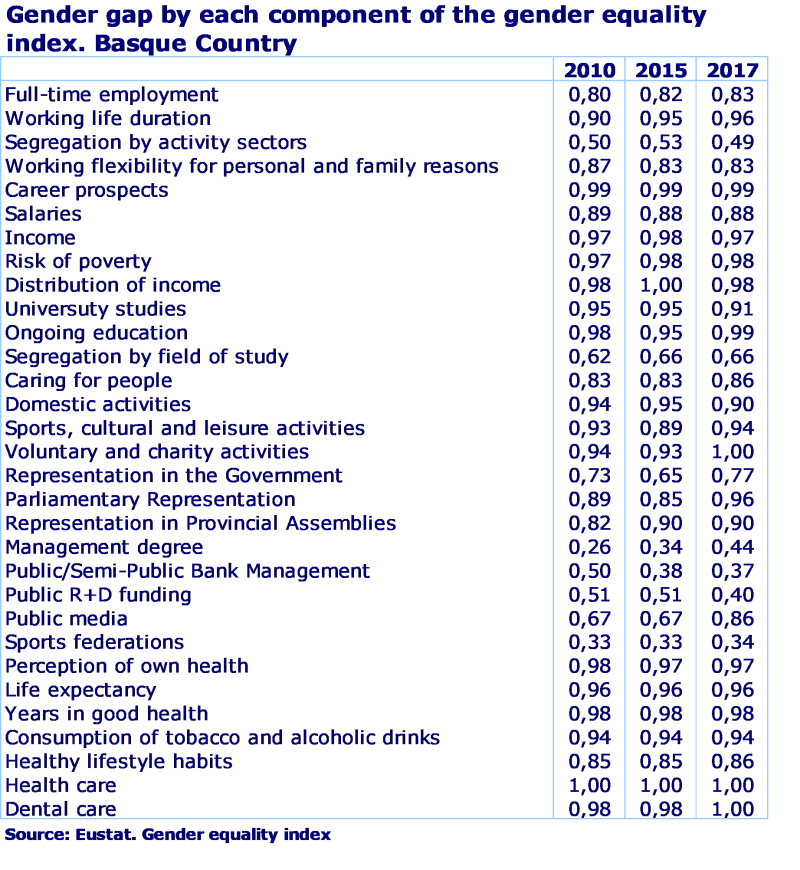
In contrast, the greatest gender gaps occurred in Sports Federations (0.34), Public/Semi-Public Bank Management (0.37), Public R+D funding (0.40), Business Management (0.44), Segregation by Activity Sectors (0.49), Segregation by Field of Study (0.66) and Representation in Government (0.77), where there remain differences by gender.
Compared to 2010, there are both positive and negative trends, but standing out are the gender gap reduction in Public Media (from 0.67 to 0.86) and Business Management (from 0.26 to 0.44) and the negative trend of the indicators in Public R+D funding (from 0.51 to 0.40) and Public/Semi-Public Bank Management (from 0.50 to 0.37).
The Gender Equality Index in the Provinces of the Basque Country reflects only slight differences
For the first time, Eustat has adapted the methodology of the European Institute for Gender Equality and calculated the Gender Equality Indexes for the provinces.
The first conclusion obtained from this comparison is that the differences between the provinces are in general, relatively small, the greatest differences occurring in the domains of Money and Power: in Money the gap between the highest-placed province, Gipuzkoa, and the lowest, Bizkaia, is 4.6 points; in Power the difference is greater still, 6.5 points, with the same actors.
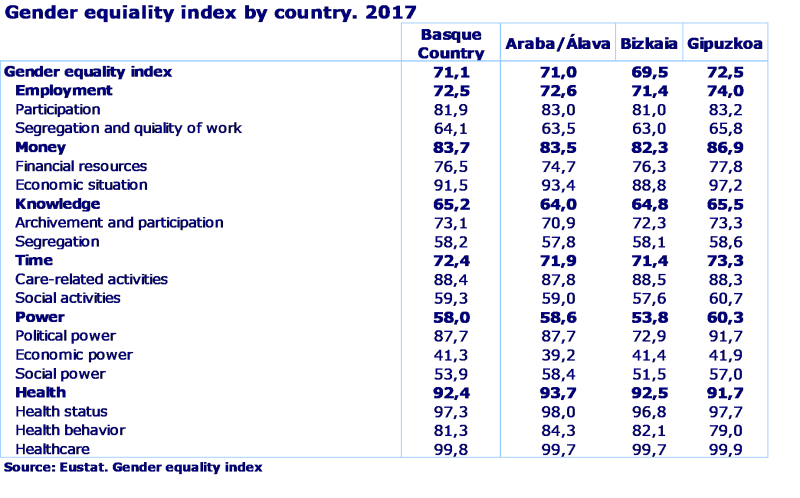
The sub-domains that cause these differences are Political Power (which reflects the equality achieved in the composition of governing bodies and representation on Provincial Councils and among the mayors of Basque towns) and Economic Situation (which does the same with two indicators of family income distribution, the poverty rate and the 20/80 indicator for distribution of earnings). In both sub-domains, the province with the best results is once again Gipuzkoa, with Álava in second place and Bizkaia third.
The differences outlined above make the Gender Equality Index higher in Gipuzkoa, where it sits at 72.5 points, followed by Álava (71.0 points) and Bizkaia (69.5).
These data mean that gender equality in Gipuzkoa is at levels close to the fourth highest European country in the ranking, above the United Kingdom and behind only the three Nordic countries and France.
However, beyond the numerical differences, the notable features in the three provinces are similar to those of the Basque Country, with minor differences.
Álava stands out in the Health domain (93.7), above all in Health Status (98.0) and Healthy Behaviour (84.3). However, in the Knowledge domain, it is below (64.0) the average in both Attainment and Participation (70.9) and Segregation (57.8). In the remaining domains it is very close to the Basque Country values. The area where gender inequality is most pronounced is Power (58.6), particularly Economic Power (39.2), in addition to the aforementioned Segregation in Knowledge.
Bizkaia, except in the area of Health, is below the Basque Country values in all the domains. Once again, Power is also the most unequal domain in Bizkaia (53.8), together with Segregation (58.1) within Knowledge (64.8).
Gipuzkoa shows the best Gender Equality Index values in all the domains, except in Health although the differences in this area are minimal. However, the areas where inequality is most pronounced are the same as in the other two provinces, although they are slightly more positive: the areas of Power (60.3) and Knowledge (65.5). In the former it is more specifically Economic (41.9) and Social (57.0) Power and not Political Power, which showed a value of 91.7. In the latter, once again it is Segregation in Knowledge, which showed a much lower value (58.6).
Gender Equality Index. Structural Indicators
METHODOLOGICAL NOTE
The Gender Equality Index (GEI) is a synthetic index that is calculated by aggregating 31 basic indicators. The GEI structure takes into account four levels:
The Gender Equality Index, maximum aggregation level
The Index of the six domains involved: Employment, Money, Knowledge, Time, Power and Health.
The Index for the sub-domains that each of the previous domains are divided into.
The Index of the basic indicators, of which a measure of gender equality is calculated for each.
The aggregation process that leads to the calculation of the Gender Equality Index occurs in the form of a scale that goes from level 4 to level 1 as follows:
The synthetic indices by sub-domains (S) are obtained by calculating the simple arithmetic mean for the measure of gender equality (M) for each basic indicator (X):

Where nj is the number of indicators included in each sub-domain, and ???????? is the synthetic index for each sub-domain, country and year.
The synthetic indices by domains (D) are obtained by calculating the geometric mean of the synthetic indices for the corresponding sub-domains (S):

Where ???? is the number of sub-domains included in each domain and ???????? is the synthetic index for each domain, country and moment in time.
The Gender Equality Index (GEI) is obtained by calculating the weighted geometric mean of the indices for each domain (D):

The weightings (w) utilised have been calculated by the European Institute for Gender Equality by applying the hierarchical clustering methodology.
Further methodological information:
Link to Basic Methodology
Link to List of Indicators
Link to Methodological Updates
For further information:
Eustat - Euskal Estatistika Erakundea / Basque Statistics Institute
C/ Donostia-San Sebastián, 1 01010 Vitoria-Gasteiz
Press service: servicioprensa@eustat.es Tel: 945 01 75 62