Press Release 29/05/2020
INDUSTRIAL STATISTICS - REGIONS. 2018
Sales in the extraction and manufacturing industry increased in 19 of the 20 regions in the Basque Country in 2018
The majority of regions also experienced a rise in employment, although this was more moderate
Employment in the extraction and manufacturing industries grew significantly in nineteen of the twenty regions of the Basque Country in 2018, according to EUSTAT data.
For an average increase in the Basque Country of 7.5%, sales only decreased in the region of Markina-Ondarra (-7.9%) in respect of 2017. Performance was positive for the remaining nineteen regions. The highest growth was in Montaña Alavesa and Urola-Costa with increases of 21.3% and 18.1%, respectively. They were followed, in third place, by the region of Estribaciones del Gorbea in Álava, where sales were up 14.3%.
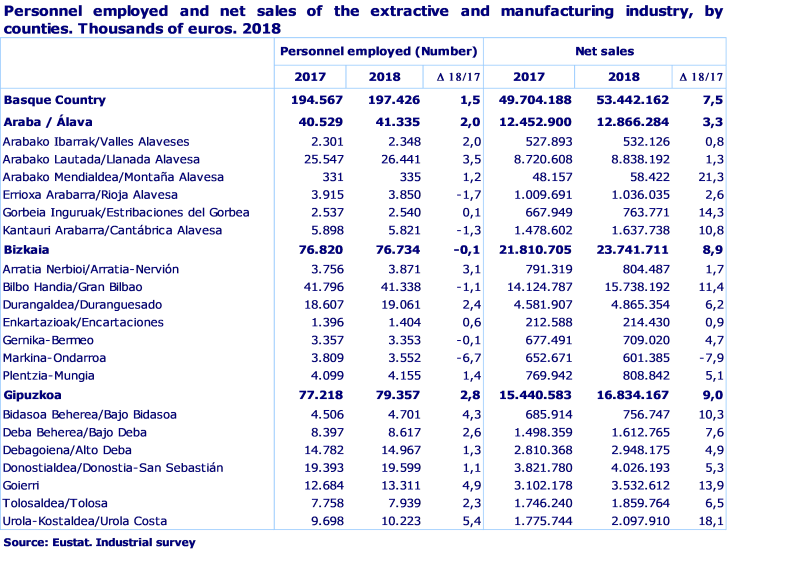
In Álava net sales were up 3.3% and, besides the aforementioned increases in Montaña Alavesa (21.3%) and Estribaciones del Gorbea (14.3%), also of note was the 10.8% rise in sales observed in Cantábrica Alavesa. Despite these high individual growth percentages, it was the region of Llanada Alavesa, with an increase in sales of 1.3% that set the trend in Álava. This region, where the provincial capital is located, concentrated the highest percentage of total sales in the province (68.7% of sales). The two remaining regions, Rioja Alavesa and Valles Alaveses, increased their sales by 2.6% and 0.8% respectively.
In Bizkaia, Gran Bilbao and Duranguesado were the two regions that made the highest percentage contribution to total sales (86.8% of provincial sales). They were both responsible for the highest growth in sales in the province, the former with 11.4% and the latter with 6.2%. Standing below the average year-on-year variation achieved in Bizkaia (8.9%), were Plentzia-Mungia, with growth of 5.1% and Gernika-Bermeo, where sales increased by 4.7%. There was less growth in Arratia-Nervión, with 1.7%, and, in last place, although still positive, Encartaciones with a rise of 0.9%. Furthermore, the only region that showed a negative evolution in sales in the Basque Country was in Bizkaia: Markina-Ondarroa with a drop in sales of -7.9%.
In Gipuzkoa there was more regional distribution of net sales. The percentage weight of regional sales in the province as a whole varied between 4.5% in Bajo Bidasoa and 23.9% in Donostia-San Sebastián; with a similar share to this latter region were Goierri with 21% and Alto Deba with17.5%. This province, with one-tenth more than Bizkaia, saw the highest growth in sales in the Basque Country. Its seven regions saw a positive evolution between 2017 and 2018. Above the provincial average of 9% were Urola Costa (18.1%), Goierri (13.9%) and Bajo Bidasoa (10.3%), whereas falling below this average were Bajo Deba (7.6%), Tolosa (6.5%), Donostia-San Sebastián (5.3%) and, with the lowest growth in the province, Alto Deba with 4.9%.
Employment also performed positively, although to a lesser extent. As a whole and in relation to 2017, employment rose by 1.5% in the Basque Country. The trend at the provincial level was very similar in Gipuzkoa and Álava, 2.8% more industrial employment in Gipuzkoa and 2.0% more in Álava, while Bizkaia maintained its 2017 figures, with a slight fall in employment of 0.1%. At a regional level, fifteen of the twenty regions attained positive annual growth rates. Among these, of particular note in Gipuzkoa are the rates in Urola-Costa, which increased by 5.4%, and Goierri, up 4.9%; in Bizkaia, Arratia-Nervión had a year-on-year rate of 3.1%; and in Álava, the rate in Llanada Alavesa was 3.5%.
In Gipuzkoa, as in the case of sales, employment in the manufacturing and extraction industry rose between 2017 and 2018 in all of its regions. In addition to the aforementioned increases in Urola-Costa and Goierri, growth was also seen in Bajo Bidasoa, Bajo Deba, Tolosa and Alto Deba, in amounts ranging between 4.3% in the former and 1.3% in the latter. In the case of the region that includes the provincial capital, Donostia-San Sebastián, growth stood at 1.1%.
In Álava only Rioja Alavesa and Cantábrica Alavesa saw a fall in employment (-1.7% and -1.3%), while in Estribaciones del Gorbea it remained practically unchanged (0.1%). Llanada Alavesa was the region that registered the highest growth, with 3.5% more employment. In the two remaining regions in this province the increases were 2% for Valles Alaveses and 1.2% in the case of Montaña Alavesa.
In Bizkaia three regions showed a negative annual variation. These were: Markina-Ondarroa, whose employment fell by 6.7% and Gernika-Bermeo (-0.1%), together with Gran Bilbao, where employment dropped by 1.1%. Standing out in the rest of the regions were the increases in Arratia-Nervión, with 3.1% more employment, followed by Duranguesado, up 2.4% and Plentzia-Mungia with an increase of 1.4%. The lowest positive growth was in the region of Encartaciones with 0.6%.
In Álava and Bizkaia the dominance of employment in the regions where the provincial capital is located, although striking, is less pronounced than that seen in sales. Thus, in the former, Llanada Alavesa accounted for 64% of employment in its province, when it represents 68.7% of sales. In Bizkaia, the region of Gran Bilbao accounted for 53.9% of total employment, but 66.3% of its sales. In contrast, in Gipuzkoa the weight of Donostia-San Sebastián is very similar in both cases, 24.7% of regional employment against 23.9% of sales and lower than that shown by the other capitals and their regions in respect of the province.
Distribution of net sales in the extraction and manufacturing industry by regions. Thousands of euros. 2018
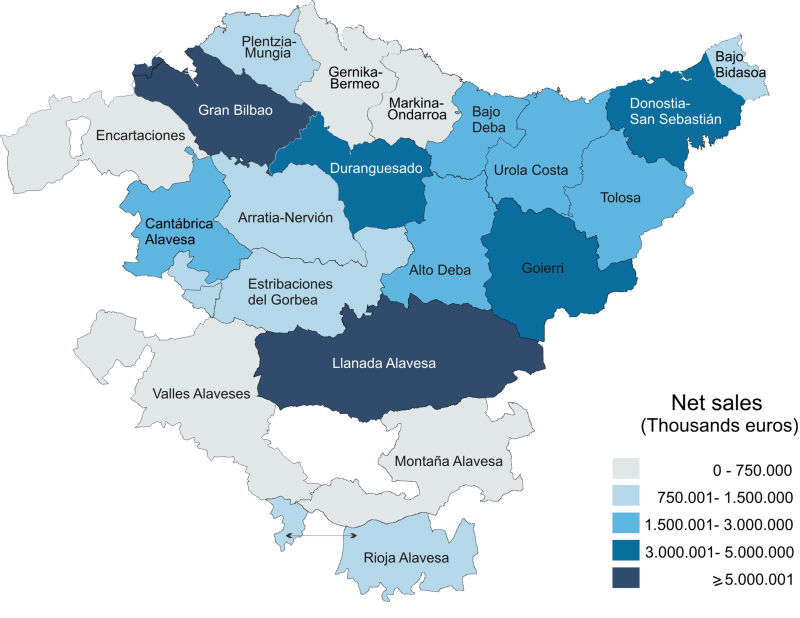
Source: EUSTAT. Industrial Survey
As regards gross value added, which is the difference between the value of what is produced and that of the consumption utilised and represents the wealth generated, registered a rise of 3.8% in 2018 The regional trend was positive for fifteen of the twenty regions in the Basque Country. Among those that registered positive variations were Montaña Alavesa, Urola-Costa and Goierri, with increases of 16.5%, 12.6% and 12.3%, respectively.
It should be mentioned that in Gipuzkoa, with provincial growth of 6.5%, all its regions had positive variations in value added. In Bizkaia, four of its regions showed negative performance, which varied between -0.1% in Plentzia-Mungia and -8% in Markina-Ondarroa. In this province and compared to 2017 value added increased in Duranguesado, Encartaciones and Gran Bilbao at a rate of 4.9%, 3.9% and 2.1%, respectively. In turn, Álava saw the same growth in value added as Bizkaia, 2%, and only one of its regions posted a negative variation, Rioja Alavesa, with a fall of 1.2%. At the opposite extreme, of note is the growth we have already mentioned that occurred in Montaña Alavesa, with 16.5%, and Cantábrica Alavesa with 7.3%.
Methodological note:
The sectorisation used is the National Classification of Economic Activities (CNAE-2009), with the B (extractive industries) and C (manufacturing industries) being the only sections included in this disaggregation by regions.
For further information:
Eustat - Euskal Estatistika Erakundea / Basque Statistics Institute
C/ Donostia-San Sebastián, 1 01010 Vitoria-Gasteiz
Press service: servicioprensa@eustat.es Tel: 945 01 75 62