Press Release 14/05/2020
INDUSTRIAL SURVEY. 2018
In 2018 the turnover figure for industry increased by 6.8% in the Basque Country
Employment grew by 1.4%, maintaining the sustained growth trend of the last four years
The net turnover figure for the industrial sector of the Basque country was up 6.8% in 2018, according to Eustat data. The increase of the previous year (5.4%) was thus ratified and its volume now exceeded 60 thousand million euros, the highest record in the last ten years, approaching the maximum of 66 thousand million recorded in 2008.
The increase in the net turnover figure for companies in the industrial sector was affected by the increase in expenditure on supplies, up 7.9%, restricting the growth of value added in 2018 to 4.4%. However, this increase is more than two points above that seen in 2017 (2.0%), thus extending the series of positive records begun in 2014 and which, as occurred with the turnover figure, this year stands at the maximum for the decade.
Another industry indicator with a clearly positive trend in more recent years is the number of people employed, which again recorded growth, in this case of 1.4%, with which the total number of people employed in industry stood at 206,349.
In turn, the productivity of Basque industry, measured as value added provided per person in work, was € 73,100 in 2018, 3% up on the previous year.
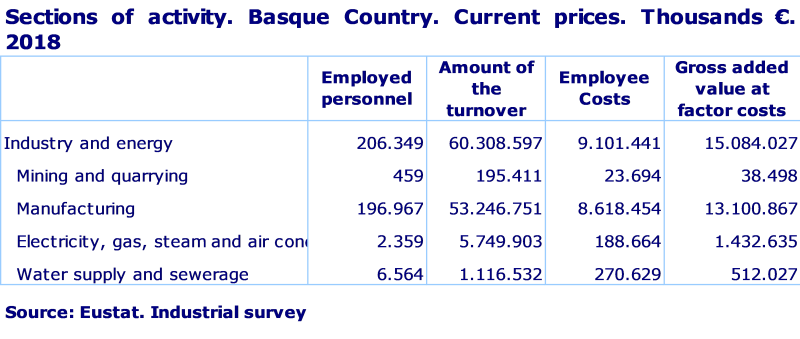
Within Industry, manufacturing, accounting for 95.5% of the number of people employed, 88.3% of turnover and 86.9% of the total value added, registered a positive performance in 2018, with growth of 1.5% in the number of people employed, 3.7% in value added, and particularly in turnover which was up 7.6%.
The largest sectors in Basque industry; Metallurgy & Metal Products, Machinery & Equipment, and Transport Material, saw strong upward trends. These three sectors employed more than half the number of people employed in industry (57.3%), and accounted for 57.3% of the total value added in 2018. The performance of Transport Material stood out with a 7.6% growth in its value added, an increase of 5.4% in turnover and a 8.7% rise in the number of people employed compared to the previous year. A similar trend was seen in the Metallurgy & Metal Products sector, which with only a 0.9% increase in employment, obtained increases of 4% in value added and 6.5% in sales. In the third largest sector, Machinery and Equipment, employment grew by 2%, value added increased by 2.1% and turnover was up 7.1%.
Another significant sector in Basque industry, in terms of value added, is Electricity, Gas & Steam. In this sector, with practically the same employment, -0.1%, valued added grew by 12% and sales by 1.1%.
In relation to the turnover figure, the branch that grew the most was Coke Plants and Oil Refining, up 26.6% with a 0.5% increase in employment. This large increase in sales is not reflected in value added as it was counteracted by the highest increase in supplies, which meant value added fell by 7.6%.
Basque manufacturing industry companies showed a clear openness towards foreign markets. Foreign exports accounted for 44.5% of manufacturing industry sales in 2018, only one tenth down on that obtained in 2017. Out of the total sales, 28.8% was to the European Union while 15.7% was to the Rest of the World.
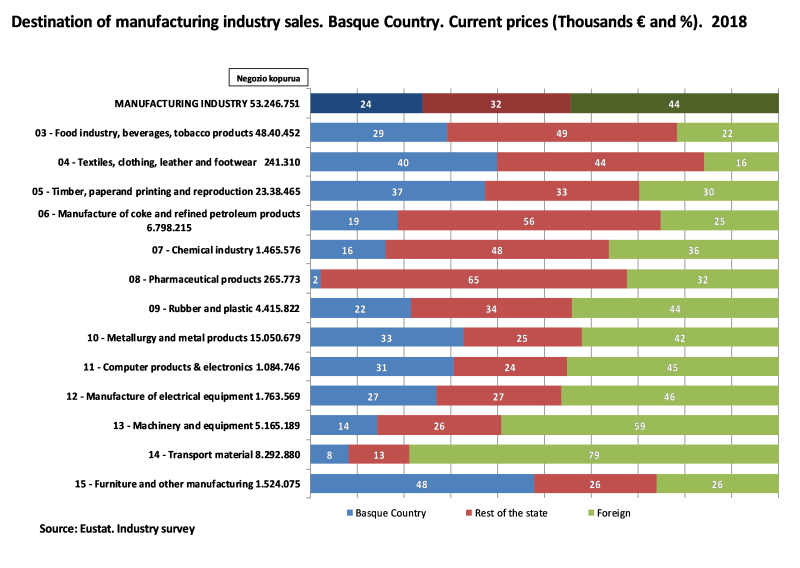
Sales to the Rest of Spain were up 0.5 percentage points on total sales compared to 2017, accounting for 31.6% of total sales in 2018. Finally, the internal market (the Basque Country) took 23.9% of the total sold, practically the same drop as that borne by the Spanish market in 2017.
By sector, Transport Material, the branch with a higher percentage of exports, increased by 1.3 tenths of a point the percentage of foreign sales on total sales, reaching 78.7% in 2018. Exports in the sector of Machinery & Equipment stood at 59.1% in 2018, eight tenths more than that exported the previous year. In contrast, Metallurgy & Metal Products, the second largest sector by export volume, reduced the weight of its exports on total sales by 1.1 percentage points.
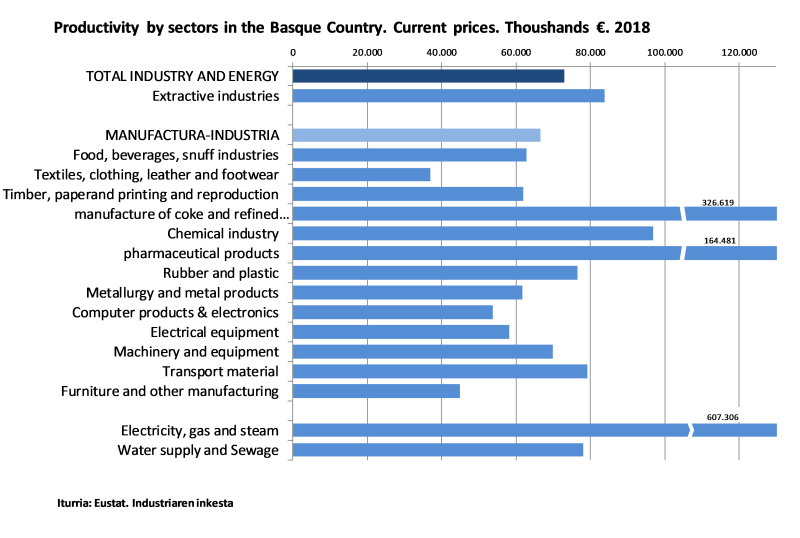
In relation to productivity, the branches with most productivity were the sectors of Electricity, Gas & Steam (607 thousand euros per person) and Coke Plants and Oil Refining (327 thousand euros per person), the former with growth of 12% and with a reduction of 8.2% in the latter. Besides these sectors, Pharmaceutical Products; with 164 thousand euros per person; and Chemical Industry; with 97 thousand euros per person; also stood out. At the other end of the scale are the Textile, Garments, Leather & Footwear (37 thousand euros) and Furniture & Other Manufacturing Industries sectors (45 thousand euros). The average for Industry and Energy as a whole was 73,100 euros, up 3% on the previous year.
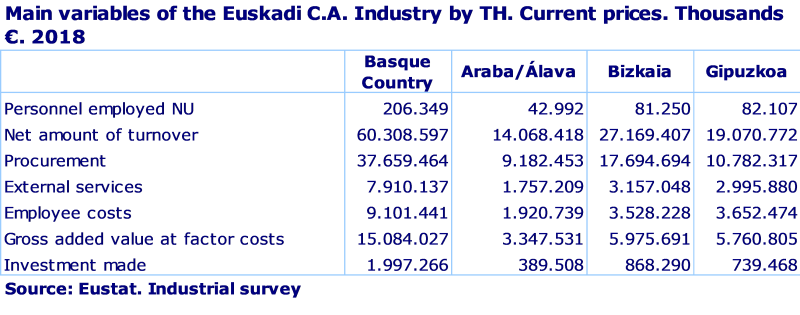
By province, all three provinces registered positive figures for the main variables. In Álava and Gipuzkoa industrial personnel grew by 2% and 2.7% respectively, but in Bizkaia employment remained practically the same with a small drop of -0.2%. These increases were higher in the variables of sales and value added, above all in Gipuzkoa and Bizkaia where sales were up 8.5% in the former and 7.4% in the latter; and value added increased by 6.8% in Gipuzkoa and 3.6% in Bizkaia. Despite having positive values, Álava did not reach the levels of the other two provinces, growing 3.3% in sales and 2% in value added.
Evolution of employment in industry: sustained recovery
As has been indicated above, employment in industry was up 1.4% in 2018. However, between 2008 and 2018 Basque industry shed 42,881 jobs, a drop of 17.2% in respect of the number at the start. Nevertheless, two periods may be clearly distinguished: the first between 2008 and 2013 that accumulated the total loss of almost 57 thousand jobs; and the second, between 2014 and 2018, a five-year period in which 14 thousand jobs out of those previously lost were recovered, with sustained yearly increases that reached their maximum in 2017, with growth of 2.7% .
This reversal was led by precisely those industrial sectors that lost the most jobs in the early years of the crisis. Thus, Transport Material and Metallurgy & Metal Products, with almost four thousand more jobs each in the last five years, are responsible for over half of the recovered jobs.
Likewise, notable gains have been achieved in the last five years by the sectors of Rubber, Plastic and other Non-Metallic Industries, Furniture and Other Manufacturing Industries and Manufacture of Computer and Electronic Products, all with a positive balance of over one thousand jobs, particularly the latter, which showed a relative increase of 18.7% since 2014.
Just three branches finished this last period of recovery in negative values: Electrical Material & Equipment and Timber, Paper & Graphic Art and Coke Plants and Oil Refining, but in the case of the latter the amount was minimal.
In terms of the distribution of employment by sector, Basque industry remained clearly concentrated in a reduced number of sectors. The predominance of Manufacture of Base Metals and Metal Products was evident, given that it accounted for one out of three jobs (33.7%). If we add to this those of Machinery & Equipment and Transport Material, with 11% of total personnel in the former and 10% in the latter, they comfortably exceeded half of the total employment created by Industry (54.7%)
With weights that fluctuated between 5% and 10% of total employment were the sectors of: Rubber and Plastics, 9.3%; Food, Beverages & Tobacco, 7.4%; Manufacture of Furniture and Other Manufacturing Industries, 6.9%; and Timber, Paper & Graphic Arts, 5.6%.
The nine remaining sectors accounted for barely 16% of the total number of people employed. Those with least relevance in terms of employment were: Coke Plants and Oil Refining, 0.5%, Pharmaceutical Products, 0.3%, and Extraction Industries, 0.2%.
For further information:
Eustat - Euskal Estatistika Erakundea / Basque Statistics Institute
C/ Donostia-San Sebastián, 1 01010 Vitoria-Gasteiz
Press Service: servicioprensa@eustat.es Tel: 945 01 75 62