Press Release 12/03/2020
MUNICIPAL GDP. 2017
Industrial activities predominated in eight of the ten municipalities with the highest GDP per capita in the Basque Country
In the three Basque capitals, however, it was the services sector that generated the most wealth
Among the 10 municipalities with the highest GDP per capita in the Basque Country, the predominance of the industrial sector stood out in eight of them, according to data published by Eustat, being particularly important in municipalities such as Olaberria, Ajangiz, Etxeberria, Izurtza and Arama, where it exceeded 79.0% of global activity.
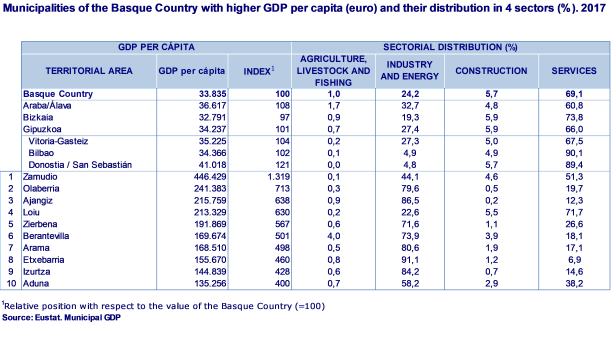
Zamudio, Olaberria and Ajangiz remained the municipalities with the highest GDP per capita in the Basque Country
Companies in the municipality of Zamudio, in the province of Bizkaia, achieved the highest Gross Domestic Product per capita in the whole of the Basque Country for another year running. The municipalities of Olaberria and Ajangiz occupied second and third place, respectively; the former in Gipuzkoa and the latter in Bizkaia. In Álava, Berantevilla was the municipality with the highest GDP per capita, occupying sixth place in the Basque Country.
In the case of Olaberria, the industrial activity sectors that had the greatest weight in the municipality were Iron & Steel Products and General Use Machinery. Conversely, in Ajangiz the Plastic Products sector predominates. In Zierbena, which occupied fifth place with regard to GDP per capita, the predominant activity sector is Electricity.
However, the municipalities of Zamudio and Aduna showed a more equal distribution between the industrial and services sectors. In the case of Zamudio, this was mainly due, on the one hand, to the strong presence of Engineering Services companies and, on the other, to the industry linked to aircraft, concentrated in its Technology Park. In Aduna, Wholesale Trade stood out in the services sector, while industry was underpinned by Non-metal Industry.
In contrast, in Loiu the Services sector had the greatest weight due to services related to airport activity.
Service activities predominated in the three Basque capitals, as in the three Provinces as a whole
With regard to the capitals, in 2017 San Sebastián showed the highest relative index position in respect of the GDP per capita of the Basque Country (121), that is, its GDP per capita is 21.0% higher than the Basque Country average. Vitoria-Gasteiz had an index of 104 and Bilbao stood slightly above the Basque Country average, with an index of 102.
Around 90.0% of the GDP of both Bilbao and San Sebastián was generated by the services sector, due to Property Activities and Hotel Management & Catering, among others, compared with Vitoria-Gasteiz where the percentage stood at 67.5%, due to the considerable contribution from the industrial sector (27.3%), mainly underpinned by the Automotive Industry and Rubber Products. However, the industrial sector registered a minimal weight in both San Sebastián (4.8%) and Bilbao (4.9%).
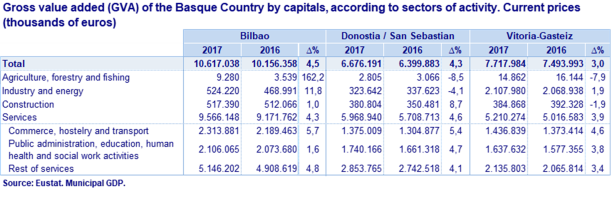
As for the overall performance of Gross Value Added (GVA) in the three capitals in 2017 compared to the previous year, there was a positive variation in all three. Bilbao had the highest year-on-year growth rate (4.5%), followed by San Sebastián (4.3%) and Vitoria-Gasteiz (3.0%). By sector, the Services sector made the greatest contribution to growth in the three capitals. The increase is based principally on the growth of Trade, Hotel Management & Catering and Transport.
�
The three regions with the highest values of GDP per capita are located in the province of Ávala
By region, the three regions that contributed the highest values of GDP per capita were in Álava. Rioja Alavesa registered the highest index (194) in respect of the Basque Country average (100). The municipalities which posted the highest indexes within this region were Laguardia (386), Villabuena de Álava/Eskuernaga (326) and Samaniego (233). In all cases, the high index value came from industrial activity associated with the wine sector.
The first three positions were completed by the regions of Valles Alaveses (156) and Estribaciones del Gorbea (137). The fourth, fifth and sixth positions were occupied by, respectively, the region of Duranguesado (118) in Bizkaia; Alto Deba in Gipuzkoa (112) and Montaña Alavesa in Ávala, with an index of 109.
As in Rioja Alavesa, in the regions of Valles Alaveses, Estribaciones del Gorbea and Goierri more than 53% of their GVA was underpinned by industrial activities.
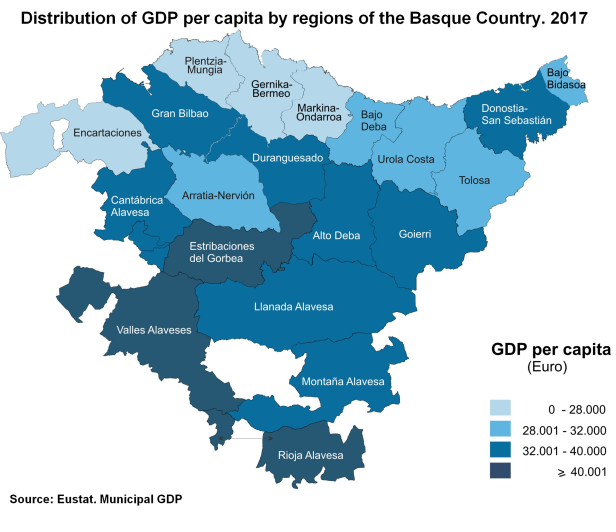
However, the services sector predominated to a greater extent in the other regions, above all in Gran Bilbao (78.9%), Donostialdea (78.0%), Bajo Bidasoa (75.8%) and Encartaciones (71.9%), all above the Basque Country average, which stood at 69.1%.
Methodological note:
For a better interpretation of these data, a distinction must be made between Municipal GDP and Municipal Income; GDP is connected to production, to wealth generation, and is concentrated in municipalities with important productive establishments. Income, on the other hand, is related to individuals and their residence.
For further information:
Eustat - Euskal Estatistika Erakundea / Basque Statistics Institute
C/ Donostia-San Sebastián, 1 01010 Vitoria-Gasteiz
Press Service: servicioprensa@eustat.es Tel: 945 01 75 62