Press release 21/04/2020
In February 2020 exports in the Basque Country were down by 7.9% and imports by 13.6%
Energy products registered a more negative performance, in terms of both exports and imports
In February and compared to the same month of the previous year exports of goods from the Basque Country (1,902.3 million euros) registered a downturn of 7.9%, according to Eustat data. Imports (1,549.8 million) dropped 13.6% compared to the previous year. The trade balance was positive (352.5 million) and 80.6 million up on that registered in February 2019.
Periodic fluctuations in Energy products determined this downturn; in the case of exports, there was a 44.5% decline (55.1 million), which together with the 5.5% (107.3 million) decrease in non-energy exports meant that the fall in exports as a whole finally stood at 162.4 million.
The direct relationship that exists between imports and exports of energy products explains why energy imports were also down, by 25.7% (123.6 million).
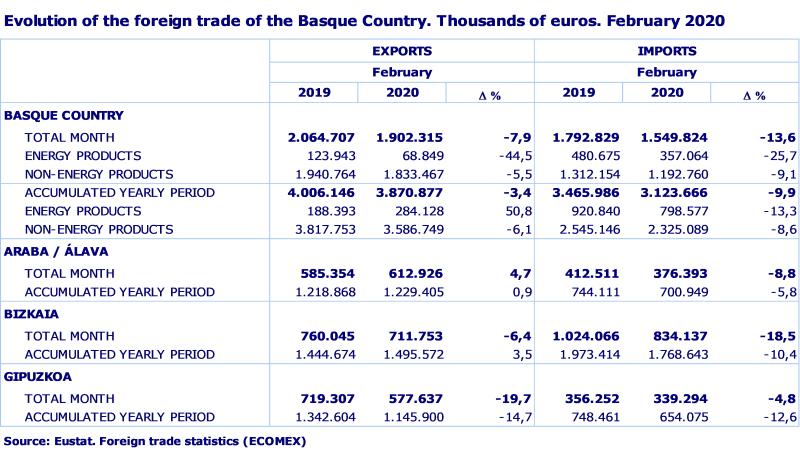
This fall in exports was concentrated in Gipukzoa (-19.7%), due to the drop in non-energy exports, which saw a fall of 141.7 million. It is primarily concentrated in Transport Material (-31.2%, down 54.6 million), Electrical Material (-22.0% and 55.5 million) and Metals & Manufactured (-15.4% and 22.8 million), all in respect of the same month of the previous year.
Exports from Bizkaia fell by 6.4% as a consequence of the 42.0% drop in Mineral and Energy products (down 52.7 million) and the 19.2% decrease in Electrical Material (-22.2 million).
Álava, however, grew 4.7% due to the increase in Transport Material (9.0%, up 30.4 million).
In February five countries (Germany, France, United States, United Kingdom and Italy) were our main clients, absorbing 50.9% (967 million) of total exports from the Basque Country. Three of these belong to the EU27, an entity that accounts for 63.3% of exports. This percentage would have been 69.5% for the former EU28.
Exports were up 7.6% to Italy, 7.4% to Germany and 3.3% to Portugal; however, exports to France were down 15.0%, as were those to the Netherlands, with a fall of 39.8%. Exports to the United Kingdom were also down by 20.3%. Sales to the United States decreased by 10.4%, as well as those to China (-7.8%) and Mexico (-16.9%).
In February half of all imports came from the EU27, 53.3% of the total; this percentage would have been 55.5% for the erstwhile EU28. The Netherlands stood out among the most important countries in terms of imports (74.3 million), with growth of 44.0% and, at the opposite extreme was Ireland (43 million) with a sharp drop of 33.7%. The country that the Basque Country imported most from in February was Germany (249 million), which was also the country that received most of our exports (341 million); therefore, the balance with this country was positive this month.
Exported products in February 2020
Analysing exports by branches of activity (A86), there were decreases in General Use Machinery, down 16.7%, and Iron and Steel products (-9.3%); in contrast, Motor Vehicles were up 5.8% and Metal Products increased by 3.7%. Coke Plants & Oil Refining decreased by 30.6% and Electric Material by 14.4%.
A more detailed look reveals that, in February, the ten main export duty groups accounted for 42.2% of exports, with a combined value of 801.9 million euros. The following groups stood out with varying increases in respect of the same period of the previous year: Seamless tubes and hollow profiles made of iron or steel (34.7% and 40.4 million), Passenger cars with less than 10 seats (16.4% and 203.6 million) and Goods Transport Vehicles with an increase of 4.1% and 126.66 million. However, there were percentage declines in Refined petroleum oils (-25.4% and 58.9 million), Iron or non-alloy steel sections (-23.9% and 34.4 million) and Interchangeable tools for hand tools or for machine tools (-17.6% and 28.8 million).
Analysing imports by branches of activity (A86) and considering only the four largest, it can be observed that the largest, Extraction and Petroleum Industries (20.9% of the total) saw a decrease of 25.9% compared to the same month of the previous year, as did Iron and Steel Products (-27.9%) and General Use Machinery (-6.9%); however, Manufacture of motor vehicles increased by 0.9%.
As regards import duty groups, we see that the group with the largest specific weight, Petroleum oils or oils obtained from bituminous minerals (20% of the total) saw a drop of 12.9% compared to the same month of the previous year. This pattern was repeated in the other 10 main import duty groups, with the exception of the group occupying fifth place, Soya beans, whether or not broken, which with 29.9 million euros imported was up 37.5%.
Over the first two months of 2020 as a whole, foreign trade in goods in the Basque Country had a positive balance of 747.2 million euros
For the first two months as a whole, and for exports from the Basque Country, a decrease of 3.4% was registered compared to the same period of the previous year, which translates into a drop of 135 million euros. The total amount of exports in this period was 3,870.9 million, equivalent to a trade balance of 747.2 million euros, 207 million more than that registered in the same period of 2019, which represents a coverage rate of 123.9%.
For this period, exports stood at over 1,000 million euros in the three provinces: Bizkaia 1,495.6 million, Alava 1,229.4 million and Gipuzkoa 1,145.9 million. Exports are only down in Gipuzkoa, by 14.7% and 196.7 million euros.
The export ranking of these first two months of 2020 situates Germany as the prime receiver country of Basque exports, with 18.0% of the total exported. Germany is followed by France (16.4%), the United States (6.7%) and the United Kingdom (6.3%). Between them, these four countries accounted for almost 50% of Basque exports for this period.
Accumulated imports for the Basque Country as a whole during the period in question amounted to 3,123.7 million euros. The year-on-year comparison of this figure reveals that is 342.3 million euros down on that registered in the same period of the previous year.
For further information:
Eustat - Euskal Estatistika Erakundea / Basque Statistics Institute
C/ Donostia-San Sebastián, 1 01010 Vitoria-Gasteiz
Press Service: servicioprensa@eustat.es Tel: 945 01 75 62