Press Release 20/04/2020
SURVEY ON THE INFORMATION SOCIETY IN COMPANIES 2019
The ICT capacity of companies in the Basque Country is uneven in terms of confronting the COVID-19 crisis
A third of total personnel had access to a remote connection via a portable device, but teleworking only affected 4% of workers in 2019
Information and Communication Technologies (ICT) in companies in the Basque Country allow for greater adaptation in the face of the new working situations arising from the COVID-19 health crisis, and in the case of Basque companies ICT capacity is uneven, according to Eustat data. In 2019 the percentage of users of these technologies in companies reached 73.1% of the total and 11.0% were personnel specialised in ICT systems.
In addition, a third of total personnel, 32.7%, had a remote connection via a portable device for professional use, enabling them to work away from the physical location of the company. The provincial breakdown reveals that Gipuzkoa was the province with the greatest proportion of employed people with a remote connection, 34.7% of total personnel. In Bizkaia this percentage was slightly lower, 32.5% of its employees, and even smaller in the case of Álava, where it did not exceed 30% (29.2%).
The spread of remote connexions also varied considering the sector of economic activity of the establishment. In the construction and services sectors more than one in three employed people had a remote connection in their establishment, 37.4% in the case of the former and 34.3% in that of the latter. In the industrial sector this type of connection was only possible for one in four working people (25.6%).
On average, 3.9% of employees worked off company premises for at least a third of the working day on a regular basis, using telematic networks to connect to the company’s ICT systems, and in this sense can be considered as teleworkers. Gipuzkoa was the province with a greater proportion of teleworkers with 4.5%, followed by Bizkaia with 3.8%; for its part, Álava was the province in which teleworking was least widespread, solely affecting 3.2% of employed people.
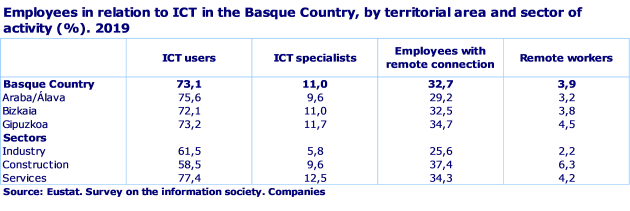
The incidence of teleworking according to the sector of economic activity of the establishment also maintained the differences observed in the case of remote connections. In the case of industry, teleworking only reached 2.2% of its personnel, whilst in services this figure increased to 4.2% and went up even more in the construction sector, with 6.3% of total personnel.
Being well positioned regarding the use of these technologies is proving to be a decisive factor when it comes to adopting these changes. In this sense, the mobile telephone is the most widespread piece of ICT equipment and is found in 93.4% of Basque establishments, 91.6% of which have access to the Internet. In addition, just over half of the companies, 54.6%, have a website.
These equipment percentages are higher in companies with 10 or more employees. In these establishments the levels are high enough to be considered implemented across the board: 99.6% have a computer, 99.2% internet access, 96.3% a mobile telephone and 92.3% have a website.
The type of connection used to access the Internet is equally relevant as regards the mobility of the companies’ employees. In the Basque Country, connections via mobile phone, 88.6%, and fibre optic connections (Cable, FTTH etc.), 71.0%, were the most common ways of accessing the Internet. 94.5% of companies with internet access had fixed connections, whereas 89.6% of connected companies had mobile connections, via mobile phones (Smartphone, PDA etc.) or laptop computer (tablet, netbook, etc).
Security is also fundamental for guaranteeing work done from home. Among other security measures used by our business network, data encryption (31.6%) and the use of VPN networks for guaranteeing confidentiality in the transfer of information via the Internet (21.8%), are of vital importance for this task. In the case of companies with 10 or more employees, more than half use these security measures.
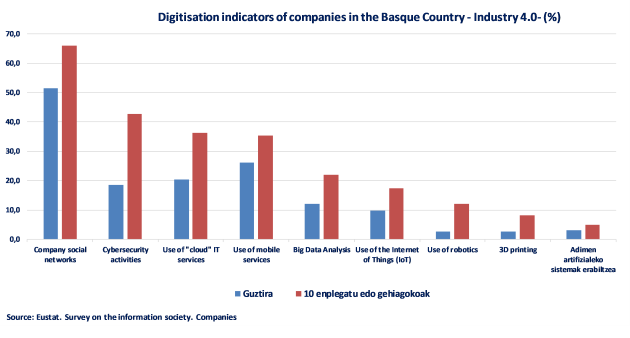
In order to evaluate the digital transformation of companies - Industry 4.0 -a series of indicators are considered, which we shall analyse below.
In the case of establishments with 10 or more employees, which are those that are most rapidly implementing this process of change, the use of social networks for business purposes stands out, with 66.0% of establishments in the Basque Country in 2019. In second place, Cyber security activities are present in 42.8% of establishments. Cloud Computer Services and Mobile Services were also both above 30%. In respect of the former, Cloud Computing, 36.3% of establishments pay for this service; it should be pointed out that this type of service enables access to company information or services, through an internet connection from any mobile or fixed device in any location. As regards the latter, Mobile Services, that is, those services used in applications related to company activity and production processes, reach 35.4% of establishments. Finally, Big Data Analysis (22.1%) and other technologies such as Robotics (12.1%) and 3D Printing (8.2%), technologies that enable the rapid analysis and adaptation of production in changing situations, are also present in establishments of this size.
E-commerce, for its part, complementing or substituting face-to-face trade, shows an unequal distribution depending on whether it involves purchases or sales via this system in companies in the Basque Country. The percentage of companies that engaged in e-commerce throughout 2018 was 26.3%, with 24.1% purchasing and 6.9% selling. If size is taken into account, in companies with 10 or more employees, e-commerce stood at 31.6%, 27.0% in purchases and 13.1% in sales.
It is estimated that purchases via e-commerce in the Basque Country reached a total of 14,065.9 million euros in 2018, while sales stood at 19,142.9 million euros in the same period.
Despite the increases produced in e-commerce over recent years, the impact that this type of exchange has on Basque companies was, until now, moderate. It is safe to say that the economic impact of the health crisis will change these figures considerably, both in terms of the number of establishments with e-commerce and the sums of money exchanged, particularly in certain sectors.
For further information:
Eustat - Euskal Estatistika Erakundea / Basque Statistics Institute
C/ Donostia-San Sebastián, 1 01010 Vitoria-Gasteiz
Press Service: servicioprensa@eustat.es Tel: 945 01 75 62