Press release 06/03/2020
QUARTERLY ACCOUNTS. IV/2019
The GDP of the Basque Country grew by 2.2% in 2019 as whole and 15,000 jobs were created
The fourth quarter also closed with year-on-year growth of 2.2%, which signified quarter-on-quarter growth of 0.5%
The GDP of the Basque Country posted an increase of 2.2% in the fourth quarter of 2019, compared to the same quarter of the previous year, according to estimates made by Eustat. Compared to the third quarter of 2019, the estimated quarter-on-quarter variation rate was 0.5%. In 2019 as a whole GDP growth was estimated at 2.2%, the fifth consecutive year with rates above 2%, and more than 15,000 net jobs were created.
The year-on-year growth figures for the fourth quarter of 2019 were the same as those obtained for the Advance Quarterly Accounts for 24 January 2020. However, the estimated quarter-on-quarter growth rate is one tenth higher that that obtained with the relevant information available in the Advance Quarterly Accounts.
From the point of view of supply, all sectors registered positive year-on-year and quarter-on quarter increases. The most significant increases were in the Industrial and Service sectors.
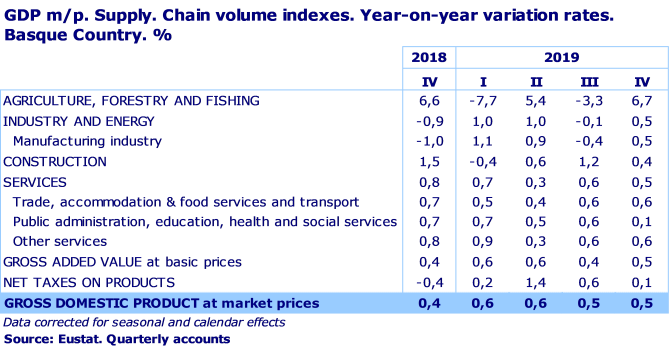
Industry saw a year-on-year variation rate of 2.3% compared to the same quarter of the previous year, a higher rate than that observed in the preceding quarters With respect to the third quarter of 2019, growth was estimated at 0.5%. Manufacturing Industry grew at a slightly slower rate than Industry as a whole, with estimated year-on-year and quarter-on quarter rates of 2.1% and 0.5%, respectively.
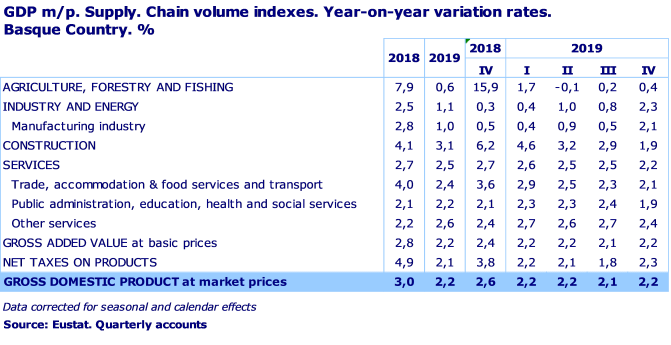
The Construction sector posted positive growth rates throughout 2019, but with a downward trend. In the fourth quarter, the estimated year-on-year variation rate was 1.9%, which indicates a growth rate of 0.4% compared to the third quarter. Throughout 2019 the Construction sector grew 3.1% compared to the previous year.
Global activity within the Services sector in the last quarter of the year continued the growth trend observed in previous quarters, with a year-on-year growth rate of 2.2%, which represented growth of 0.5% in respect of the third quarter of 2019.
The performance of the Services sector varied by branches. The Trade, Hotel Management & Catering and Transport branch saw growth of 2.1% compared to the same quarter of the previous year, and growth of 0.6% compared to the previous quarter. Although this was an upturn, in the last two years a continuous year-on-year deceleration was observed.
In the Public Administration, Education, Health and Social Services branch, growth was slightly more modest than in the previous quarters, with a year-on-year growth rate of 1.9% in the fourth quarter, and a quarter-on-quarter growth rate of 0.1%. These values are half a percentage point less than those estimated in the third quarter.
Finally, the activities included in the Other Services branch; which includes property, professional, scientific and technical, and financial and insurance activities; as a whole closed 2019 with year-on-year growth in the fourth quarter of 2.4% and quarter-on-quarter growth of 0.6%. Both variation rates were in harmony with those estimated for the preceding quarters.
The aggregated performance by sector in the fourth quarter of 2019 gave rise to an upturn in Value Added both in year-on-year terms (up 2.2%) and in quarter-on-quarter terms (with an increase of 0.5%), variations that remained very stable throughout the year.
From the point of view of Demand, the performance of Internal Demand was less positive than that of GDP, with year-on-year growth of 1.9%. Its two components (Final Consumption Expenditure and Gross Capital Formation) both performed positively, particularly Gross Capital Formation, with year-on-year growth of 2.4%.
The contribution of the foreign sector was therefore positive, with year-on-year variations of 1.3% in exports as whole and 0.9% in overall imports.
Final Consumption Expenditure of Households and Non-profit Institutions Servicing Households (ISFLSH) (Private Consumption) continued the deceleration observed in recent years The year-on-year variation rate stood at 1.5%, which was three tenths lower than that observed in the previous quarter. The quarter-on-quarter rate was also lower than that of the previous quarter, reaching 0.3% this quarter (2 tenths down on the previous quarter).
Public Consumption (Final Consumption Expenditure of Public Administrations) posted growth of 2.2% in year-on-year terms, which was a 0.4% increase compared to the previous quarter. There was a slight acceleration in Public Consumption over the course of 2019, with increased year-on-year rates.
The overall performance of Final Consumption Expenditure of Public Administrations together with Final Consumption Expenditure of Households led to growth of 1.7% in Final Consumption Expenditure. With regards to the previous quarter there was an upturn of 0.3%.
This quarter Gross Capital Formation (Investment) achieved a year-on-year variation rate of 2.4%, two tenths more than in the previous quarter. In quarter-on-quarter terms Investment was up 1.6%. This overall performance of investment was based on two trends of different direction and intensity.
The performance of Investment in Capital Goods showed a positive trend in the last quarter, with a year-on-year growth rate of 2.9%, and a quarter-on-quarter rate of 2.8%, a clearly more positive performance than that seen in the third quarter.
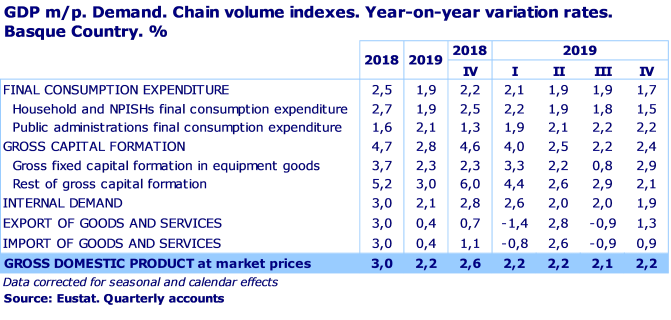
In Other Gross Capital Formation, which is more closely linked to the performance of construction, year-on-year growth stood at 2.1% (less growth than in previous quarters), which signified quarter-on-quarter growth of 0.9%
Internal Demand, composed of Final Consumption Expenditure and Gross Capital Formation, posted a positive variation in year-on-year terms of 1.9%. This growth was below that estimated for GDP, for which the contribution of the Foreign Sector was positive in this last quarter of the year. Exports were up 1.3% compared to the fourth quarter of the previous year, whilst Imports increased slightly less, by 0.9%.
With regards to employment (measured as Full-time Equivalent Jobs), a variation rate of 1.3% was estimated in year-on-year terms, thus continuing the deceleration observed over the last quarters. This year-on-year rate means 0.1% growth with respect to the third quarter of 2019.
The year-on-year performance of employment levels was positive in all branches of activity except the primary sector. The positive performance of the Construction sector stands out, given that in this last quarter it was up 1.9% on the same quarter of 2018. The Services sector also continued creating a significant number of jobs, up 1.7% on the number of jobs registered in the last quarter of 2018. The industrial sector also posted a modest year-on-year growth rate (0.1%), although it shed jobs in relation to the rate observed in the previous quarter (0.3%). Finally, the Primary sector saw a different pattern, this last quarter being the only one in 2019 in which it experienced a negative variation rate compared to that observed in the same quarter of the previous year, with a rate of -0.2%, which signified an increase of 0.1% in respect of the previous quarter.

As for the performance of GDP by Province, Álava posted a year-on-year rate of 2.4%, whilst Gipuzkoa and Bizkaia registered more moderate year-on-year growth (of 2.2% and 2.1%, respectively). However, compared to the third quarter of the year, Álava had the highest growth with a quarter-on-quarter rate of 1.0%, compared to 0.6% and 0.2% in Gipuzkoa and Bizkaia, respectively.
BALANCE FOR 2019
The GDP of the Basque Country grew by 2.2% over the course of 2019, eight tenths less than in 2018. This is the fifth consecutive year with growth rates higher than 2%. The first provisional estimate of GDP for 2019 was obtained as an aggregation of the GDP estimates for each of the four quarters.
In 2019, in terms of Supply, all the major sectors of the economy registered an upward trend. The Construction sector stands out, with an annual growth of 3.1%. It was followed by the Services sector (2.5%), Industry (1.1%), and finally the Primary sector (0.6%). Within Services, the sector with the smallest growth was Public Administration, Education, Health and Social Services (2.2%). Other Services was the most dynamic (2.6%), above Trade, Hotel Management & Catering and Transport (2.4%).
The analysis in terms of Demand showed a growth in Internal Demand of 2.1% in 2019 as a whole, which being less than the 2.2% growth in GDP meant a slightly positive contribution to the foreign sector in 2019 (an improved foreign balance).
The growth in Internal Demand in 2019 was mainly due to the growth in Gross Capital Formation (up 2.8%, with an increase of 2.3% in investment in capital goods and a rise of 3.0% in other gross capital formation). Final Consumption Expenditure grew at a rate of 1.9%, due particularly to Public Consumption (2.1%), which rose above Final Consumption Expenditure of Households (1.9%).
The performance of employment, measured in Full Time Equivalent Jobs was positive, with an estimated growth of 1.6% for 2019, with the creation of 15,335 more net jobs. Annual employment was obtained as an average of the estimated number of employees in each of the quarters and constitutes the first provisional estimate of this figure.
Within employment, the Construction sector performed best, with growth of 2.8% compared with the average for 2018, an increase below that estimated in 2018 (3.6%). It was followed by the Services sector with a variation rate of 1.8% (lower than the 2.7% estimated last year). In the Primary sector growth was 0.9% (higher than the negative growth rate of -1% estimated for 2018). Finally, the Industry sector grew by 0.6% (in 2018 it was 2.2%).
The trend in GDP by Province for 2019 was positive in all three provinces: Gipuzkoa was up 2.3%, Bizkaia 2.1% and Álava 2.0%.
For further information:
Eustat - Euskal Estatistika Erakundea / Basque Statistics Institute
C/ Donostia-San Sebastián, 1 01010 Vitoria-Gasteiz
Press Service: servicioprensa@eustat.es Tel: 945 01 75 62