Press release 20/02/2020
Total exports of goods from the Basque Country increased by 4.0% in December 2019
The trade surplus increased in 2019 as a whole and exceeded 5,200 million euros
In December 2019 there was a 4.0% increase in exports of goods from the Basque Country, in year-on-year terms, according to EUSTAT data. They totalled 1,820 million euros compared to 1,750 million in the same month of the previous year. Exports of Energy products decreased by 32.0% and exports of Non-energy products were up 9.0%.
Álava is the province that registered the best performance, with an increase in exports of 39.6%, whereas in Bizkaia and Gipuzkoa exports fell by 2.4% and 6.7%, respectively.
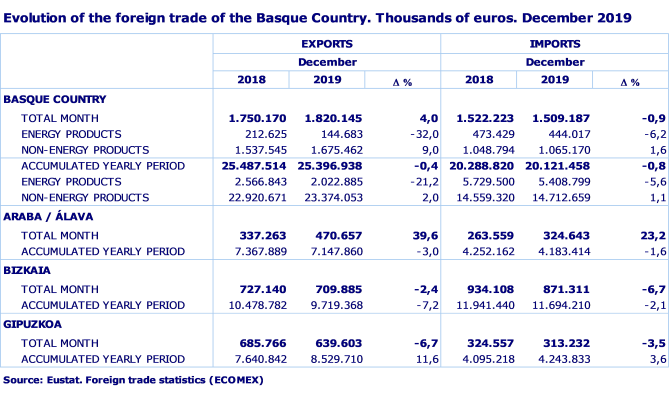
Imports of goods to the Basque Country, with a total of 1,509 million euros, fell by 0.9% compared to December 2018. Energy imports decreased by 6.2%, while non-energy imports were up 1.6%.
At provincial level, in Álava imports grew by 23.2%, whereas in Bizkaia they were down 6.7%, and in Gipuzkoa they fell by 3.5%.
Analysing exports by branches of activity (A86), strong growth was observed in Motor Vehicles (420 million exported), which was the most important branch this month, up 75% in respect of the same period of the previous year. There were also increases in Metal Products (125 million) up 6.0% and Iron & Steel Products (5.3% and almost 186 million). In contrast, it should be pointed out that there were decreases in the traditionally important branches of activity such as Coke Plants & Oil Refining (130 million and down 29.7%) and General Use Machinery (217 million and a drop of 8.7%).
A more detailed look reveals that in December the ten main export duty groups accounted for 42.7% of exports, with a combined value of 777.8 million euros. Amongst these, due to their growth, the following all stood out: Passenger cars with fewer than 10 seats (116.4%), Goods Transport Vehicles (101.3%), Vehicle Parts and Accessories (21.8%) and, above all, Vehicles for transporting more than 10 people, including the driver (254.6%). An opposite trend occurred in Refined petroleum oils, which fell 27.3% and New rubber tyres, down 4.9%.
This month ten countries - France, Germany, the United States, the United Kingdom, Italy, Belgium, the Netherlands, Portugal, Greenland and Mexico – accounted for 63.6% of our exports. The majority belong to the EU-28, which with 1,098.8 million, accounted for 60.4% of Basque Country exports this month.
Analysing imports by branches of activity (A86) reveals that the largest, Extraction and Petroleum Industries (26.8% of the total), saw a drop of 9.1%. There was also a decrease in imports of Iron and Steel products (-13.7%), whereas there was a rise in imports of Motor vehicles (96.4%) and General Use Machinery (2.2%).
BALANCE FOR 2019
For 2019 as a whole, both exports and imports were down, by 0.4% and 0.8%, respectively
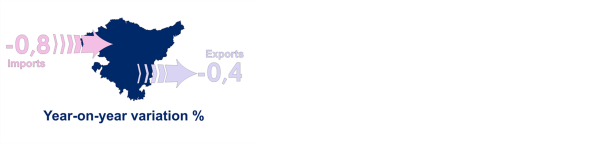
In 2019 Basque Country exports reached 25,396.9 million euros, representing a year-on-year decrease of 0.4%. Imports stood at 20,121.5 million euros, a drop of 0.8% compared to the previous year.
There was a positive trade balance of 5,275.5 million. This figure represents an increase in the trade surplus of 1.5% in respect of the same period of the previous year (5,198.7 million). Analysing solely the “non-energy” trade balance reveals that this was equally positive and reached 8,661.4 million, which represents, if we compare it with the previous year (8,361.4 million), an increase of 3.6%.
The coverage rate of total exports over imports was up 0.6 percentage points, going from 125.6% to 126.2%. The non-energy coverage rate went from 157.4% to 158.9%.
Gipuzkoa was the only province in which exports increased (11.6%)
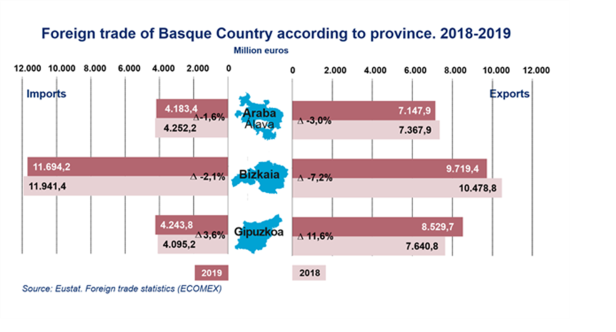
The most dynamic province during the previous tax year was Gipuzkoa, where both exports (11.6%) and imports (3.6%) experienced growth. The opposite situation occurred in the other two provinces; in Bizkaia exports were down 7.2% and imports fell 2.1%. In Álava exports decreased by 3.0% and imports by 1.6%.
Within exports, the customs duty group with the greatest weight in the Basque Country is Passenger cars with fewer than 10 seats, having registered a year-on-year decrease of 4.4%
During 2019, of the 25 main groups, 10 registered increases and 15 experienced decreases compared to the same period of the previous year.
The two most important Basque export groups during 2019 were Passenger cars with fewer than 10 seats and Vehicle parts and accessories. The former, with 2,290 million, accounted for 9.0% of total exports, after having dropped 4.4%; the latter registered a decrease of 5.9% and the 1,767 million exported accounted for 7.0% of the aforementioned total.Occupying third place in the ranking was Refined Petroleum Oils, reaching an export value of 1,451 million euros, which represented 5.7% of the total, after registering a year-on-year decrease of 19.9% for the period in question. The next largest group, Goods Transport Vehicles, was down 9.5%.
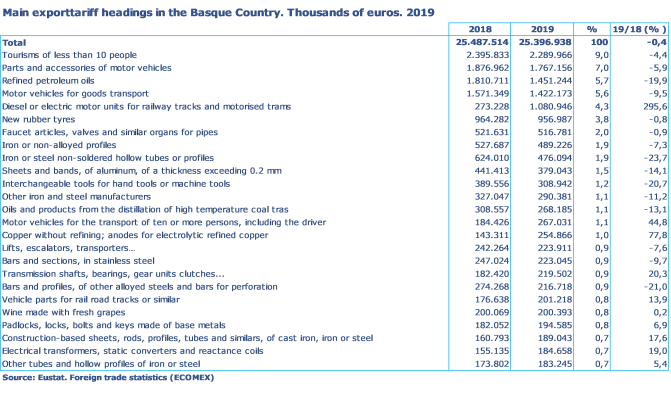
Diesel and electric motor units for railway tracks and motorised trams attained fifth place in the export ranking with an extraordinary increase of 295.6% and a sales figure of almost 1,081 million euros. This was the reason why there was not a greater drop in global exports, above all taking into account that it is the only customs duty group out of the top three that was not down compared to the previous year.
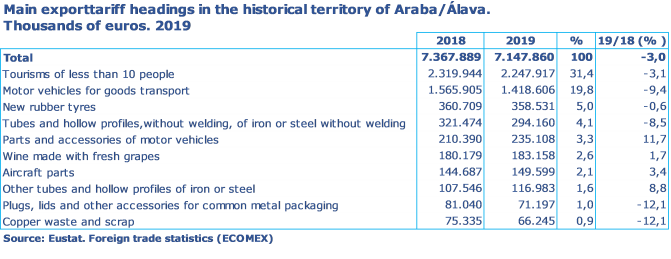
Exports from the province of Álava were down 3.0%. Of the ten main groups, which accounted for 71.9% of the total, six showed negative growth rates, those connected with the vehicle sector being of particular relevance: Passenger cars with fewer than 10 seats (-3.1%), Goods Transport Vehicles(-9.4%) and New rubber tyres (-0.6%), however, Vehicle parts and accessories increased by 11.7%.
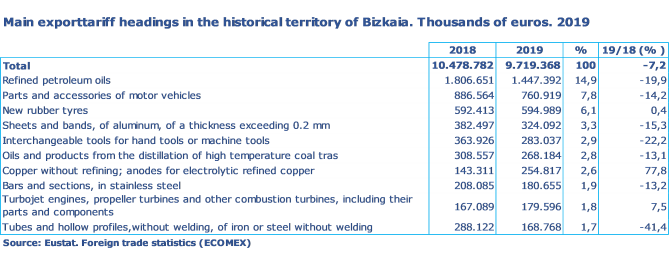
In Bizkaia exports fell by 7.2%. This phenomenon is primarily due to the contribution of the groups included in chapter 27, “Mineral fuels, mineral oils and products of their distillation; bituminous substances; mineral waxes.” Thus, the most important group, Refined petroleum oils, was down 19.9% and Oils and products derived from the distillation of coal tars at high temperatures dropped 13.1%. Of the 759 million year-on-year decrease, almost 400 million corresponded to these two customs duty groups. Among the 10 main exported products (45.9% of the total and 4,462 million) only three did not experience any drop in sales and one of them, Unrefined copper and copper anodes for electrolytic refining, was even up 77.8%
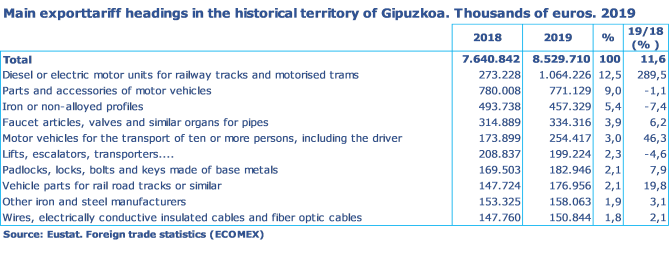
Gipuzkoa, unlike the other two provinces, showed a global increase of 11.6% compared to the previous year. This significant growth fundamentally comes down to, and is concentrated in, this province’s star customs duty group for 2019, Diesel and electric motor units for railway tracks and motorised trams, which, with growth of 289.5% (1.064 million) accounted for 89% of the 888.9 million growth experienced by Gipuzkoa in respect of 2018.
Exports to the European Union (EU-28) were up 3.8% and imports increased by 0.9%
68.3% of our total exports, 17,340 million euros, were destined for the European Union (EU-28), which represented a 3.8% increase compared to the previous year, when total exports amounted to 16,713 million.
Imports of goods originating from the EU were up 0.9%, but if the effect of energy products is eliminated an increase of 1.0% is observed.
Thus, the trade balance in respect of the European Union is positive (6,772 million) and was up 535.9 million euros compared to the previous year; in turn, the coverage rate went from 159.5% to 164.1%.
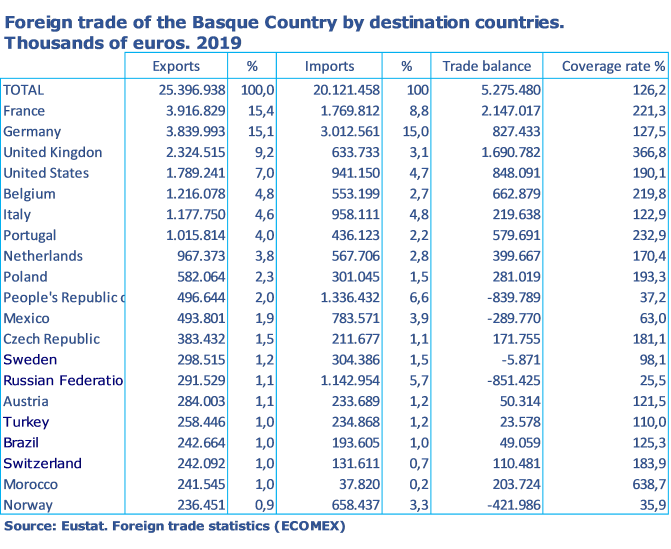
In more detail, exports to the majority of countries in the European Union registered an increase and of particular note among the most important were the United Kingdom (34.2%) and Belgium (24.1%); in contrast, there were decreases in exports to the Netherlands (-11.6%), Italy (-5.9%) and Portugal (-3.6%).
In turn, three countries accounted for the majority of exports to non-EU countries: the United States (1,789.2 million), China (496.6 million) and Mexico (493.8 million).
For imports, of particular note is the rise in those from Belgium (22.1%), Ireland (14.4%) and Germany, which, with a moderate increase of 3.2%, achieved 15% of the total purchases made by the Basque Country during 2019. Standing out among the non-EU countries were the growth in imports from Russia (196.2%) for a total of 1,143 million, the United States (86.6%) with 941 million and from China (16.3%) with a total of 1,336 million. Practically all Russian imports and half of those from the United States were energy-related.
For further information:
Eustat - Euskal Estatistika Erakundea / Basque Statistics Institute
C/ Donostia-San Sebastián, 1 01010 Vitoria-Gasteiz
Press Service: servicioprensa@eustat.es Tel: 945 01 75 62