Press Release 28/02/2020
BASQUE INDUSTRY OVERVIEW. 2020
The economy of the Basque Country maintained its industrial vocation with a stable weight of around 24.2% over the last five years
Basque industry is characterised by a high degree of concentration sustained over time and a high propensity towards exports
As a whole, Basque industry represented 24.2% of value added in the Basque Country in 2017, according to the Basque Industry Overview 2020 prepared by Eustat In the past four years it has been able to maintain its relative dimension without significant changes and with a similar weight to that of Germany (25.8%), but was more than four points higher than that of industry in the EU-28 as whole (19.6%) and well above the proportion provided by Spain (16.2%) and, even more so, France (13.7%).
Regarding the percentage distribution of gross value added (GVA) in industry among the different branches of industrial activity, the Metallurgy & Metal Products sector, with 28.3% of the total in 2017, was predominant. Other relevant sectors were: Transport Material, with a rise of 10.9%; Electricity, Gas & Steam, up 10.5%; and Machinery & Equipment, which increased by 10.3%. The percentage represented by the GVA of the 4 largest industrial branches in the GVA of industry as a whole is frequently used as an indicator of industry concentration. In our case, this index obtained a value of 60 in 2017, and for the past four years has remained around this level.
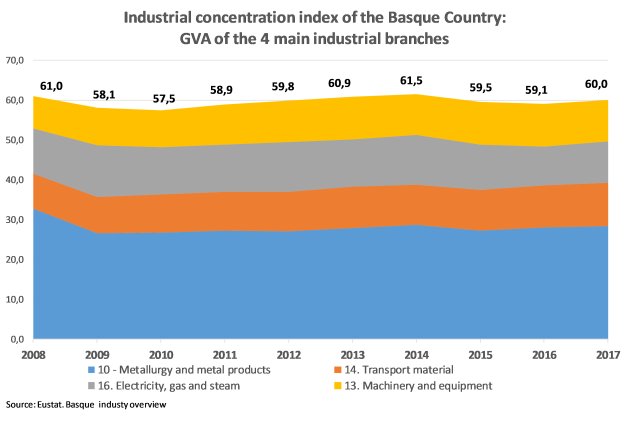
The other industrial sectors showed percentages below 10%, and it is notable that this industrial structure remained over time with slight sectoral variations. The most significant variations were negative and corresponded to the sector of Electrical Material & Equipment, which saw its weight reduce from 6% in 2009 to 3.6% in 2017, and the loss of the already minimal weight of the Extraction Industries sector, which represented just 0.2% of total GVA when in 2009 it accounted for 0.9%.
The value added of Basque industry increased by 3.0% in 2017, in chain volume indexes, its growth rates showing a similar evolution to that observed in its neighbouring economies such as Germany and the European Union 28 average, all these rates being positive and slightly over 3%.
An interesting aspect of the industry analysis is determining how attractive the predominant sectors of Basque industry can be as regards their technological level, as well as what their most recent evolution has been. According to this criterion, the majority of the industrial sectors in the Basque Country - at least those that account for 42.5% of its GVA - were in sectors catalogued by the OECD as having a “medium-low” technological level in 2017. For the last three years this percentage has remained identical. However, in recent years a moderate but sustained increase was observed in the categories of “high” and “medium-high” technological level. The former, sectors with a “high” technological level, went from 3.5% in 2010 to 5.1% in 2017, while the latter, sectors with a “medium-high” level, were up 1.5 percentage points for the same period of time, standing at 26.4% in 2017.
From the point of view of competitiveness, the unit labour cost is a basic analytical variable that allows the impact of the cost of labour per product unit to be analysed: that is, to measure the joint effect of the cost of labour and productivity variables. A comparative analysis with other economies reveals that although the Basque manufacturing industry started off more competitive than the Spanish economy and the European Union average in 2008, with lower unit labour costs, in 2016 (the most recent comparable data), it was above them in these terms.
Another notable characteristic of Basque industrial companies is the clear outward orientation. This is evidenced by its high propensity towards exports, measured according to the proportion of industrial exports over industrial GDP, and which stood at 154% in 2017. This characteristic is not uniform across all sectors, and those such as Transport Material (401%) and Coke Plants & Oil Refining (376%) stand out for their high export trends. The year-on-year variation rates of industrial exports and imports, after two years of negative values (2015 and 2016), turned positive again in 2017, with growth of 11.5% in exports and 19.9% in imports. France, Germany and the United States consolidated the main destinations for exports.
Finally, the Basque Industry Overview also analyses innovation and the use of information and communication technologies, as driving forces for improving competitiveness. Expenditure on innovation activities in 2017 for industry overall represented 41.9 % of total expenditure in the Basque Country. The most marked element in the weight of each type of activity in the Basque Country was internal R&D, representing almost half, 43.8%, of total expenditure by industry, followed by the purchase of machinery, 26.6%, and resources allocated to external R+D, which with 23.4% occupied third place. In relation to the second aspect, Basque industry has a high level of implementation of Information and Communication Technologies. 95.2% of industrial establishments had a computer, 93.6% had e-mail, 93.3% had internet, 65.5% had a website and 95.2% had a mobile phone.
Note: The structure of this Industry Overview consists of 10 chapters. The first three are devoted to situating industry in the local and international macroeconomic context; industrial production is analysed and an overview is given of the competitiveness indicators that are essential to the classical study of economic sectors. The following chapters analyse the orientation of the Basque industrial market from a foreign trade perspective, looking at the trends and characteristics of employed personnel, as well as analysing investment. Certain key aspects in current economic development are also studied: the progression of innovation in the industrial sector and the implementation of “Information and Communication Technologies” (ICT) in industrial companies in the Basque Country. It ends with a look at entrepreneurial dynamism and analyses industry from a closer geographical perspective, the regional level.
For further information:
Eustat - Euskal Estatistika Erakundea / Basque Statistics Institute
C/ Donostia-San Sebastián, 1 01010 Vitoria-Gasteiz
Press Service: servicioprensa@eustat.es Tel: 945 01 75 62