Press Release 22/11/2019
STATISTICS ON SCIENTIFIC RESEARCH AND TECHNOLOGICAL DEVELOPMENT ACTIVITIES - R&D - 2018
Expenditure on R+D in the Basque Country in 2018 reached an historic maximum of 1,423.4 million euros
Almost 20,000 people were registered in full-time employment in R+D in 2018, up 3.8% on the previous year
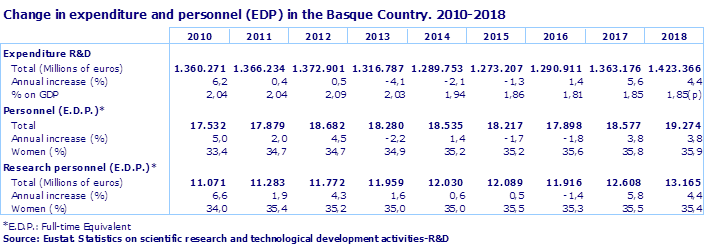
In 2018 1,423.4 million euros were invested in Technological Development and Scientific Research (internal R&D) in the Basque Country, 4.4% up on the previous year and the highest figure registered in the historic series, according to Eustat data. This is the third year of consolidated growth initiated in 2016.
There were 19,274 people in Full-Time Equivalent Jobs, with an increase of 3.8% compared to the previous year. The number of research staff in Full-Time Equivalent Jobs (13,165) also increased by 4.4%. As with expenditure, both employed personnel and research staff in R +D reached historic maximums.
In relation to GDP, expenditure on internal R+D in the Basque Country reached 1.85% in 2018, the same percentage as the previous year. In the context of the European Union 28 (EU-28), and taking into account the most recent data available (2017), the Basque Country is in ninth place, close to countries such as the Netherlands (1.99%) and Slovenia (1.86%), although a long way from Sweden (3.4%) and Austria (3.16%) In Spain this indicator was 1.21% and for the EU-28 as a whole it stood at 2.06%, all in relation to 2017.
On a provincial level, 45.8% of total expenditure on internal R+D in the Basque Country was carried out in Bizkaia, 42.5% in Gipuzkoa and 11.7% in Álava. However, it should be pointed out that this expenditure represented 2.37% of GDP in Gipuzkoa, 1.68% in the case of Bizkaia and 1.35% in that of Álava.
75.9% of expenditure on internal R&D in the Basque Country was implemented by the business sector
In terms of the sector that carried out internal R&D expenditure, the majority, 75.9% (1,079.8 million euros) was implemented by businesses, whereas 17.4% (247.1 million) corresponded to Higher Education and the remaining 6.8% (96.5 million) was carried out by various bodies dependent on the Administration. This sectorial distribution of implementation of R+D expenditure has remained relatively stable in recent years.
Compared to the previous year, two of the three sectors, Businesses and Higher Education, increased their expenditure on internal R+D by 5.5% and 4.2%, respectively. However, in the case of the Public Administration expenditure fell by 6.2%, largely due to the reduction in its capital expenditure, which dropped from 19.5 million euros in 2017 to 7.1 million last year.
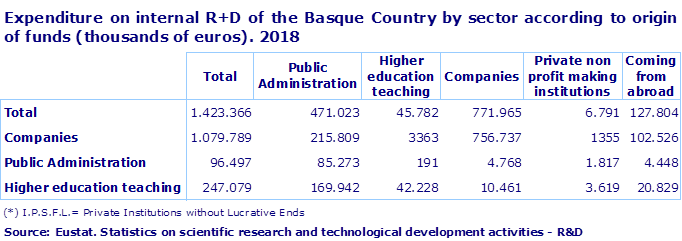
From the point of view of funding internal R&D expenditure, the percentages of the previous year stayed largely the same. Funding by companies, which spent 772 million euros on research, 3.5% more than in 2017 and 54.2% of total funding, remained the primary source of funding.
Public funding, with 471 million euros and an increase of 3.7% in the amounts provided, represented 33.1% of total expenditure on R+D. The contribution from the autonomous administration predominated (377.2 million euros), up 4.3% on the previous year and representing 80.1% of total funding by the public administration in 2018 (in 2010 it was 62.9%). For its part, the central administration (69.3 million euros) reduced its funding by 7.2% this year and limited its participation to 14.2% of total funding whilst the provincial and local administration (24.5 million euros) participated with 5.2%, but increased their contribution by 36.9% in relation to the previous year.
There were 19,274 people in full-time employment and they corresponded to the following implementation sectors: 13,678 people corresponded to the Business Sector (71% of the total), 4,288 to Higher Education (22.2%) and 1,309 to Public Administration (6.8%). Of particular note is the increase in research staff, up 4.4% compared to 3.8% for total staff.
35.9% of R&D personnel were women in 2018, 2.5 percentage points more than in 2010
35.9% of R+D personnel in full-time employment were women; the variation compared to the previous year was scarcely significant, up one tenth on total personnel, however the increase in relation to 2010 was 2.5 percentage points and up to 4.1 points on 2005.
Considering the sector implementing R+D, it can be observed that there are higher numbers of women in the Business and Higher Education sectors, 4,108 and 2,110 women, respectively. However, in relative terms, the Public Administration accounts for 53.9% (706 women) compared to Higher Education with 49.2% and Businesses with 30%.
For further information:
Eustat - Euskal Estatistika Erakundea / Basque Statistics Institute
C/ Donostia-San Sebastián, 1 01010 Vitoria-Gasteiz
Press service: servicioprensa@eustat.es Tel: 945 01 75 62