Press release 27/11/2019
INFORMATION AND COMMUNICATION TECHNOLOGY SECTOR (ICT) STATISTICS. 2017
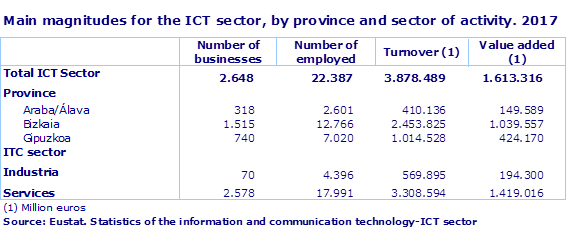
The ICT sector in the Basque Country employed 22,387 people in 2017, 3.5% more than the previous year
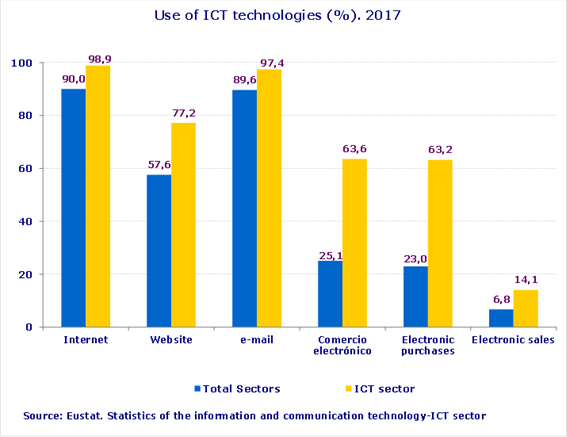
63.6% of companies in the ICT sector engaged in e-commerce, compared to 25.1% of the total of all sectors
In 2017 in the Basque Country there was in increase in both the number of companies; up 1.8% (47 more companies); and employment; up 3.5% (765 more people); in the Information and Communication Technology (ICT) sector, according to EUSTAT data. Specifically, 2,648 companies and 22,387 jobs were registered in this sector, with an average company size of 8.5 people. The turnover figure also grew by 8.8% and the value added by 4.3%.
With these data, the ICT sector represented 2.1% of those employed in the Basque economy, and 2.2% of total value added (1,613.3 million), and reached a turnover of 3,878.5 million euros.
Businesses in the ICT sector carried out more R&D&i activities than all the other sectors
5.9% of companies in the ICT sector carried out internal R&D activities, a percentage far higher than the 1.0% of the total for all sectors. Furthermore, the ICT sector, which represented just 1.8% of companies in the Basque Country, accounted for 11.1% of those carrying out R&D and, with 72.8 million euros, spent 7.1% of the business sector’s total expenditure on internal R&D, representing an increase in its weight of two tenths compared to the total expenditure in 2016.
In 2017 there were 1,288 people working in R&D in “full-time equivalent positions” of whom 22.9% (295) were women. Within personnel dedicated to R&D in the business sector, 9.8% are found in companies belonging to the ICT sector; this percentage is lower (6.9%) if the comparison is made with respect to the economy as a whole.
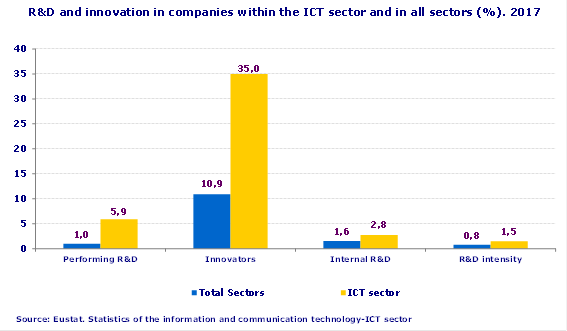
Regarding innovation, as with R&D, there were significant differences between the total for all sectors and that for the ICT sector. In 2017, 35.0% of establishments in the ICT sector were innovators compared to 10.9% of the total for all sectors. If company size is taken into account, those with “10 or more employees” recorded percentages of 53.8% in the first case and 27.3% for the total number of sectors.
Regarding expenditure on innovation, ICT establishments contributed 148.8 million euros, 5.6% of total expenditure for all sectors. Of this expenditure, 128.1 million corresponded to establishments with “10 or more employees”, which represented 5.7% of the total spent by companies of this size.
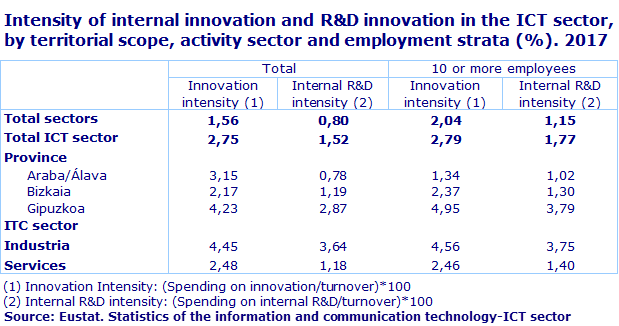
The ICT sector also allocated a greater proportion of resources towards R&D&i than the other sectors, as indicated by the figures spent both on innovation and on internal R&D with regards to the turnover figure (innovation and internal R&D intensity ratios). Specifically, innovation intensity in this sector was 2.8 compared to 1.6 over the economic sectors as a whole. In the case of internal R&D, the ratio was 1.5 for the ICT sector and 0.8 for all sectors. In both cases, innovation intensity decreased compared to the previous year; in the first case, there was a fall of 1.58 percentage points, and in the second, there was a drop of 0.32 points.
E-commerce was more widespread in the ICT sector than in the total of all the sectors
As the use of ICT technology is extremely commonplace amongst the companies in this sector, e-commerce, although more developed than in the other sectors, is not as widely implemented, above all in terms of sales. The establishments that made purchases via this method in the ICT sector accounted for 63.2% and those that carried out sales accounted for 14.1%, compared to 23.0% and 6.8% respectively for the total of all sectors. Hence, 63.6% of ICT establishments engaged in e-commerce, 4.9 percentage points lower than in 2016, whereas for the total of all sectors, it represented 25.1%, down 0.9 points on the previous year.
On the other hand, the impact of the ICT sector on the foreign trade of goods remained at insignificant levels. Whilst exports accounted for 320.0 million euros out of a total of 24,109.9 million, imports stood at 463.4 million out of the 18,707.9 million of total imports, accounting for 1.3% and 2.5% respectively.
The most common products traded in terms of exports were Electronic Components (39.2%), and Other ICT Products (35.1%). In terms of imports, the most common products were, once again, Other ICT Products (36.7%), Electronic Components (23.2%) and Telecommunications Equipment (21.5%).
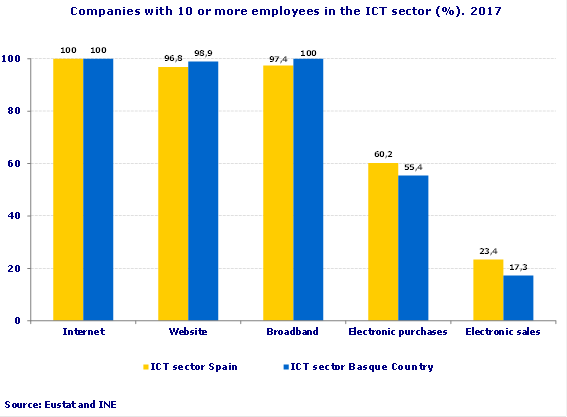
More companies in the ICT sector in the Basque Country had a website and broadband connection than in Spain as a whole, but engaged in less e-commerce
Lastly, if we compare ICT sector data for the Basque Country with Spain as a whole in companies with 10 or more employees, it can be observed that in both cases 100% of companies had internet connection. Regarding the availability of a website or broadband, the percentages were slightly more advantageous to the Basque Country, 98.9% compared to 96.8% in Spain in terms of websites, and 100% compared to 97.4% in terms of broadband. In contrast, in both electronic purchases and sales, Spain obtained better results: for purchases it stood at 60.2% compared to 55.4%, and for sales, 23.4% compared to 17.3% in the Basque Country.
Methodological note:
The ICT sector is made up of manufacturing industries and services whose primary activity is linked to the development, production, commercialisation, and intensive use of Information and Communication Technologies, characterised by high rates of innovation, technological progress, and productivity. Accordingly, it has a considerable impact on economic activity. Eustat website. Methodology file: ICT sector
For further information:
Eustat - Euskal Estatistika Erakundea / Basque Statistics Institute
C/ Donostia-San Sebastián, 1 01010 Vitoria-Gasteiz
Press service: servicioprensa@eustat.es Tel: 945 01 75 62