Press Release 25/10/2019
EUROPEAN INNOVATION SCOREBOARD (EIS) 2019
The Basque Country remained at the same level as European countries with high innovation in 2019
The best indicators of the Basque Country were obtained in the Human Resources dimension, with a value of 0.69 for an EU-28 average of 0.46
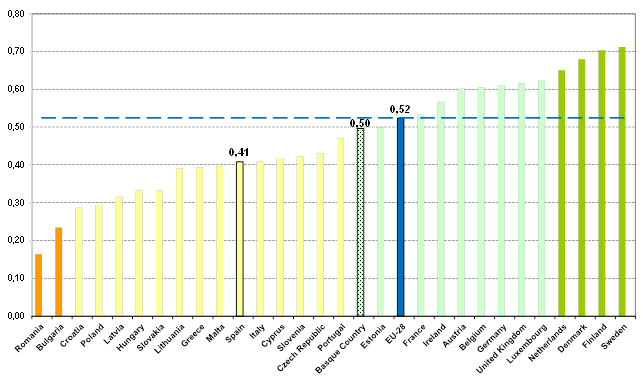
The European Innovation Scoreboard (EIS) 2019, stood at 0.50 in the Basque Country, remaining at two hundredths below the EU-28 average, which had a value of 0.52, according to Eustat data. This places the Basque Country at the level of the group of countries with high innovation, obtaining an average higher than the 90% registered by the EU, specifically 94.7%. Spain was amongst the moderately innovative countries, with a value of 0.41 and reached 77.9% of the European average.
The EIS scoreboard is continuously revised, in terms of both its component indicators and its calculation formula, but also because every year the most up-to-date data on the countries is incorporated, requiring the entire series to be recalculated on a yearly basis. Taking into account the aforementioned recalculation, the EIS has improved, in the case of the Basque Country, by one hundredth compared to the previous year, and by nine, from 0.41, in the last eight years taken into consideration for its calculation.
European Innovation Scoreboard EIS 2019 Basque Country and EU-28
Source: Eustat and the European Commission
Note: The grey columns correspond to the values of the previous year, calculated according to EIS 2019
The EIS 2019 Innovation Union Scoreboard attempts to measure the extent to which countries' economies have the capacity to develop innovation activities. The EU-28 countries are grouped into four categories, according to the rating scored and their position in relation to the European average. In the first category, innovation leader countries, were those countries that scored a rating more than 120% of the European Union average: they were Sweden (0.71), Finland (0.70), Denmark (0.68), and the Netherlands (0.65), although the country that was at the forefront of innovation in Europe was Switzerland (0.82).
In the second group, countries with high innovation, were those that achieved a rating of between 90% and 120% of the average. In this case, in descending order, were Luxembourg, United Kingdom, Germany, Belgium, Austria, Ireland, France and Estonia with scores between 0.62 and 0.50. The Basque Country, with a rating of 0.50, would be placed in this group, reaching 94.7% of the EU-28 average.
Following these, the third group, countries with moderate innovation (between 50% and 90% of the average) included Portugal, Czech Republic, Slovenia, Cyprus, Italy, Spain, Malta, Greece, Lithuania, and six other countries, with ratings between 0.47 for Portugal and 0.29 for Poland and Croatia. Lastly, in the fourth group, countries with low innovation (under 50% of the average) were Bulgaria and Romania, obtaining 0.23 and 0.16 points respectively.
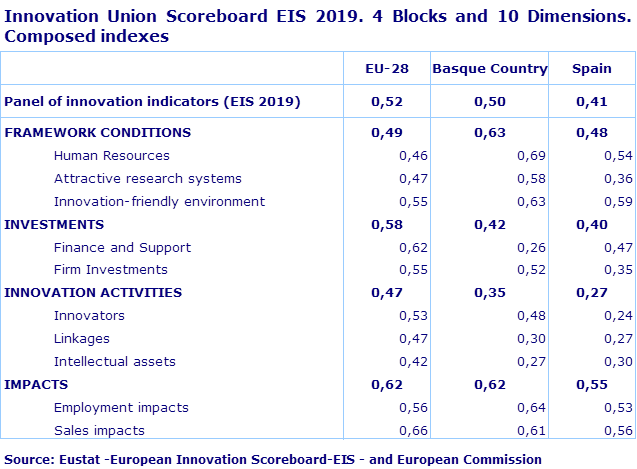
The EIS 2019 European Innovation Scoreboard is structured into four main blocks, with 10 dimensions, for a total of 27 indicators.
In relation to the European average, the Basque Country stood out in the first block, Framework Conditions, particularly in the Human Resources dimension, but also in the other two dimensions, Attractive Research Systems and Innovation Friendly Environment.
In Human Resources, a dimension that measures the availability of a highly qualified and trained workforce as key information for innovation, in the Basque Country two of the three indicators stood out with respect to the European average: the New doctorate graduates aged 25-34 stood at 3.47 per thousand in the Basque Country, while in the EU-28 it was 2.09 per thousand; the percentage of the Population aged 25-34 with tertiary education stood at 51.6%, with the community average standing at 39.8%. In the third indicator, Percentage of the population aged 25 to 64 participating in lifelong learning, the value obtained was 9.1% in the Autonomous Region and 10.9% in the EU-28.
Attractive Research Systems, a dimension that measures the international competitiveness of the scientific framework, also includes three indicators. The Basque Country stood out compared to the EU-28 in two of them. The number of International scientific co-publications per million inhabitants stood at 1,528 in the Basque Country compared to 1,070 in Europe, and Foreign doctorate students as a percentage of all doctorate students, stood at 33.71% for the Basque Country compared to 20.31% in the EU-28. For its part, in the third indicator, the percentage of Scientific Publications most cited internationally (excellent), the value for the Basque Country was 10.10% and 11.46% in the EU-28.
Innovation Friendly Environment measures the implementation of high speed broadband networks and opportunity-driven entrepreneurship. It gathers two indicators and the Basque Country stood out in Broadband Penetration with 30.1% compared to 18.0% in the EU-28, whereas in Opportunity-driven Entrepreneurship, motivational index, it attained 1.93 and was surpassed by the European Union that had value of 3.60.
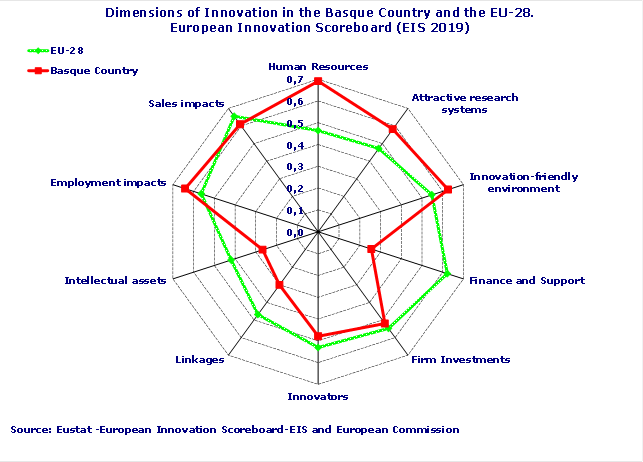
The Basque Country also obtained a better rating than the rest of Europe in the dimension Employment Impacts, a dimension that records the economic success of innovation on employment and included two indicators: Employment in knowledge-intensive activities as a % of total employment with 12.50% in the Basque Country and 14.20% in Europe; and Employment in fast growing enterprises in innovative sectors, where the Basque Country, with 6.95% surpassed Europe, with 5.19%
The dimension Firm Investments displayed similar figures in the Basque Country and in the EU-28. In this dimension, two of its three indicators achieved higher figures in the Basque Country. Private spending on R&D as a percentage over GDP obtained 1.39% in the Basque Country and the European average was 1.36% and Enterprises providing training to develop or upgrade ICT skills of their personnel, stood at 24.2% in the Basque Country and 23.0% in Europe. However, Non-R&D innovation expenditure as a percentage of turnover attained higher figures in Europe, 0.62% in the Basque Country, and 0.86% in the EU-28.
In the remaining dimensions, Finance & Support, Innovators, Linkages, Intellectual Assets, and Sales Impacts, the scores obtained are lower than the European average.
Even so, amongst these it is also possible to cite three indicators whose results in the Basque Country are higher than those in the EU-28. In the dimension Innovators, the indicators SMEs with product or process innovations as a percentage of SMEs and SMEs innovating in-house as a percentage of SMEs, were above the European average, 35.51% compared to 34.34% in the first indicator and 32.17% compared to 28.06% in the second. Also, in the dimension Sales Impacts, the indicator Sales of new-to-market and new-to-firm innovations as a percentage of turnover was higher in the Basque Country, 18.51%, than in Europe, 12.96%.
European Innovation Scoreboard, EIS 2019
http://ec.europa.eu/growth/industry/innovation/facts-figures/scoreboards/index_en.htm
For further information:
Eustat - Euskal Estatistika Erakundea / Basque Statistics Institute
C/ Donostia-San Sebastián, 1 01010 Vitoria-Gasteiz
Press Service: servicioprensa@eustat.eus Tel: 945 01 75 62