Press Release 07/06/2019
QUARTERLY ACCOUNTS I/2019
The GDP of the Basque Country posted a 2.3% year-on-year growth in the first quarter of 2019
Internal Demand consolidated its growth at a rate of 2.6%, driven by a 4.1% increase in investment
The GDP of the Basque Country registered growth of 2.3% in the first quarter of 2019, compared to the same quarter of the previous year, according to Eustat data. With regards to the fourth quarter of 2018, the variation was estimated at 0.7%, two tenths higher than that seen in the previous quarter.
The growth estimates for the first quarter of 2019 were one tenth higher than those published for the same quarter in the Advance Quarterly Accounts of 26 April 2018, due to a better performance of the indicators compared to the estimates made.
From the point of view of supply, the year-on-year growth in GDP during the first quarter of 2019 has resulted from the positive performance of all activity sectors, with the industrial sector posting the most moderate growth. The construction sector once again significantly increased its value added, and the services sector also maintained a positive year-on-year growth, although it was slightly more moderate than the previous quarter in the three analysed subsectors.
The Primary sector saw an upturn of 8.4% compared to the same quarter of the previous year, as was the case in the previous quarter.
Industry registered a year-on-year growth rate of 0.4% in this first quarter, thus returning to a growth trend after a slight decline in the fourth quarter. Manufacturing industry saw growth one tenth below that registered in the industrial sector as a whole. In quarter-on-quarter terms, the whole industrial sector grew by 1.1%, particularly due to the recovery of manufacturing industry, which posted growth of 1.3% compared to the previous quarter.
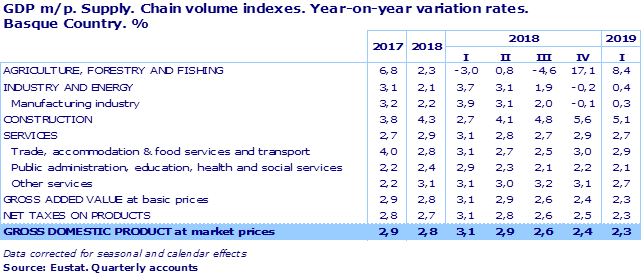
The Construction sector maintained the positive rate seen in recent periods, with a year-on-year growth rate of 5.1%. Compared to the fourth quarter of 2018 it grew by just 0.1%, as the last quarter of the previous year was particularly dynamic in this sector.
The Services sector as a whole also maintained a higher growth than the whole economy sector, with positive variations in both year-on-year and quarter-on-quarter terms in the three activity sub-sectors. As a whole, the sector had year-on-year growth of 2.7% and the quarterly rate was up 0.8%. The Public Administration, Education, Health and Social Services branch registered lower growth in both cases.
The Trade, Hotel Management & Catering and Transport branch was the most dynamic of the sector, with 2.9% growth compared to the first quarter of 2018, which translates as a positive variation of 0.9% with respect to the previous quarter. These increases were slightly lower than those seen in the previous quarter (3% and 1.1%, respectively).
Other Services which includes, amongst others, professional, finance and insurance activities, posted slightly more moderate year-on-year growth than in the previous quarter, although it was up 2.7%. However, the first quarter of the year was 0.9% higher than the last quarter of 2018; that is, the quarter-on-quarter rate was three tenths higher than that observed in the previous quarter.
Finally, the Public Administration, Education, Health and Social Services sector exhibited a more moderate upward trend within the services sector as a whole, with a year-on-year growth rate of 2.1% and quarter-on-quarter growth of 0.6%.
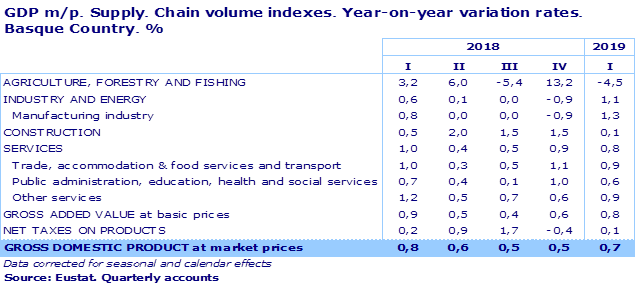
The aggregated performance of the production sectors gave rise to an upturn in Value Added of 2.3% compared to the first quarter of 2018 and 0.8% higher than that registered in the fourth quarter of 2018. These increases were very similar to the estimates for the fourth quarter of 2018, which rose to 2.4% and 0.6%, respectively.
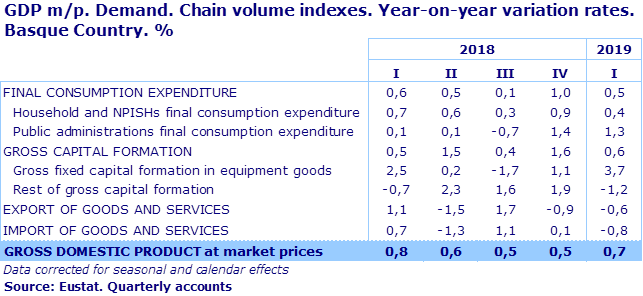
From the point of view of Demand, the further growth seen in Gross Capital Formation this quarter stood out, with a growth rate above 4%. If a solid consumption expenditure, with growth above 2%, is added to this the result is a dynamic Internal Demand that compensates for the worsening foreign trade balance (exports have performed worse than imports) and underpins the expansion of the Basque Country GDP seen this quarter.
Final Consumption Expenditure of Households (Private Consumption) maintained its growth profile, with year-on-year growth of 2.2%. In quarter-on-quarter terms, this increase translates as 0.4% growth. These variations were less pronounced than in the final quarter of 2018 (2.6% and 0.9%, respectively).
Public Consumption (Final Consumption Expenditure of Public Administrations) performed better in year-on-year terms, with a year-on-year growth of 2.0% (compared to 0.8% in the previous quarter), although quarter-on-quarter growth changed slightly, going from 1.4% in the fourth quarter of 2018 to 1.3% in the first quarter of 2019.
The overall performance of the Final Consumption Expenditure of Public Administrations combined with the Final Consumption Expenditure of Households led to a year-on-year upturn of 2.1% in Final Consumption Expenditure. With regards to the previous quarter there was an upturn of 0.5%.
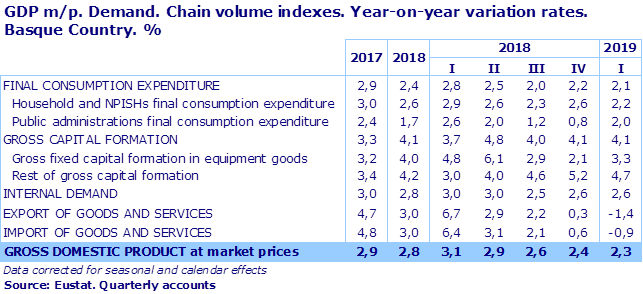
Gross Capital Formation (Investment) also posted a notable year-on-year growth of 4.1% this quarter, the same as the estimated growth for the previous quarter. The quarter-on-quarter growth rate was, however, more moderate, increasing to 0.6% this quarter compared to the 1.6% that it reached in the previous quarter.
Investment in Capital Goods grew by 3.3% with respect to the first quarter of 2018 and by 3.7% compared to the fourth quarter of 2018. These increases were higher than those in the fourth quarter of 2018, estimated at 2.1% and 1.1%, respectively. The Rest of Gross Capital Formation, which includes, among other types of investment, investment in building materials and R&D, increased by 4.7% in year-on-year terms, but in quarter-on-quarter terms it fell by 1.2%.
Internal Demand, which is obtained by adding Final Consumption Expenditure and Gross Capital Formation, was 2.6% higher in the first quarter of 2019 than in the first quarter of 2018.
As regards the level of employment (measured in Full-Time Equivalent Jobs), there was an overall increase in the level of employment, which was up 1.8% in year-on-year terms. This upward trend is a growth of 0.3% compared to the fourth quarter of 2018.
The number of jobs increased in all activity sectors in relation to the first quarter of 2018. In the primary sector, employment increased by 1.6% in year-on-year terms, although it was down 1.3% compared to the previous quarter. The situation was similar in both industry and construction. The number of people employed in the industrial sector was up 1.1% on the same quarter of the previous year, which is a slight quarter-on-quarter decline of 0.1%. Employment in the construction sector continued the growth seen in previous periods; in this quarter it saw a significant increase of 3.7%, however this represented a quarter-on-quarter decrease of 0.9%. Conversely, in the services sector, employment rose both in year-on year (1.8%) and quarter-on-quarter terms (0.6%), as has been the case in recent years.
Regarding the evolution of GDP by Province, in year-on-year terms Gipuzkoa showed the highest growth, of 2.4%, followed by Bizkaia with 2.3%, while Álava registered year-on-year growth of 2.1%. In quarter-on-quarter terms Bizkaia was up 0.8%, Álava 0.7% and Gipuzkoa 0.6%.
For further information:
Eustat - Euskal Estatistika Erakundea / Basque Statistics Institute
C/ Donostia-San Sebastián, 1 01010 Vitoria-Gasteiz
Press Service: servicioprensa@eustat.es Tel: 945 01 75 62