Press Release 17/04/2019
SURVEY ON POPULATION IN RELATION TO ACTIVITY. I/2019
The unemployment rate stood at 10.2%, and the employment rate was down 0.2% in the first quarter of 2019 in the Basque Country
The unemployment rate decreased in the last year from 11.3% to 10.2% and the number of employed people increased by 16,200
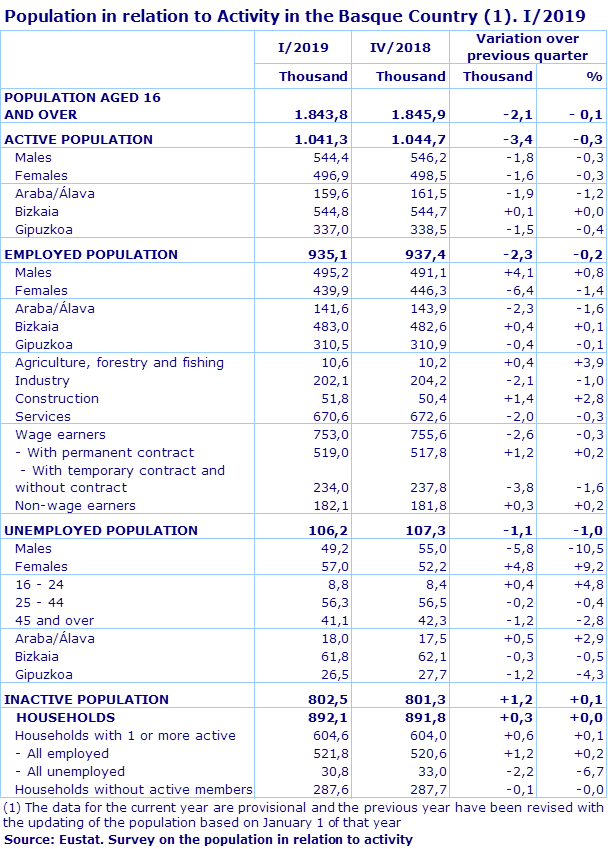
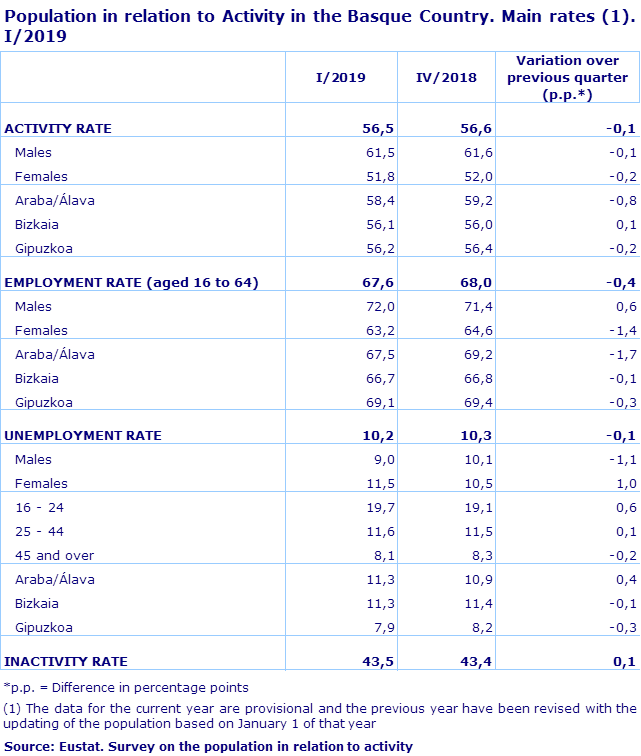
Basque Country labour market data the for the first quarter of 2019 showed a figure of 935,100 individuals in work, which is a decrease of 2,300 compared to the previous quarter (-0.2%), according to Eustat data. On the other hand, the unemployment rate of the Basque Country stood at 10.2%, one percentage point down on the fourth quarter of 2018. As a result of the change in the working and unemployed population, the activity rate was 56.5% in the first quarter of 2019, one percentage point below that of the previous quarter.
In the last year, the unemployment rate went from 11.3% in the first quarter of 2018 to 10.2% in the first quarter of 2019. The number of employed people increased by 16,200 in this period, with 9,000 more employed men and 7,200 more employed women.
By province and compared to the previous quarter, Álava experienced the biggest drop in employment, with 2,300 fewer people in work; followed by Gipuzkoa, with a drop of 400, whilst in Bizkaia employment was up by 400. With regards to the capitals, Vitoria-Gasteiz had the greatest decrease in employment, with 1,900 fewer people in work; on the other hand, in Bilbao employment was up by 900 and in San Sebastián by 1,300.
As far as gender was concerned, the fall in employment affected women, with 6,400 fewer in work than in the previous quarter, whilst the number of men in work increased by 4,100.
Employment increased in the primary sector and in the construction sector, and decreased in the industry and services sectors
The employed population in the Basque Country was up by 1,400 in the construction sector and by 400 in the primary sector; on the other hand, employment fell by 2,100 in industry and by 2,000 in the services sector.
The employment rate, calculated as the percentage of people in work aged 16 to 64 over the total for these ages, was down by 0.4 percentage points compared to the previous quarter, standing at 67.6%. This figure reached 72% for men and 63.2% for women.
By province, Gipuzkoa had the highest employment rate, at 69.1%, a decrease of 0.3 percentage points compared to the previous quarter. Álava came second with 67.5% and a decrease of 1.7 points, and in Bizkaia, the employment rate fell by 0.1 percentage points to stand at 66.7%.
The number of households with all active individuals out of work fell by 2,200
In the first quarter of 2019 it was estimated that there were 892,100 households in the Basque Country, of which a third did not have any active individuals. In just over half of households, all of the active individuals were in work, 1,200 families more than the previous quarter; furthermore, households where all active individuals were unemployed stood at 30,800, 2,200 households fewer than the previous quarter.
The first quarter of 2019 revealed an unemployment rate of 10.2%, one tenth less than the previous quarter.
The unemployed population in the Basque Country, that is, individuals who are available for work, actively making enquiries and seeking employment, was estimated to be 106,200 in the first quarter of the year, 1,100 down on the previous quarter. The number of unemployed men, 49,200, was down by 5,800, whilst the number of unemployed women increased by 4,800, reaching a total of 57,000 for the quarter.
The data for the first quarter of 2019 revealed an unemployment rate of 10.2%, one percentage point less than the previous quarter. The male unemployment rate stood at 9% (1.1 percentage points down) and the female rate was up by one percentage point, reaching 11.5%. The youth unemployment rate continued to be the highest, standing at 19.7%, an increase of 0.6 percentage points compared to the previous quarter.
By province, the greatest decrease in the number of people out of work was in Gipuzkoa (-1,200 individuals) where the unemployment rate stood at 7.9%, 0.3 percentage points down on the previous quarter. In Bizkaia, with 61,800 people out of work, the number of unemployed fell by 300 and the unemployment rate decreased by 0.1 percentage points to 11.3%. In Álava, there were 500 more unemployed people than the previous quarter and the unemployment rate was up 0.4 percentage points (11.3%).
As for the capitals, the highest fall in unemployment was in San Sebastián, with 1,800 fewer people out of work, followed by Bilbao (-1,200) and Vitoria-Gasteiz (-200).
According to EUROSTAT – the Statistical Office of the European Union – in February 2019 the unemployment rate of the European Union-28 stood at 6.5% and that of Spain stood at 13.9%.
In the last year, the number of employed people increased by 16,200 and the unemployment rate dropped from 11.3% to 10.2%.
The employed population in the Basque Country grew by 16,200 people in relation to the first quarter of 2018, an increase of 1.8%. The working population increased in all activity sectors except the industry sector. Of particular note was the increase in net employment of 15,900 in the services sector.
The unemployment rate was down by 1.1 percentage points (from 11.3% to 10.2%), with 11,000 fewer individuals unemployed in the Basque Country compared to the data from the first quarter of 2018.
98.8% of average registered workers were in work, according to ILO criteria
It is estimated that there were 869,900 registered workers for the quarter on average in the Basque Country, i.e. the number of individuals residing in the Basque Country who were registered for Social Security at the time of the survey. Of those, the PRA estimates that 98.8% were employed, according to criteria from the International Labour Organisation (ILO), a total of 859,400 individuals.
Amongst those employed according to ILO criteria in the PRA, 69,800 people, 7.5%, were not registered in the Social Security system, either because they did not work for companies based in the Basque Country, or they belonged to public mutual societies for civil servants, or are in other situations.
32.4% of those unemployed were not registered as unemployed with the Basque Employment Institute (Lanbide)
It is estimated that there was a quarterly average of 106,300 unemployed individuals registered with Lanbide, i.e. individuals residing in the Basque Country who were registered in Lanbide at the time of the survey in any one of the categories designated for registered unemployment. Of those, 67% were unemployed according to the ILO definition (71,300 unemployed individuals). Of the individuals unemployed according to the ILO definition in the PRA, 32.4% were not registered as unemployed with Lanbide (34,400 individuals), even though they may be registered under other categories.
For further information:
Eustat - Euskal Estatistika Erakundea / Basque Statistics Institute
C/ Donostia-San Sebastián, 1 01010 Vitoria-Gasteiz
Press Service: servicioprensa@eustat.es Tel: 945 01 75 62