Press Release 22/11/2018
STATISTICS ON SCIENTIFIC RESEARCH AND TECHNOLOGICAL DEVELOPMENT ACTIVITIES - R&D - 2017
Expenditure on R&D in the Basque Country grew by 5.6% in 2017, the largest increase since 2010
The number of research staff in full-time employment was 12,608, and has grown by 30.8% since 2008
In 2017 1,363.2 million euros were invested in Technological Development and Scientific Research (R&D) in the Basque Country, 5.6% up on the previous year, according to data provided by Eustat. This increase made this the second consecutive year of positive growth, after three years of decreases in expenditure.
There were 18,577 people in Full-Time Equivalent Jobs amongst employed people in 2017, with an increase of 3.8% compared to the previous year. The number of research staff in Full-Time Equivalent Jobs (12,608) also increased by 5.8%, and notably by 30.8% since 2008, almost 3,000 more researchers.
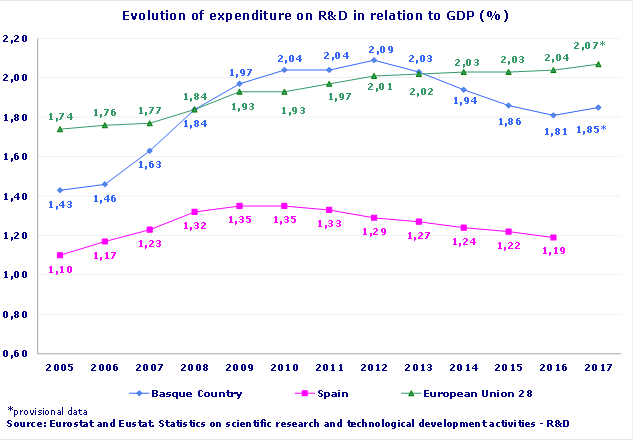
In relation to GDP, expenditure on R&D in the Basque Country stood at 1.85% of GDP in 2017, after falling by 4 hundredths of a percentage point compared to the previous year. Compared to the provisional data for the EU-28, the Basque Country was below the European average of 2.07%, although the gap between them fell by one hundredth. The latest available data from Spain is from 2016, which situated its R&D expenditure above its GDP by 1.19%.
75.1% of expenditure on R&D in the Basque Country was implemented by the business sector
In terms of who carried out expenditure on R&D, the majority, 75.1% (1,023.2 million euros) was implemented by companies, whereas 17.4% (237.1 million) corresponded to Higher Education and the remaining 7.5% (102.9 million) was carried out by various bodies dependent on the Administration. These figures, compared to the previous year, indicate that there were increases of 5.2%,11.8% and 4.9% in expenditure respectively in the three sectors of Businesses, Public Administration and Higher Education. This meant that the Public Administration gained the proportion (four percentage points) lost by both the Business (3 tenths) and Higher Education (1 tenth) sectors.
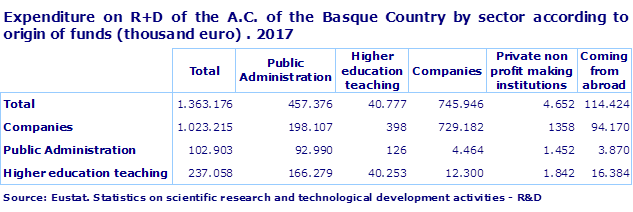
From the point of view of those who finance R&D, the percentages of the previous year stayed largely the same. Private funding through companies, which spent 745.9 million euros on research, 3.7% more than in 2016 and 54.7% of total funding, remained the primary source of funding.
Public funding, with 457.4 million and an increase of 5.8% in the amount contributed, representing 33.6% of the total. Higher education, at 40.8 million, accounted for 3.0% of the funds, whereas 114.4 million, or 8.4%, came from abroad. Finally, 4.7 million, or 0.3%, came from various non-profit institutions.
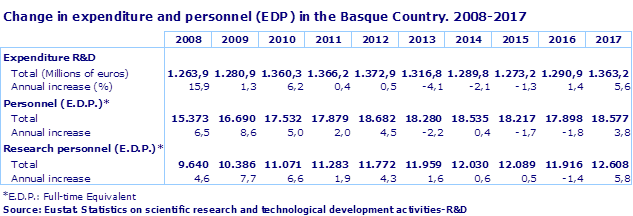
The number of individuals employed full time was 18,577, which, when broken down by implementation sector, corresponds to 13,154 people in Businesses (70.8% of the total), 4,140 in Higher Education (22.3%) and 1,283 in Public Administration (6.9%).
35.8% of R&D staff were women in 2017, two tenths more than in 2016
35.8% of full-time staff in R&D were women, representing an increase of two tenths in the proportion of the sector. The highest percentages were still in Public Administration and in Higher Education, with 54.6% and 50.4% respectively, whilst in Businesses women represented 29.4% of the total. In total, 6,657 women were in Full-Time Equivalent Jobs, 4.4% more than the previous year.
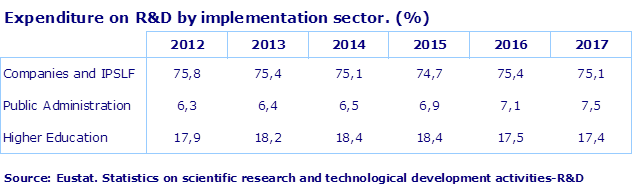
Comparing this to the situation of the previous year, participation percentages of sectors in the total expenditure in R&D, with regards to the execution of the expenditure, were quite similar in terms of large numbers, although there are some differences. For example, the Businesses Sector and Private Non-Profit Institutions in the Basque Country, the sector making the greatest effort in research tasks, fell by three tenths in its percentage of participation, down to 75.1%. Public Administration gained four tenths and is now situated at 7.5% and, finally, Higher Education lost a tenth, situating it at 17.4%.
For further information:
Eustat - Euskal Estatistika Erakundea / Basque Statistics Institute
C/ Donostia-San Sebastián, 1 01010 Vitoria-Gasteiz
Press Service: servicioprensa@eustat.es Tel: 945 01 75 62