Press release 15/11/2018
MUNICIPAL INHABITANTS STATISTICS (EMH) 2018
The greatest increase was in Álava, both in terms of absolute numbers and percentages
The population of the Basque Country stood at 2,180,449 people on 1 January 2018, maintaining the upward trend of the previous year, according to Eustat data. Specifically, the population of the Basque Country rose by 4,630 people compared to 2017, getting closer to the levels of 2012, a year in which the population reached a historic high.
The three provinces saw a growth in their populations between 2017 and 2018. Álava experienced the greatest increase, with 1,926 more residents, meaning that its population was larger than in 2012, after the decreases of 2013 and 2014. It was followed by Gipuzkoa, where 1,468 more people were registered, continuing the population growth that began in 2012, with an increase of 8,675 inhabitants over this seven year period. In the case of Bizkaia, despite the increase of 1,236 residents, there was still a loss of 13,472 people since 2012, which contributed to the Basque Country not reaching the levels of 2012 again.
All three Basque capitals saw an increase in their populations between 2017 and 2018, with Vitoria-Gasteiz experiencing the greatest increase, of 1,561 more people. The populations of San Sebastián and Bilbao increased by 431 and 413 inhabitants respectively. Analysis of a longer period of time, however, produced different results. In 2009 the populations of Bilbao and San Sebastián reached historic highs. However, since then Bilbao has experienced a steady decline in population, with 12,246 fewer inhabitants over the past nine years. The population of San Sebastián has fluctuated, which has resulted in a loss of 1,585 inhabitants since 2009. The population of Vitoria-Gasteiz, apart from in 2013 and 2014, has only increased, reaching its highest number of inhabitants in 2018, of 243,815, which was 9,074 more inhabitants than in 2009.
The remaining municipalities in the Basque Country did not experience significant population changes between 2017 and 2018. The municipality which saw the greatest increase in its population was Amorebieta-Etxano, with 208 more inhabitants, an increase of 1.1%. Another small percentage change, but in the opposite direction, was in Getxo, which was the municipality with the greatest absolute decrease in population, of 263 inhabitants.
Between 2008 and 2018, Basauri, Getxo, Portugalete, Santurtzi and Sestao lost over 1,000 inhabitants each, a total loss of 10,815 people. All of these are part of Greater Bilbao, which has the highest concentration of municipalities with a higher population density in the Basque Country, above 5,000 inhabitants per km2, with the highest density occurring in Portugalete, with 14,506 inhabitants per km2 in 2018.
This downward trend was also seen in Greater Bilbao, which has lost 14,052 inhabitants in the last 10 years; in contrast, Llanada Alavesa saw an increase in its population of 13,918 over the same period.
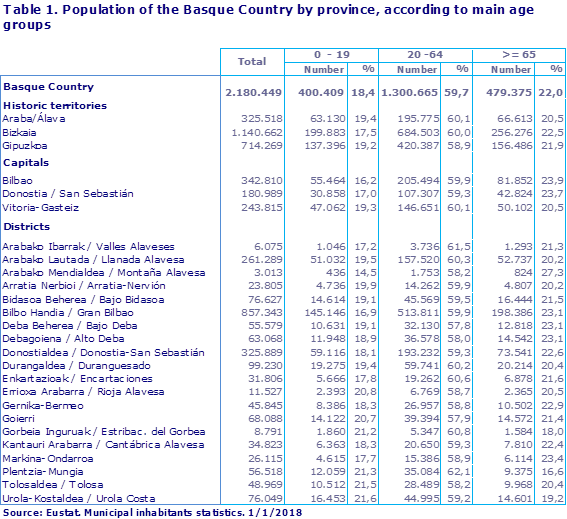
In 34 municipalities in the Basque Country, people aged 65 or more accounted for over a quarter of the total population
In 2018, the proportion of the population of the Basque Country who were 65 or older (22%) was greater than in Spain (19.2%), although there were other Autonomous Communities such as Principado de Asturias, Castilla y León and Galicia that had higher proportions, with percentages above 24%. Compared to Europe, only Italy has higher figures than the Basque Country, although only by three tenths. If we take gender into account, the proportion of women who are 65 or over was 24.6% compared to 19.2% of men.
85 municipalities exceeded the average percentage of elderly people of the Basque Country, whilst 166 presented the same or a lower percentage. Amongst those that exceed it are Bilbao, San Sebastián and Barakaldo, which account for almost 29.0% of the total population of the Basque Country. In 2008, there were quite a few more municipalities (135) with a percentage higher than the average. Moreover, between the two dates the proportion of people over 65 years of age dropped in 61 municipalities, although they only represented 2.2% of the total population.
There was quite a lot of disparity between the municipalities regarding the age of the resident population and, more specifically, the percentage of people 65 and over, as it went from 9.9% in Irura to 39.0% in Harana/Valle de Arana. Besides those previously mentioned, there are four other municipalities that have a percentage under 12%. These are Larraul, Alegría-Dulantzi, Iruña de Oca and Arakaldo. The total population of these municipalities increased to 6,938. On the other hand, there are three municipalities with a percentage over 30%: Harana/Valle de Arana, Lagrán and Elantxobe, which have a combined total of 777 residents.
Regionally, there was a notably high proportion of elderly people in the region of Montaña Alavesa, reaching 27.3% of the total, whilst in the region with the second highest percentage, Markina-Ondarroa, it reached 23.4% and in the region of Plentzia-Mungia, it was down to 16.6%.
If we look at older age groups, people aged 85 and above went from constituting 2.2% of the total population in 2008 to 3.7% of the total population in 2018, although this increase was not evenly distributed between women and men. In the case of men, it increased by 1.1 percentage points over this 10 year period and by 1.8 points amongst women. As a result, women who were 85 or over in the Basque Country represented 5% of the total, whereas in the case of men, the percentage dropped to 2.4%. This process has been very dramatic for the centenarian population, with a rise in the number of centenarians from 364 in 2008 to 669 ten years later, 84.3% of whom were women.
In the Basque Country, there was a ratio of 1.5 people aged 65 or more to every person under 16, exceeding the ratio for Spain as a whole, which is 1.2, but still far from the ratio in Principado de Asturias, which is 2.1.
There are 68 municipalities which exceed this ratio, with extreme cases such as Harana/Valle de Arana, which has a ratio of 6 to 1 and Lagrán and Elantxobe, which both have a ratio of over 4 to 1. On the other hand, municipalities such as Irura, Baliarrain, Larraul, Alegría-Dulantzi and Arakaldo had more than 2 young people up to the age of 15 for each person aged 65 and over.
Population distribution by age is most extreme in the municipalities of Álava, due above all to its small size and the fact that any demographic phenomena, particularly migration, causes changes in the distribution.
For further information:
Eustat - Euskal Estatistika Erakundea / Basque Statistics Institute
C/ Donostia-San Sebastián, 1 01010 Vitoria-Gasteiz
Press Service: servicioprensa@eustat.eus Tel: 945 01 75 62