Press Release 17/10/2018
PERSONAL AND FAMILY INCOME STATISTICS 2016
The average income of the population of the Basque Country increased by 2.4% in 2016 compared to the previous year
Families with the main recipient aged under 40 and over 70 had below average incomes
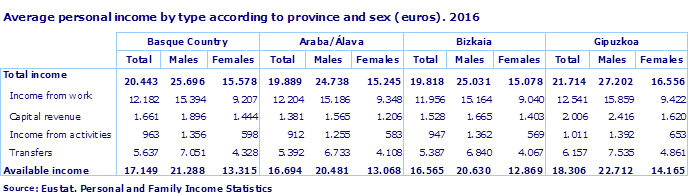
Basque Country residents aged 18 and over obtained an average personal income of 20,443 euros in 2016, which was an increase of 2.4% compared to the previous year, according to the Personal and Family Income Statistics prepared by Eustat, in collaboration with the Provincial Councils of Álava, Bizkaia and Gipuzkoa.
Regarding distribution between provinces, a difference of almost 2,000 euros was observed between the average personal income obtained in Gipuzkoa (€21,714) and that obtained in Álava (€19,889) and Bizkaia (€19,818). Gipuzkoa also stands out for improved performance in respect of the previous year, with an increase of 5.1% compared to Bizkaia (+1.2%) and Álava (+0.5%).
In the capitals, the aforementioned provincial differences were maintained, so the average income of people residing in San Sebastián reached €24,552, higher than the figures of €20,526 in Bilbao and €20,115 in Vitoria-Gasteiz. Despite the differences, both San Sebastián and Bilbao exceeded the average for the Basque Country, whereas Vitoria-Gasteiz was below it.
The disposable income, after taxes, of the population resident in the Basque Country in 2016 is €17,149, reproducing the provincial differences, given that, once again, Gipuzkoa (€18,306) achieved a higher disposable income than that obtained in Álava and Bizkaia (€16,694 and €16,565, respectively).
In relation to the distribution of income amongst the resident population aged 18 and over, 60.3% had an income below the Basque Country average, although it must be taken into account that this group includes people who received no type of income in 2016 (13.1%); at the opposite extreme, 11.6% of the population had an income that was double the average, that is, over €40,800.
In 2016 half of the population residing in the Basque Country aged 18 and over had incomes below €15,581, which was the median income figure.
An uneven distribution was found between men and women. Men in the Basque Country received an average income of €25,696, whereas women received an average income of €15,578. In other words, men earned €10,000 more than women.
The greatest difference between the personal income of men and women was amongst those aged between 65 and 69, where the average income of men exceeded that of women by almost €17,000.
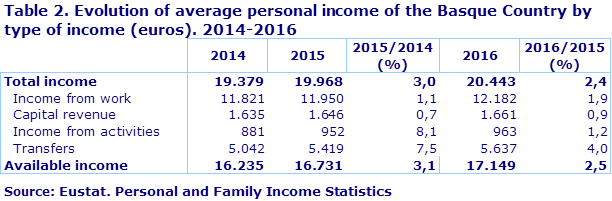
Compared to 2015, the total income was up by 2.4% . All types of income increased although income from capital and income from activities did so moderately: 0.8% and 1.2%, respectively. The growth in income from transfers stood out, with a rate of 4%, followed by incomes from work, which were up by 1.9%. Disposable income also increased by 2.5%, one tenth higher than the total income.
Half of families in the Basque Country received an average yearly family income above €33,833 in 2016
Average family income in the Basque Country stood at €42,464 in 2016. The total family income is produced as an aggregation of the personal incomes of all adult members of the family. As in the case with personal income, Gipuzkoa was the province with the highest family income, €44,855, followed in this case by Bizkaia with €41,766 and Álava with €39,738.
Compared to 2015, average family incomes in the Basque Country increased by 3.4%. Gipuzkoa was the province that registered the highest increase, 6.2%, followed by Bizkaia, with 2.1%, and Álava, up 1.5%.
Donostia-San Sebastián, with €50,656, was the capital with the highest family income, followed by Bilbao, with €42,370 and Vitoria-Gasteiz, with €39,748.
Regarding the regional distribution, there were also differences between the twenty regions of the Basque Country. Nine of these regions received family income higher than the average, with special mention going to Estribaciones del Gorbea (€49,920) in Álava, Plentzia-Mungia (€49,193) in Bizkaia and Alto Deba (€47,292) in Gipuzkoa. The eleven remaining regions, however, received family income lower than the average, and the lowest figures of the classification are found in Encartaciones (€35,770) in Bizkaia, Bajo Bidasoa (€40,001) in Gipuzkoa and Montaña Alavesa, which, at €33,899, was the region with the lowest family income in the Basque Country.
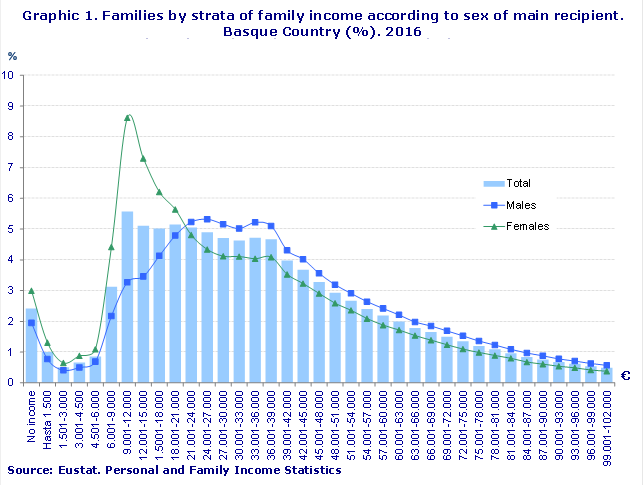
Furthermore, family incomes differ depending on whether the main recipient was a man or a woman. Where the main recipient was a man, the families had an average income of €46,709, with the majority of families being concentrated in the intermediate and high strata, whereas if the main recipient was a woman the average income stood at €36,819 euros and was concentrated in the lowest income strata; 9% of these families were in the €9,001 to €12,000 stratum.
The average income for families overall in the Basque Country corresponded to 2.1 times the average personal income.
62.8% of families received an income below the Basque Country average, or they received no income at all. In 2016, 2.4% of families fell under this category. On the other hand, 8.9% of families had an income that was double the average, that is €84,928.
As for age, families with the main recipient aged under 40 and over 70 had family incomes below the Basque Country average.
For further information:
Eustat - Euskal Estatistika Erakundea / Basque Statistics Institute
C/ Donostia-San Sebastián, 1 01010 Vitoria-Gasteiz
Press Service: servicioprensa@eustat.eus Tel: 945 01 75 62