Press Release 29/06/2018
STATISTICS ON POPULATION AND HOUSING. ACTIVITY. 2016
In two out of every three municipalities in the Basque Country the unemployment rate in 2016 fell compared to 2011
On a sectoral basis, there was a certain provincial specialisation of those in work
According to the Population and Housing Statistics prepared by Eustat, the unemployment rate at 1 November 2016 fell in two out of every three municipalities in the Basque Country (160 of the 251 municipalities), compared to the same date in 2011.
In addition, in 61 municipalities the rate was below 10%, most notably in Orexa (3.6%), Kortezubi (4.7%), Bidania-Goiatz (4.9%), Kripan (5.2%), Samaniego and Altzaga, both with 5.5%. However, five municipalities stand out for having particularly high rates: Oyón-Oion (24.2%), Lanestosa and Trucios-Trutzioz (22.7%), Sestao (22.3%) and Zambrana (21.1%).
In general, the smallest municipalities had the lowest unemployment rates. Municipalities with fewer than 10,000 inhabitants had an unemployment rate of 12.9%, whereas in those with between 10,000 and 40,000 inhabitants it reached 13.6% and for municipalities with between 40,000 and 100,000 inhabitants it stood at 16.5%. Bilbao had the highest unemployment rate of the three capitals, with 17.9%, compared to 15% in Vitoria-Gasteiz and 12% in Donostia-San Sebastián.
The regions with the lowest unemployment rate in the Basque Country were in the province of Álava: Estribaciones del Gorbea (9.8%) and Montaña Alavesa (10.8%). In contrast, the regions with the highest unemployment rate were in Bizkaia: Encartaciones (18.6%) and Gran Bilbao (16.8%). As regards the regions of Gipuzkoa, with the exception of Bajo Bidasoa (14.9%), all the rest had unemployment rates below the Basque Country average.
The employment rate increased in all regions of the Basque Country, except Bajo Bidasoa
Regarding the employment rate, and from a regional perspective, the largest increases were in the regions of Duranguesado (+2.3 percentage points), Urola-Costa and Montaña Alavesa (+2 points). Furthermore, and with the exception of Bajo Bidasoa where there was a 0.1 point drop in the employment rate, in the other regions it also increased in relation to 2011.
In the case of the municipalities, standing out in terms of growth were Añana (+11.8 percentage points), Izurtza (+8.5 points), Baliarrain (+8.4 points), Errezil and Kortezubi (both +7.8 points); at the opposite extreme were Belauntza (-6 points), Leza (-5.6 points) and Ribera Baja (-5.2 points).
Working women stand out amongst salaried temporary staff and family support
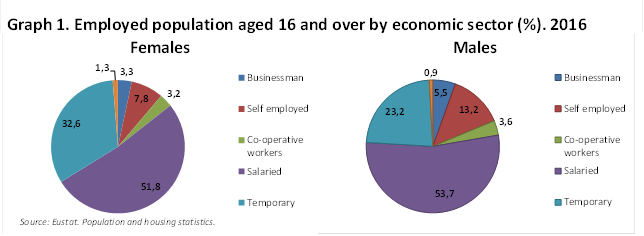
In 2016, working women in the Basque Country stood out in the professional categories of salaried temporary staff and family support, standing at 33.8% compared to 24.1% of men. Men, in contrast stood out in the categories of self-employed workers, salaried permanent staff and members of cooperatives (as a whole, 75.9% compared to 66.2% of women).
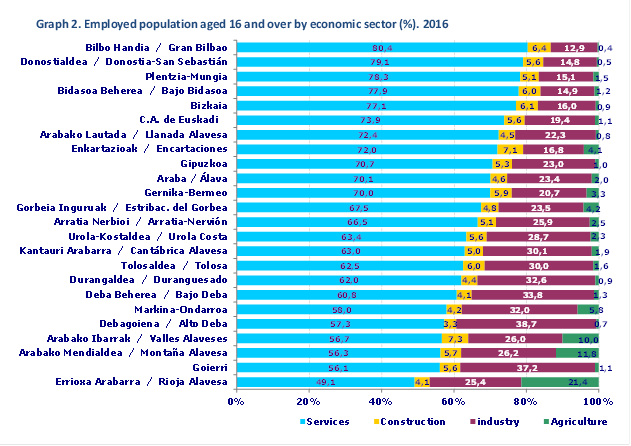
On a sectoral basis, in each region there was a certain specialisation
Gipuzkoa had the municipalities with a higher proportion of people employed in industry, Álava those with more weight in agriculture and in Bizkaia in construction and services.
Standing out on a regional basis was the specialisation of industrial workers in Alto Deba (38.7%) and agricultural workers in Rioja Alavesa (21.4%), whereas in Gran Bilbao the services sector was of particular note (80.4%).
The most striking differences were at a municipal level. While in Navaridas and Baños de Ebro only 2 out of every 10 people were employed in the services sector, in Getxo, Plentzia, Bilbao and Donostia/San Sebastián, amongst others, this reached 8 out of every 10.
The municipalities with the highest percentages of industrial workers were concentrated in Gipuzkoa: Antzuola (46.5%), Oñati (46.3%), Olaberria (43.3%) and Idiazabal (43.2%), amongst others. In contrast, the six municipalities with a lower proportion of industrial employment were in Bizkaia, most notably Lanestosa, Plentzia and Barrika, all below 10%.
The vast majority of municipalities with high employment in the agricultural sector were in Álava, in particular Yécora/Iekora, Baños de Ebro/Mañueta and Navaridas, where half of the population worked in this sector.
Finally, Lanestosa (17.4%), Añana (16.1%), Beizama (15.7%) and Belauntza (14.8%) were the municipalities with more employment in the construction sector.
For further information:
Eustat - Euskal Estatistika Erakundea / Basque Statistics Institute
C/ Donostia-San Sebastián, 1 01010 Vitoria-Gasteiz
Press Service: servicioprensa@eustat.es Tel: 945 01 75 62