Press Release 16/03/2018
420,264 students enrolled in non-university education in the Basque Country in the 2016-17 academic year
The amount of grants and aid increased to 54 million euros and benefited a total of 126,644 students
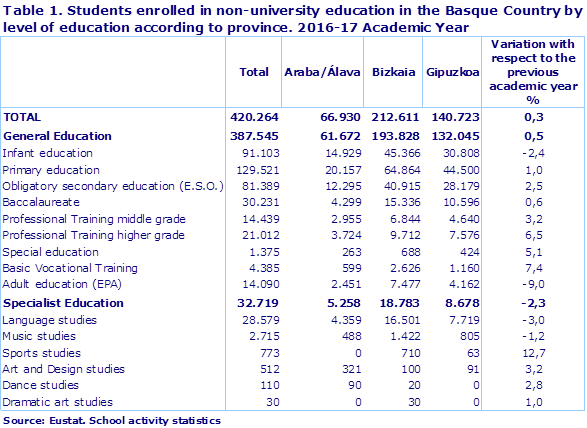
There were 420,264 students enrolled in non-university education in the Basque Country over the 2016-17 academic year, which signified an increase of 0.3% with respect to the previous academic year, according to data prepared by Eustat.
92% of them took General Education courses, which saw an increase of 0.5%, while the remaining 8% were enrolled in Specialised Education, which fell by 2.3%, this being the third consecutive academic year with a drop in enrolments.
By province, half of all students in General Education studied in Bizkaia, 33% in Gipuzkoa and 16% in Álava. However, with the exception of Music and Languages, in Specialised Education there exists a specialisation by province due to the low number of students: 63% of enrolments in Visual Arts are in Álava, those of Dramatic Art are only offered in Bizkaia, Elementary and Professional-Level Dance Studies are offered in Álava and Advanced-Level in Bizkaia; finally, Sports Education is concentrated in Bizkaia (92%).
In General Education, students were distributed equally between public and private centres, except for Intermediate-Level Professional Training studies where six out of every ten enrolments were at a public centre, and Adult Education, where almost all enrolments were at public centres. It is worth mentioning that the opposite is true for Basic Professional Training, with 72% of enrolments in private centres. For Specialised Education, the majority of students were registered at public centres: 100% in Languages, Dance and Dramatic Art, and more than 70% in the other courses.
Enrolments in Basic Professional Training increased by 7.4%
General Education increased by 2,021 enrolments compared to the previous academic year but the largest increase was in Basic Professional Training (7.4%), followed by Advanced-Level Professional Training (6.5%). There were increases in all other levels except for Adult Education (-9%) and Infant Education (-2.4%), whose enrolments dropped for the fourth consecutive year.
For Specialised Education, enrolments dropped by 2.3%, accounting for 785 fewer enrolments, affecting Music and Languages.
Balance in Upper Secondary Education between boys and girls and greater male presence in Intermediate-Level Professional Training
Upon completion of compulsory education, 68% of students choose to enrol in Upper Secondary Education as opposed to 32% who opt for a more professional route, signing up for the various intermediate-level modules.
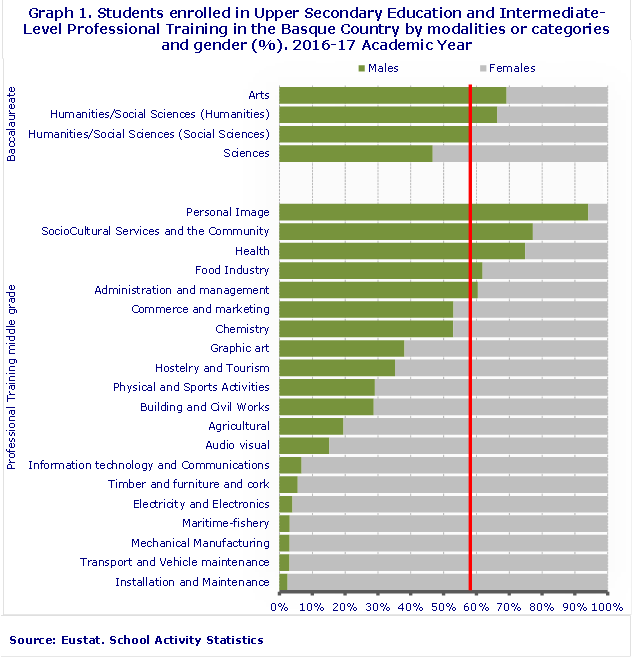
In Upper Secondary Education the proportion of boys and girls is the same, whereas in Intermediate-Level Professional Training two-thirds of students are boys.
Predominance of female students in the Arts and Humanities branch of Upper Secondary Education
There are also differences by gender in the choice of specialisations in Upper Secondary Education and Professional Training. In Upper Secondary Education there is a greater presence of women in all of them except Science (48%) with the two-thirds female enrolment in Arts and Humanities particularly standing out.
For Intermediate-Level Professional Training, there is a female majority in only five of the twenty categories offered: Hair and Beauty (94%), Socio-cultural and Community Services (77%), Healthcare (75%), Food Industries (62%) and Administration and Management (60%). There are two branches, Sales-marketing and Chemistry, in which the ratio between boys and girls is similar. In the other categories there is a clear predominance of boys.
21,012 students enrolled in Advanced-Level Professional Training, 6.5% more than in the previous academic year. Of these, 35% were women and half were 24 or older.
The choice of branch is marked by gender in this case as well, with a greater presence of women in sectors related to hair and beauty, caring for people, food and textiles and manufacturing.
Tolosa is the only region with all of its students enrolled in Model D
In the 2016-17 academic year, in General Education, 66% of students enrolled in model D, 18% in model B and the remaining 15% in model A.
This distribution is not homogeneous, but rather depends on the educational level and the location of the centre. Model D is prevalent in Infant Education in both Gipuzkoa and Bizkaia, with the exception of Gran Bilbao with 64%. In Álava, on the other hand, all regions are below 80%, except in Estribaciones del Gorbea, where the figure stands at 95%.
Within Basic Education (Primary and Compulsory Secondary Education), the map is similar since all regions are above 70%, both in Gipuzkoa and Bizkaia, except for Gran Bilbao (56%). Álava is the province with the fewest enrolments in model D (52.4%), with the exception of Estribaciones del Gorbea (79%) and Montaña Alavesa (76%).
At higher levels of education, the predominance of model A is significant, reaching 100% in Estribaciones del Gorbea. It is worth mentioning that in the regions with the capitals and largest concentrations of population and students, model D is studied less. Thus, in Donostia-San Sebastián model D accounts for 43% while Gran Bilbao and Llanada Alavesa stand at 26% and 24%, respectively.
47% of the total amount of grants was allocated to Primary Education
In the 2016-17 academic year, the amount of grants and aid awarded by the Public Administration of the Basque Country increased to 54 million euros, and benefited a total of 126,644 students, 31% of the total.
Practically the entire allocation of grants was assigned to General Education (99.8%), notably Primary Education (47%), Infant Education (22%) and Compulsory Secondary Education (19%). About €130,000 was assigned to Specialised Education.
Public centres received two-thirds of the aid, favouring early and basic education, while grants for students enrolled in private centres rose to a total of 19 million.
For further information:
Eustat - Euskal Estatistika Erakundea / Instituto Vasco de Estadística
C/ Donostia-San Sebastián, 1 01010 Vitoria-Gasteiz
Press Service: servicioprensa@eustat.eus Tlf: 945 01 75 62