Press Release 29/11/2017
The Basque population decreased by more than 3,000 between the census counts of 2011 and 2016
The percentage of foreign residents maintained the same levels as in the 2011 census
The population of the Basque Country totalled 2,176,577 individuals according to Population and Housing Statistics for 2016 compiled by Eustat, that is to say 3,238 individuals fewer than the figure recorded in the 2011 Census. This decrease was concentrated in Bizkaia, which saw its population fall by 12,782 people - a fall that was not offset by population increases in Álava and Gipuzkoa (2,635 and 6,909 more people respectively).
The age distribution of the Basque population changed over the course of these five years, leading to an increase in the number of people at the very top of the population pyramid. The number of residents aged 65 or more now accounts for 21.6% of the population, which is nearly 3 percentage points higher than the figure for Spain. This age group is now 9.2% larger than it was in 2011, and it is significant that within this group the number of people reaching 85 was 28.5% higher than in 2011.
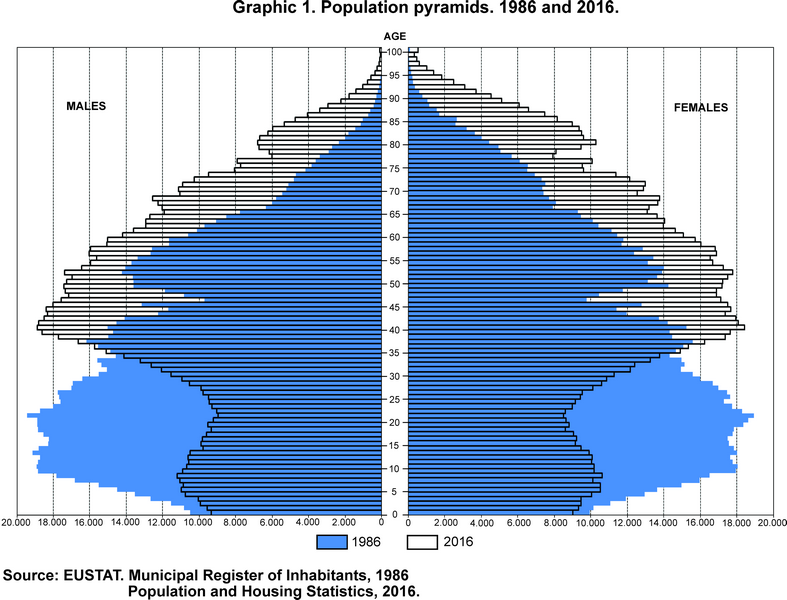
The number of people under the age of 20 also increased over the course of these five years (4.1%), although there are differences within this group: the number of people under the age of 10 fell by 1.5%, whereas the number of people aged between 10 and 19 rose by 10.6%.
The proportion of residents aged between 20 and 64, the bulk of the working population, fell between 2011 and 2016 by nearly 3 percentage points, going from 62.6% to 60%. If we divide this category up into three age groups, we see that the proportion of people aged between 50 and 64 rose by 6.4%, whereas the proportion of those aged between 20 and 34 fell by nearly 19%, with the intermediate group, i.e. people aged between 35 and 49, also experiencing a drop, albeit only 2.5%.
Bizkaia was the only province that had a higher proportion of individuals aged 65 than the Basque Country as a whole (22.1%), whereas Álava had the lowest (20.1%) and Gipuzkoa the closest to the average (21.5%). By regions, the variation in weighting of this age group was greater, given that it went from 16.2% in Plentzia-Mungia and 17.1% in Estribaciones del Gorbea to 27% in Montaña Alavesa. In the latter region, we see that the percentage for 2001 was in fact higher at 29.1%.
Various regions experienced this fall in the percentage of elderly people between 2011 and 2016, including Valles Alaveses, where it went from 24.6% to 20.6%, and Rioja Alavesa, where it went from 22.8% to 20.3%. This is not due to the fall in the absolute number of people aged 65 and above, which has increased in some cases, but rather the greater rise in the population of other age groups.
In the Basque Country there were 26 municipalities where the population aged 65 and over exceeded 25%, but they were small, representing just 4.7% of the total population. Ten years ago this figure stood at 17, and they were even smaller, with their resident populations accounting for 0.1% of the total.
Special mention should go to Harana/Valle de Arana, where over 40% of its population is over 65. Lagrán is also close to this percentage, where the figure is 39.2%. There are two other municipalities where the figure is over 30%: Elantxobe and Ereño with 34.1% and 30.1% respectively. At the other extreme, there were three municipalities, two of them in Gipuzkoa, which had a percentage below 11%: Irura (10.1%), Larraul (10.4%) and Alegria-Dulantzi (10.5%).
In the Basque Country, people from Latin American countries are the predominant foreign nationals
Foreign nationals constitute 7.3% of the population of the Basque Country, which is the same proportion as the 2011 Census, and nearly seven percentage points more than the 2001 Census, when this figure stood at only 1.5%. This number was lower than that for Spain, where it stood at 9.5%.
By province, Álava still has the highest proportion of foreign residents (9.1%), which far exceeds the proportion in Bizkaia (6.7%) and Gipuzkoa (7.4%). Nevertheless, the disparity amongst municipalities is far greater, indeed there are three municipalities with double the average percentage: Yécora/Iekora, Baños de Ebro/Mañueta and Ordizia, whereas four other municipalities have hardly any foreign nationals: Larraul, Mutiloa, Elantxobe and Lagrán.
Latin American nationals in the Basque Country account for 27.2% of all foreign residents, whereas in the 2011 Census, they accounted for 43.3%. This is due to naturalisation processes that have affected these residents, and potentially because some have returned to their countries of origin. As a result of this decrease, African nationals went from making up 23.1% of the population in 2011 to 28.1% in 2016. European nationals continued to constitute 26% of the population.
Lastly, despite not exceeding 9% of the total foreign population, the Asian population increased by 18% over the course of these five years.
For further information:
Eustat - Euskal Estatistika Erakundea / Basque Statistics Institute
C/ Donostia-San Sebastián, 1 01010 Vitoria-Gasteiz
Press Service: servicioprensa@eustat.es Tel: 945 01 75 62