Press Release 27/11/2017
Births in the Basque Country fell by 4.5% in the second quarter of 2017
Babies born to unmarried mothers accounted for 44.5% of births
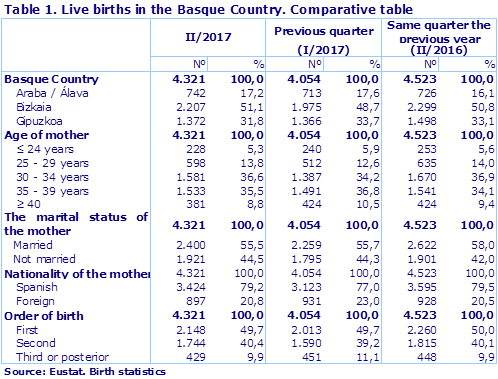
The number of births in the Basque Country in the second quarter of 2017 stood at 4,321, a figure 4.5% lower than that recorded in the same period of the previous year, according to Eustat data. There was a decrease in two of the three provinces, although to different degrees: it was higher in Gipuzkoa (-8.4%) than Bizkaia (-4.0%). In Álava, on the other hand, there was an increase of 2.2%. In figures, 742 girls and boys were born in Álava, 2,207 in Bizkaia and 1,372 in Gipuzkoa.
During April, May and June 2017 births outside marriage accounted for 44.5% of the total, a greater percentage than the 42% recorded in the same quarter of 2016. Bizkaia, with 46%, was the only province with values higher than the Basque Country average; in Álava and in Gipuzkoa the percentages were lower, 44.1% and 42.1%, respectively.
According to the order of birth in the second quarter of 2017, almost half, 2,148, were first children; 1,744 girls and boys (40.4%) arrived in families that already had another son or daughter, and the percentage of third or subsequent children stood at 9.9%.
In 8 out of every 10 births the mothers were aged 30 or over
Regarding the distribution of births according to age, the group of mothers between the ages of 30-34 continued to be in the majority, producing 36.6% of births. They were closely followed by the 35-39 age group, with 35.5%. With percentages significantly lower than the previous groups were the 25-29 age group (13.8%) and the lowest and highest age groups: the under-25s, with 5.3%, and the over-40s, with 8.8% of births.
The age of maternity for single mothers was lower than that for mothers as a whole, with 8% of single mothers being under the age of 25 and 17% between the ages of 25 and 29.
20.8% of mothers were foreign nationals
In 20.8% of births in the Basque Country during the spring months of 2017, the mother was a foreign national. This figure was higher in Álava where it stood at 27.9%, against 18.9% in Bizkaia and 19.8% in Gipuzkoa.
For further information:
Eustat - Euskal Estatistika Erakundea / Instituto Vasco de Estadística
C/ Donostia-San Sebastián, 1 01010 Vitoria-Gasteiz
Press Service: servicioprensa@eustat.eus Tlf: 945 01 75 62