Press Release 25/10/2017
The number of marriages increased by 1.9% in 2016 with respect to the previous year
81% of marriages in 2016 were civil, which is 3.5 times the percentage of civil marriages in 1990
The total number of marriages stood at 8,028 in 2016, 1.9% up on the previous year, of which 180 were homosexual couples, up 23.3%, according to Eustat data.
Taking into account civil status prior to marriage, single men represented 86.5%, the same as the figure for single women.
Summer was the preferred month for partners to get married: specifically July was the most popular month with 1,421 weddings, followed by September with 1,232 and June with 1,049.
The preferred destinations for the 471 couples who fixed their residency outside the Basque Country after getting married were Madrid, Barcelona and France. There were differences, regarding destination, amongst the marriages that took place in the three provinces: those in Álava preferred Madrid, Barcelona and La Rioja; those in Bizkaia Madrid, Cantabria and Barcelona and those in Gipuzkoa France, Madrid, and Barcelona.
The number of homosexual marriages were up by 23.3%, while heterosexuals marriages increased by 1.5%
In 2016 there were 180 weddings between individuals of the same sex, 101 being between women and 79 between men. Regarding distribution between provinces, 21 were resident in Álava, 62 in Gipuzkoa, 87 in Bizkaia and 10 outside the Basque Country.
If we only consider marriages of Basque Country residents between people of different sexes, the number stood at 7,848. 114 more weddings took place than in the previous year, which was a rise of 1.5%.
The Basque marriage rate was 3.4 weddings per thousand inhabitants, a lower number than the Spanish rate (3.7%o), and that for European Union (28 countries), which in 2011 (latest available data) stood at 4.2%o.
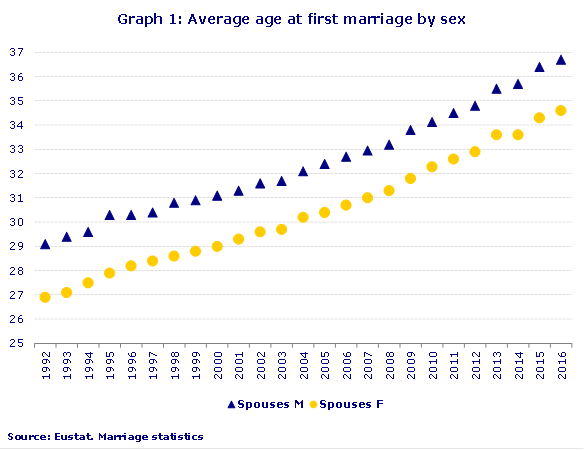
There was an increase in the age of marriage alongside a delay in the age at which women become mothers. In 2016, the average age of single men when they entered into marriage was 36.7 years old, whilst for single women it stood at 34.6. In the last 25 years, the average age of husbands has increased by 7.6 years and by 7.7 in the case of wives.
The number of civil weddings has almost tripled since 1990
The number of civil weddings has risen throughout the last few years, going from 23% in 1990 to 80.9% in 2016, when they stood at 6,346. There were 1,491 catholic weddings and 11 that corresponded to other religious faiths.
By provinces, the most civil weddings took place in Bizkaia (84%), followed by Gipuzkoa (81.3%) and Álava (79%). However, in the case of Basque residents whose wedding took place outside of the Basque Country, the percentage fell to 67%.
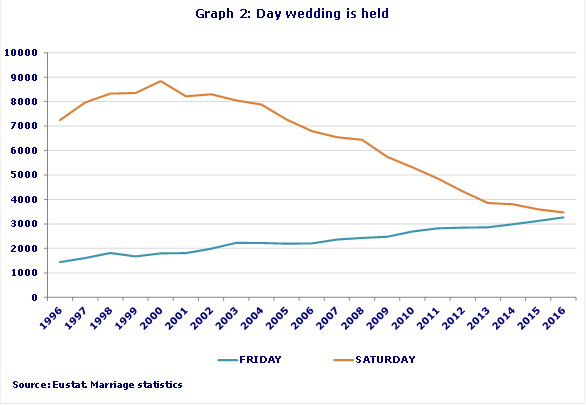
The percentages of weddings held on Fridays and Saturdays are becoming equal
The number of weddings held on Fridays is reaching the number held on Saturdays, because Fridays are when mostly civil weddings take place, whereas religious ceremonies are held on Saturdays and have been declining since 1996. Thus, in 2016, 44% of weddings took place on a Saturday and 42% on a Friday.
In 15.5% of heterosexual marriages at least one of the spouses was of foreign nationality
Regarding the nationality of the individuals entering into marriage, in 1,213 marriages (15.5% of the total) at least one of the spouses was a foreign national. In 44.6% of these couples the wife had foreign nationality, in 26.5% the husband and in the remaining 28.9%, both spouses were foreigners.
Amongst recently married women the most common countries of origin were Colombia with 107, Bolivia with 81, Brazil with 68, Nicaragua with 61, Morocco with 60 and Ecuador with 46. With regards to new spouses, 83 originated from Morocco, 71 from Colombia, 49 from Bolivia, 33 from Ecuador, 31 from Portugal and 30 from France.
For further information:
Eustat - Euskal Estatistika Erakundea / Instituto Vasco de Estadística
C/ Donostia-San Sebastián, 1 01010 Vitoria-Gasteiz
Press Service: servicioprensa@eustat.eus Tlf: 945 01 75 62