Press Release 01/12/2017
INTERNATIONAL BASQUE LANGUAGE DAY 03 December 2017
Half of companies with 10 or more employees with a website have a Basque version
Two in three students are enrolled in the D model of the non-university general education regime in the Basque Country
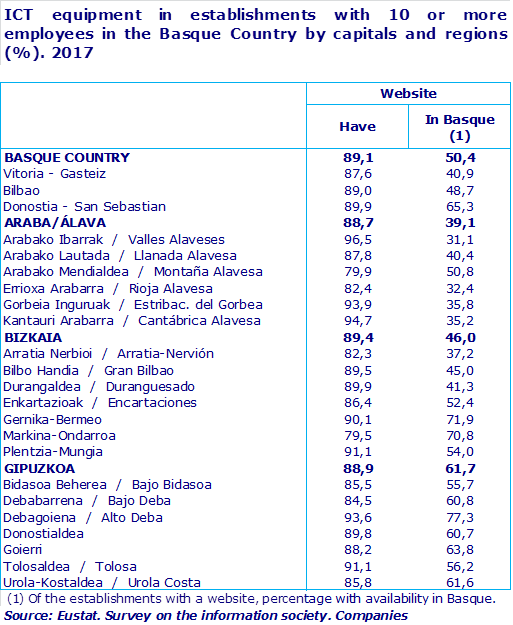
Websites are mostly available in Basque in companies with 10 or more employees based in the regions of Gipuzkoa (on average 61.7% of the establishments that have a website), whilst for the Basque Country as a whole it is 50.4%, according to Eustat data. Thus, in Gipuzkoa 77.3% of websites found in companies in Alto Deba were available in Basque, 63.8% of those in Goierri and 61.6% of those in Urola Costa. In the other regions of Gipuzkoa they exceeded 55%.
Following these were those in Bizkaia (46.0% on average), where over 70% of the websites of companies based in Gernika-Bermeo and Markina-Ondarroa, 71.9% and 70.8% respectively, had a Basque version available. On the other hand, Arratia-Nervión is the region with the lowest percentage (37.2%) of companies in the province with websites available in Basque.
Lastly, in Álava (39.1% on average), Montaña Alavesa stood out, where 50.8% of websites were available in Basque, followed by Llanada Alavesa (40.4%). This percentage decreased in the rest of the regions. Valles Alaveses achieved the lowest percentage (31.1%).
Amongst the Basque capitals, Donostia-San Sebastián stands out in websites available in Basque, where its percentage is clearly higher (65.3%) than the rest of the capitals: 48.7% in companies with 10 or more employees in Bilbao and 40.9% in Vitoria-Gasteiz.
By branches of activity, 55.7% of companies with 10 or more employees in the Services sector are those that have the highest number of websites in Basque, followed by those in the Construction and Industry sectors, 49.8% and 34.4% respectively.
Language model
A total of 384,792 students enrolled in the non-university general education regime in the Basque Country, according to those corresponding to the 2016-2017 academic year. When looking at the linguistic model chosen, in this academic year 246,533 students (64%) enrolled in model D (all teaching in Basque), 69,636 in model B (18%) and 66,562 in model A (17.3%).
By levels of education, in Upper Secondary Education the vast majority of students enrolled in model D, 18,798 students, compared to only 1,142 in model B and 10,105 in model A. In compulsory secondary education the predominance of enrolments in model D is also clear (53,618) compared to 20,238 in model B and 7,031 in model A.
In the earlier educational levels of infant and primary education, are the remaining students who enrolled in model A (2,773 and 5,605 enrolments, respectively). However, 70,904 and 94,367 students, respectively, enrolled in model D, and 16,112 and 28,576, respectively, in model B.
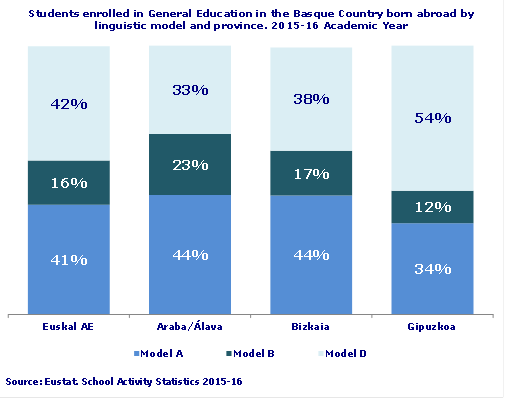
With regard to the linguistic integration of foreign students, Gipuzkoa topped the list with the highest percentage of foreign students enrolled in model D (54%) followed by Bizkaia (38%) and Álava (33%). The average for the Basque Country was 42%, according to data corresponding to the 2015/16 academic year.
If the enrolment trend is observed over time, there is clearly a progressive and significant increase in the number of enrolments in model D. Thus, in the 2005/06 academic year there were 163,054 students enrolled in this model, by 2010/11 there were 205,774 and in the 2015/16 academic year the figure reached 243,178.
In model A, for its part, there has been a steady decrease in enrolments. In the 2005/06 academic year a total of 99,862 students were enrolled in that model, whereas in 2010/11 there were 92,332. However, in the 2015/16 academic year only 71,803 enrolments were registered.
In terms of model B, the enrolment trend has gone down slightly, from 71,284 enrolments in the 2005/06 academic year to 68,457 in 2015/16.
Regarding university entrance exams, 3,428 students from model A passed these exams in 2016, whereas 7,359 students from model D did so. However, in 2006 the figures were very similar, as in that year 4,407 students from model A passed compared to 4,748 from model D.
For further information:
Eustat - Euskal Estatistika Erakundea / Basque Statistics Institute
C/ Donostia-San Sebastián, 1 01010 Vitoria-Gasteiz
Press Service: servicioprensa@eustat.eus Tel: 945 01 75 62