Press release 26/09/2017
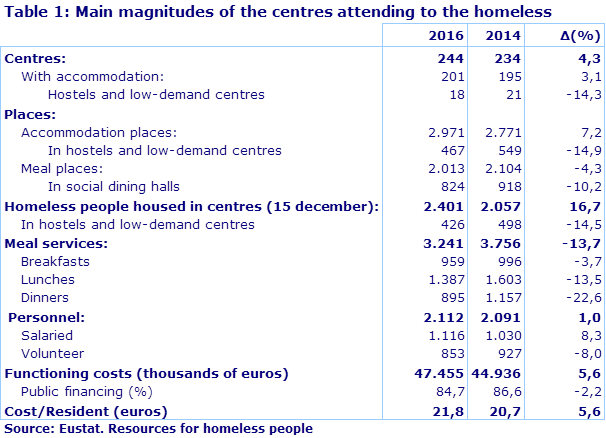
In 2016, an average of 2,372 individuals were accommodated each day at centres for the homeless in the Basque Country, 14.4% of the total for Spain
47 million euros was spent on care for the homeless, 5.6% more than in 2014
Centres with accommodation for the homeless in the Basque Country housed an average of 2,372 individuals per day in 2016, 17% more than in 2014, according to Eustat data.
The network was made up of 244 centres, 10 more than were operating in 2014. They provided accommodation, meals, daytime services and street outreach. More specifically, an average of 2,933 accommodation places were available, with 80.9% occupancy, and 2,200 day places were available, with 85.6% occupancy. An average of 3,205 meals were served. Furthermore, 17 street teams provided assistance to an average of 271 individuals.
The Basque Country offered 15% of Spain’s accommodation places
The Basque Country offered 15.3% of the total accommodation places for homeless people in Spain as a whole. Two features make the Basque network for the homeless stand out: Basque centres are smaller on average, and there is a greater percentage of publicly owned centres – 38% of the total compared to 27% countrywide.
In addition, in Basque centres the proportion of salaried employees is higher (53%) than the proportion of volunteers (40%), whereas at centres in Spain as a whole, 34% of those who worked in 2016 were paid and 59.7% were volunteers.
With regard to the use of these resources, as of 15 December 2016, 2,401 slept at accommodation centres in the Basque Country, while the figure stood at 17,483, or 13.7%, in Spain as a whole.
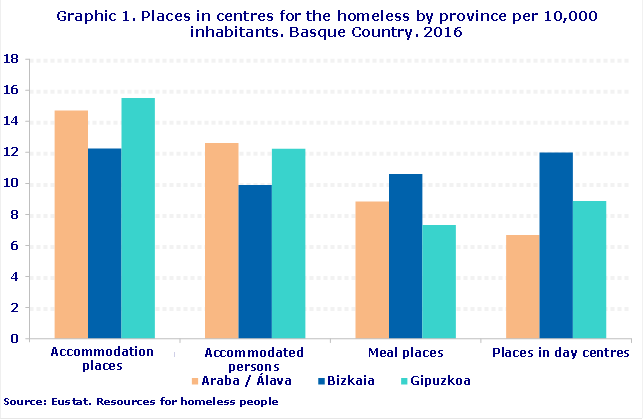
With regard to population, Gipuzkoa and Álava stood out in terms of the number of accommodation places available and Bizkaia in the number of meal places and day centres
The distribution of resources among the three provinces reveal a higher relative availability of accommodation places in Gipuzkoa (37.1%) and in Álava (16%), compared to their population, than in Bizkaia (47%). The number of individuals accommodated was also proportionally higher in Álava (16.9%) and Gipuzkoa (36.2%) than in Bizkaia (46.9%). In terms of meal places, however, Bizkaia accounted for practically 60% of the places available and 61% of the day centre places. Álava, on the other hand, offered 14.2% of the meal places and 9.7% of the day centre places. Finally, Gipuzkoa offered 25.9% of the meal places and 28.5% of the day centre places.
Homeless people were especially concentrated in big cities, meaning that resources were for the most part allocated to the provincial capitals, although Gipuzkoa had a more decentralised model. Thus, 25 of the province's 28 centres were located in Vitoria-Gasteiz, where 96.1% of the accommodation places and 100% of the meal places and day centres were concentrated. 69.5% of Bizkaia's centres, 76% of the accommodation places, 79.9% of the meal places and 88% of the day centre places were located in Bilbao. The 32 centres in Donostia-San Sebastián, however, accounted for only 37.6% of those in Gipuzkoa, with 49.7% of the accommodation places, 45.5% of the meal places and 62.7% of the day centre places.
The most common services on offer at the centres included information and shelter, at 72% of the centres; support, at 64%; career guidance, at 40%, and personal services such as toilets (47%), laundry (45%) and clothing (21%). Healthcare, psychological and legal services were provided at 17%, 30% and 20% of centres, respectively. 22% of the centres offered Internet access.
With regard to the homeless persons’ gender, the majority of the centres were open to people of both sexes, although there were differences between the provinces. Gipuzkoa had the most mixed centres (87%), compared with around 60% in Bizkaia and Álava. It is worth noting that 22% of centres in Bizkaia were only for women.
Half of the homeless people attended to in the Basque Country were foreign nationals, and the distribution was similar across the provinces.
91.2% of the places available for homeless persons were occupied as of 15 December 2016
People facing the most serious residential exclusion or homelessness are those who live on the street and spend the night at low-demand centres, hostels or on the street. Taking 15 December 2016 as a reference date, when the centres that increase the number of winter places to protect against the cold were open, there were 467 accommodation places in which 426 spent the night, with 91.2% occupancy. 492 meal services were provided in the 291 catering places available and dinner was provided to half of the people who stayed overnight in these centres. The average annual expenditure per person staying at hostels was 12,600 euros.
Furthermore, on that date, 1,949 homeless people lived in 31 residences and shelters and 352 dwellings, with a total of 2,478 available accommodation places.
In terms of the problems affecting homeless people, 60% of the centres were aimed at a population with specific problems. By order of frequency, there are centres dedicated to people with addiction (alcohol and/or drugs) (23.8%), immigration (18%) and to female victims of gender-based violence or prostitution (15.2%).
Shelters for female victims of gender-based violence, which are mostly public, consisted of 80 dwellings with 464 places, and had 60% occupancy.
Transitional resources – allocated to young people who reached the age of majority while in care or in shelters – were concentrated in 22 centres which offered 51 flats and 306 places, where 290 young people temporarily resided. "Foreign unaccompanied minors" who arrive in the Basque Country are included in this group, and so the percentage of immigrants was 100% at some centres.
This group of centres, mostly privately owned but with public financing, was staffed by 106 male and female workers, mostly salaried employees (72.6%).
The current expenditure on care for homeless people in 2016 was 47.5 million euros, 85% of which was provided by the public administrations
Current expenditure on assistance to the homeless through the Basque Country social service network was 47.5 million euros in 2016, 5.6% more than in 2014. 81% of this sum was spent on centres with accommodation services (38.5 million euros).
The public administrations – mostly provincial and local councils – financed 85% of this expenditure. The remaining 15% was covered by personal resources (9.9%), private institutions (3.2%) and private donations (1.4%).
The funding model is practically identical in Bizkaia and Gipuzkoa, with 81.4% and 84.3% public financing, respectively. In Álava, however, it can be said that it was entirely publicly funded (98%).
Volunteers accounted for 40% of staff, and 59% were women
In 2016, 2,112 individuals worked in these centres, more than half (53%) of whom were paid. Of these, 55.5% worked full-time. Furthermore, there was a large number of volunteer workers, comprising 40% of staff, most of whom worked part-time (78%).
As is true of social services in general, the presence of women is significant and is higher among salaried employees (69%) than volunteers (59%).
Volunteers who worked at centres for the homeless in 2016 decreased by 8% compared to 2014, a similar proportion to the increase in salaried employees.
Methodological note: For the purposes of this survey, a homeless individual is considered to be a person over the age of 18 who does not have access to a dwelling that complies with the commonly accepted criteria of human habitability. This survey includes women victims of gender-based violence who must leave their habitual residence to ensure their safety.
This statistical operation was performed by Eustat in collaboration with the Spanish National Statistics Institute (INE) in the Basque Country.
For further information:
Eustat - Euskal Estatistika Erakundea / Instituto Vasco de Estadística
C/ Donostia-San Sebastián, 1 01010 Vitoria-Gasteiz
Press Service: servicioprensa@eustat.eus Tlf: 945 01 75 62