Press Release 15/06/2017
Industrial employment increased in the majority of Basque regions in 2015
Over half of the regions showed positive trends in the net turnover figure
The number of personnel employed in the extraction and manufacturing industry in the Basque Country rose in sixteen of the twenty regions in the Basque Country in 2015, according to Eustat data. The largest increased were registered by Bajo Bidasoa with 6.9% and Montaña Alavesa with 6.2%.
Compared with last year, employment rose 1.3% on average in the Autonomous Region as a whole, with a relatively homogenous provincial performance. There were increases in the three provinces: 1.7% in Gipuzkoa, 1.4% in Álava and 0.9% in Bizkaia.
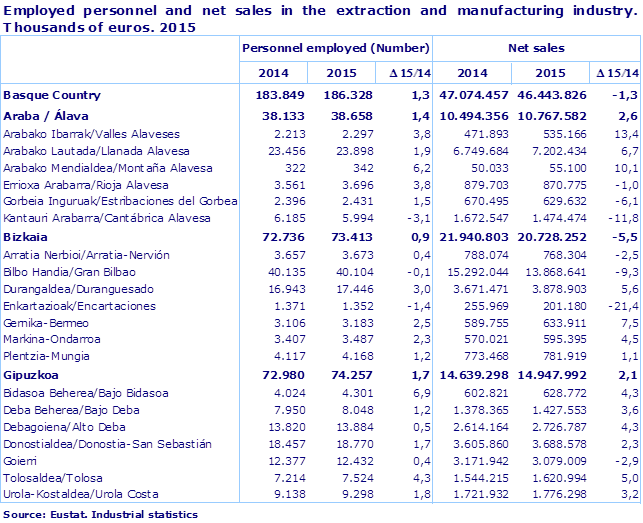
Distribution of personnel employed in the extraction and manufacturing industry by regions. 2015.

Source: Eustat. Industrial Statistics of the Basque Country
All of the regions in Gipuzkoa registered increases for people employed in 2015 which fluctuated from 6.9% in Bajo Bidasoa to 0.4% in Goierri; in Tolosa the figure stood at 4.3%, in Urola-Costa 1.8%, and 1.2% and 0.5% in Bajo Deba and Alto Deba, respectively. 1.7% of manufacturing and extraction employment was gained in the region of Donostia-San Sebastián, which accounts for 25% of the territory's overall employment in this sector.
In Alava, all of its regions, except for Cantábrica Alavesa which contracted by 3.1%, indicated employment growth above the average for the province. Worthy of mention were the rises in Montaña Alavesa with 6.2% and Valles Alaveses and Rioja Alavesa, both with 3.8%. To a lesser degree, although also positive, Estribaciones del Gorbea offered a rise of 1.5%. In Llanada Alavesa, the region which accounts for 62% of workers employed in these sectors, the rise in the employed population stood at 1.9%.
Lastly, the majority of the regions in Bizkaia revealed positive employment growth in the manufacturing and extraction industry between 2014 and 2015. The greatest increases were in the regions of Duranguesado, with 3%, Gernika-Bermeo, with 2.5%, and Markina-Ondarroa, with 2.3%. Further behind were the increases in Plentzia-Muncia (1.2%) and Arratia-Nervión (0.4%). In Gran Bilbao, where 55% of employment in the province is located, the figures stayed practically the same as the previous year. In negative terms, Encartaciones saw employment fall by 1.4%.
The evolution of the net turnover figure (sales) in the manufacturing and extraction industry in 2015 was positive for thirteen of the twenty regions in the Basque Country. Valles Alaveses and Montaña Alavesa, with growth above 10%, are the regions that have most increased their sales compared to 2014, with the former returning a figure of 13.4% and the latter, 10.1%, followed by Gernika-Bermeo with 7.5%. In turn, seven regions show negative evolutions, with Encartaciones (-21.4%) and Cantábrica Alavesa (-11.8%) with the highest falls.
The Basque extraction and manufacturing industry as a whole posted a negative variation in sales regarding the previous year, of -1.3%.
By province, in Alava the evolution was positive overall (2.6%) although with differences according to the regions: The growth in Valles Alaveses, 13.4%, Montaña Alavesa, 10.1% and Llanada Alavesa, 6.7%, which concentrates 67% of sales in the province, compensated for the negative evolutions for the other regions: Cantábrica Alavesa dropped by 11.8%, Estribaciones del Gorbea by 6.1% and Rioja Alavesa by 1.0%.
The progression in Gipuzkoa was also positive, by 2.1% in 2015. All of its regions, except Goierri, obtained positive year-on-year figures, with the 5% growth in Tolosa particularly standing out. Alto Deba and Bajo Bidasoa increased their sales to the same degree, 4.3%, whereas Bajo Deba and Urola Costa did so by 3.6% and 3.2%, respectively. Goierri, however, saw its sales fall by 2.9%. In the region of Donostia-San Sebastián, with 25% of sales in the province, the evolution was equally positive, standing at 2.3%.
In contrast, Bizkaia is the only province to produce a negative performance in its sales, with a drop of 5.5%. Encartaciones, -21.4%, Gran Bilbao, -9.3%, and Arratia-Nervión, -2.5%, are the three regions in this province with negative year-on-year variations. Gernika-Bermeo posted a 7.5% increase in sales, which also in creased in Duranguesado by 5.6% and in Markina-Ondarroa by 4.5%. Plentzia-Mungia also posted a rise, although this was less pronounced at 1.1%. Gran Bilbao accounted for 67% of sales in the province, followed by Duranguesado, with 19%.
Methodological note:
The sectorisation used is the National Classification of Economic Activities (CNAE-2009), with the B (extractive industries) and C (manufacturing industries) being the only sections included in this disaggregation by regions.
For further information:
Eustat - Euskal Estatistika Erakundea / Instituto Vasco de Estadística
C/ Donostia-San Sebastián, 1 01010 Vitoria-Gasteiz
Press Service: servicioprensa@eustat.es Tel: 945 01 75 62