Press Release 31/05/2016
Around 50% of the primary sector of the Basque Country had ICT equipment in 2016
Establishments of 10 or more employees in the Basque primary sector had ICT equipment similar to other activity sectors
Around 50% of the primary sector of the Basque Country disposed of ICT -Information and Communication Technology- equipment in 2016, according to data prepared by EUSTAT.
However, the ICT equipment in the primary sector of the Basque Country is still far removed from other sectors of the Basque economy in 2016, with the exception of the mobile telephone (85.2%). The availability of computers (53.1%), email (46.0%) or Internet access (51.1%) is less widespread than in other activity sectors. Regarding businesses that have a web presence through a website or that engage in e-commerce, these represent 6.1% and 3.9% of the total, respectively, when the total average of the sectors is 49.9% and 25.6%.
These lower utilisation percentages are due to the small size of the majority of these business establishments (85.2% have 2 employees or fewer), which makes it hard for many of them to gain access this equipment.
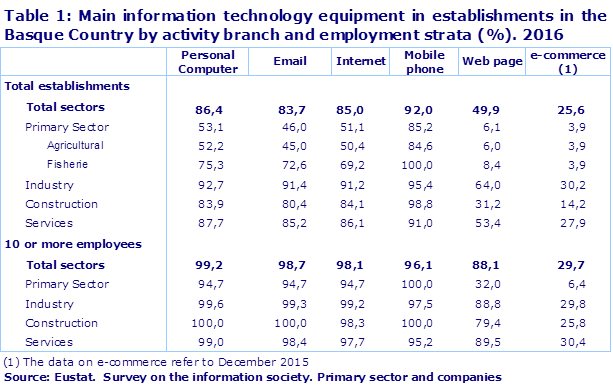
This situation varies quite substantially if we take into account the size of the establishments. Establishments of 10 or more employees in the primary sector within the Basque Country had basic ICT equipment similar to other activity sectors As such, in companies with 10 or more employees, average equipment reached 100% for those with a mobile telephone and 94.7% for those that had a computer, e-mail or Internet. Even so, percentages for non-essential equipment, e.g. websites (32.0%) and e-commerce (6.4%), were lower than for other activity sectors
Fishing companies have more ICT equipment than agricultural companies
It is worth noting that, in the primary sector, very different percentages were recorded for agricultural companies and fishing companies, with the latter having much higher equipment percentages. Nevertheless, fishing companies have practically no impact on the primary sector total seeing as the figure for these companies was merely 3.6%.
Whilst 84.6% of agricultural companies had access to a mobile telephone, 52.2% to computers, 45.0% to e-mail and 50.4% to Internet, 100% of companies in the fishing sector had access to a mobile telephone, 75.3% to computers, 72.6% to e-mail and 69.2% to Internet. 6.0% of agricultural establishment had a website, the figure being 8.4% for fishing establishments, and 3.9% of both fishing and agricultural establishments performed e-commerce.
In the agricultural sector, it is worth mentioning forestry, which reached similar equipment levels, indeed occasionally higher than those reached by the fishing sector. This is partly due to the fact that this activity branch is home to a greater proportion of establishments with 10 or more employees than the other agricultural branches.
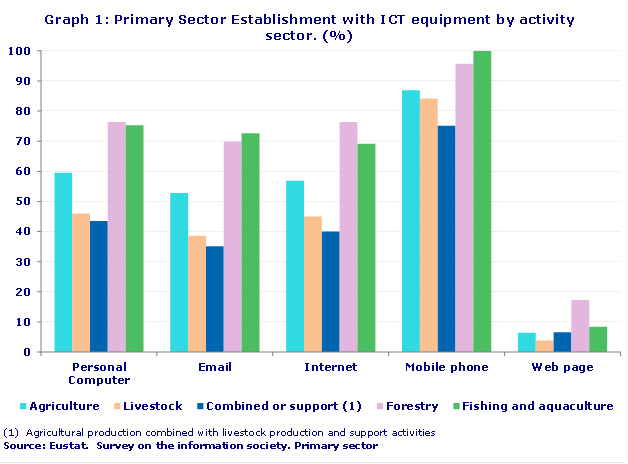
These differences are not only due to different activities, but also because the size of the establishment continues to play a role. Whereas nearly all the establishments in the agricultural sector have fewer than 10 employees, the fishing sector has a greater distribution of establishments with fewer than 10 employees or 10 employees or more.
Of those establishments with Internet access, 82.6% have fixed connections and 75.9% have mobile connections. In those establishments with fixed connections, and, as in the case of the other sectors, ADSL lines are the most common, with 62.6% of said establishments having one. The next most common connections are (fibre optic) Cables, 16.4%, followed by Other Connections, 10.6%. These latter connections primarily constitute broadband wireless connections, for instance Wimax, for improved Internet access in rural areas, and satellite connections in the fishing sector.
As for the mobile connections used in this sector, 72.5% of establishments use a mobile telephone and 31.5% use a broadband modem.
Lastly, 68.9% of primary sector establishments used the Internet to carry out some kind of procedure or service with the Public Administration in 2016. This percentage rises to 83.2% if we solely take into account establishments with 10 or more employees from this sector.
Methodological note: From this edition onwards, the Information Society Survey -ESI- primary sector has specifically targeted establishments whose main activity is within the primary sector, differing from previous editions that also included units for which this activity was secondary or which simply owned agricultural assets, meaning the data is not comparable.
For further information:
Eustat - Euskal Estatistika Erakundea / Instituto Vasco de Estadística
C/ Donostia-San Sebastián, 1 01010 Vitoria-Gasteiz
Press Service: servicioprensa@eustat.eus Tel: 945 01 75 62
Further press releases on the Survey on the information society. Primary sector