Press Release 24/02/2016
Exports from the Basque Country fell by 3.5% in the fourth quarter of 2016
The balance for 2016 closed with a positive foreign trade balance that has increased since 2015, registering a surplus in excess of 6 billion euros
Exports from the Basque Country posted a nominal decrease of 3.5% in the fourth quarter of 2016, according to EUSTAT data. They stood at 5.530 billion euros compared to 5.728 billion the previous year. Exports of both energy and non-energy products registered downturns of 1.9% and 3.6%, respectively, this quarter.
Imports, for their part, posted a rise of 0.1% in the final quarter of 2016, going from 4.175 to 4.177 billion euros, as a direct result of the increase of 3.7% in energy products. Meanwhile, imports of other products fell by 1.1%.
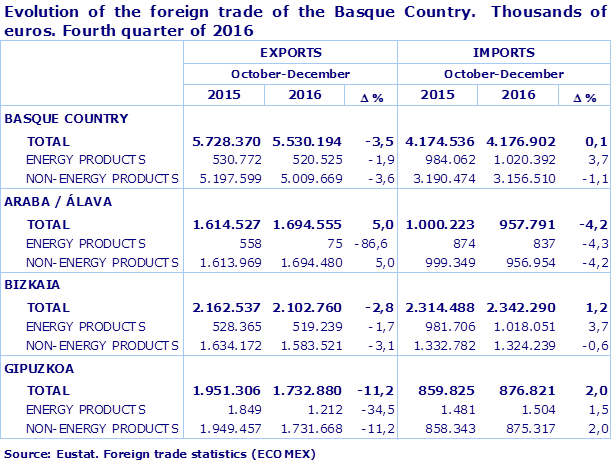
The net balance was positive and showed a trade surplus of 1.353 billion euros, with a coverage rate of exports over imports of 132.4%. If energy products are excluded, the non-energy trade balance registered a surplus of 1.853 billion. The non-energy coverage rate stood at 158.7%.
Exports destined for the European Union were down 5.2%, compared to the same period of 2015, representing 64.1% of the total exported. Special mention should be made of the increases in exports to Portugal (2.7%) and Belgium (2.4%). However, there were declines in exports to Germany (-4.2%), France (-6.8%), the United Kingdom (-12.2%) and Italy (-16.6%). Outside the EU28, it is worth mentioning the increases in exports to Morocco (66.8%), China (28.4%) and Mexico (15.0%).
Imports from the European Union fell by 6.6%, largely as a consequence of the decreases registered in imports from France (-8.9%), the Netherlands (-18.3%) and the United Kingdom (-32.0%). Those from Germany remained stable (0.1%), whilst imports from Ireland rose by 3.5%. From the rest of the world, there were significant increases in energy related imports from Iraq (242.6%), Mexico (99.2%) and Russia (21.4%). The United States also posted an increase (14.1%), though there was a drop of 13.9% in imports from China.
By customs duty groups, and in relation to exports, special mention should be made of the downturn in Metals & Manufactured (-12.2%), Electrical Material (-8.3%) and Mineral Products (-3.1%). On the other hand,Transport Materialposted a rise of 4.2%. Analysing imports, it is worth mentioning the increases in Electrical Material (7.5%) and Mineral Products (1.2%), and the decreases in Metals & Manufactured (-6.1%) and Transport Material (-4.9%).
By province, Álava saw a rise in exports of 5.0%, mainly due to the increase in Transport Material (16.2%). Imports to Álava registered a drop of 4.2%.
Exports from Bizkaia fell by 2.8% as a result of the decrease in Metals & Manufactured (-7.4%) and Transport Material (-14.5%), among others. Imports were up 1.2%, with Electrical Materialposting significant growth (22.1%).
Gipuzkoa registered the highest downturn in exports in the three provinces (-11.2%), as a result of decreases in its three key customs duty groups, Transport Material (7.6%), Electrical Material (-14.1%), and Metals & Manufactured (-15.8%). However, imports increased by 2%, with Paper and Manufactured posting a significant rise of 29.9%.
FOREIGN TRADE BALANCE IN 2016
In 2016, both exports from and imports to the Basque Country fell. Exports were down 1.6% and imports 8%, but, following the pattern initiated in 2013, with a higher foreign trade balance than the previous year and a surplus of 6.112 billion euros (1,662 more than in 2013).
Exports stood at 21.596 billion in 2016, that is to say, almost 360 million less than in 2015, which is a decrease of 1.6%. On the other hand, exports of non-energy products remained positive, posting an increase of 1.7%.
Imports stood at 15.484 billion euros, a fall of 1.338 billion on 2015, representing an 8% decrease. If non-energy imports are taken into account, we find they have remained stable (0.2%).
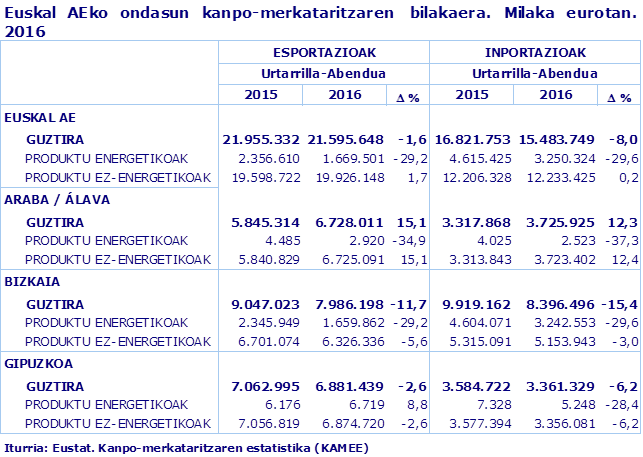
By province, the trends both trade flows varied in 2016. Both flows grew in Álava and Gipuzkoa, whereas the opposite occurred in Bizkaia. Exports increased in Álava by 15.1%. Exports were down by 11.7% in Bizkaia and by 2.6% in Gipuzkoa. As regards imports, Álava was up by 12.3%, whereas Bizkaia fell by 15.4% and Gipuzkoa by 6.2%.
By geographical area, an increase of 0.7% was registered in exports to the European Union. However, there was an 8.1% decrease in imports from the European Union. Exports to Belgium (11.9%) and Germany (4.4%) rose significantly, as did imports from Germany (9.5%) and Italy (3.5%). There was a fall in imports from France (-8.9%) and a marked decrease in those from the United Kingdom (-51.7%).
Regarding other countries, there were increases in exports to Morocco (43.7%), China (20.0%), Turkey (9.0%) and Mexico (6.6%), and a fall in exports to the United States (-10.5%). As regards the opposite trade flow, there was an increase in Russian energy imports (33.4%) and an 11.1% fall in those from China.
For further information:
Eustat - Euskal Estatistika Erakundea / Instituto Vasco de Estadística
C/ Donostia-San Sebastián, 1 01010 Vitoria-Gasteiz
Press Service: servicioprensa@eustat.eus Tlf: 945 01 75 62
Further press releases on Foreign trade statistics (ECOMEX) of the Basque Country
Database on Foreign trade statistics (ECOMEX) of the Basque Country