Press Release 23/11/2016
The GDP of the Basque Country registered 3.0% year-on-year growth in the third quarter of 2016
Over 16,000 net jobs were created on average during the first three quarters of 2016 compared with the same period of the previous year
The GDP of the Basque Country posted growth of 3.0% in the third quarter of 2016, compared to the same quarter of the previous year, according to Eustat data. With regards to the previous quarter, the variation was 0.6%. This data confirms the yearly and quarterly rates provided in the Advance quarterly accounts for 27 October.
Growth in the Basque economy in the third quarter of 2016 was two tenths lower than growth registered by the Spanish economy in annual terms, but was 1.4 percentage points higher than the growth of the Eurozone-19 (+1.6%).
From the point of view of supply, year-on-year GDP growth was due to the positive performance of both the industrial sector and the services sector. The construction sector, for its part, once again posted positive figures, while the primary sector posted slightly negative rates.
In more detail, the Industry sector posted, in this quarter, a positive year-on-year growth rate of 2.9%, which is five tenths higher than that of the second quarter. This year-on-year growth shows a growth rate of 1.4% compared to the previous quarter. The Manufacturing Industry grew at a rate two tenths higher (3.1%), with a positive quarter-on-quarter rate of 1.5%.
The Construction sector managed to maintain positive growth rates, though growth was more moderate than during the previous quarter: 1.9% growth compared with a figure of 2.7% for the second quarter. This lower annual growth resulted in a quarter-on-quarter growth rate of 0.2%.
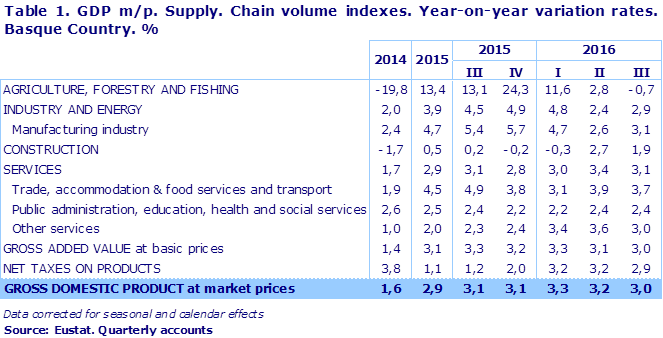
The Services sector underwent year-on-year growth of 3.1%, slightly less than the previous quarter (3.4%). However, all sub-sectors experienced upturns. The branches of both Trade, Hotel Management & Catering and Transport and Other Services, which includes, amongst others, professional, financial and insurance activities, posted higher growth rates, specifically 3.7% in the first branch and 3.0% in the second. The first of the two branches registered a decrease of two tenths from the annual rate of the second quarter, while the smallest growth in Other Services was six tenths. The branch of Public Administration, Education, Health and Social Services posted a positive annual rate of 2.4%, which is identical to the rate posted the previous quarter.
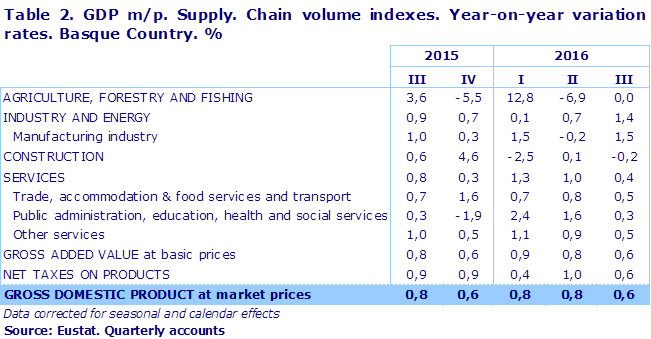
In terms of quarter-on-quarter variation, all sub-sectors posted positive growth rates, and these rates were identical in the branches of Trade, Hotel Management & Catering and Transport and Other Services, at 0.5%. The branch of Public Administration, Education, Health and Social Services also grew by 0.3% in relation to the previous quarter.
The aggregated performance by sector has given rise to a 3.0% upturn in Added Value in year-on-year terms. This is a fall of one tenth from the year-on-year figure for the previous quarter. There was also a 0.6% rise in the quarter-on-quarter rate.
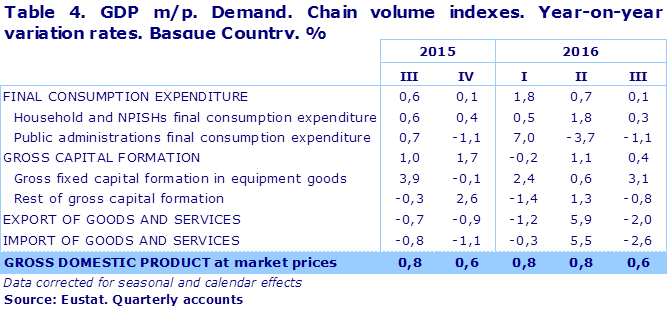
In terms of demand, it is worth noting that Internal Demand maintained a steady rate of growth at 2.7% in year-on-year terms, even though this annual rate is lower than the rate recorded for the previous quarter. This slowing down of growth is reflected in two components, Final Consumption Expenditure and Gross Capital Formation. With regards to the foreign sector, it should be noted that it has made a slightly positive contribution to growth, resulting in higher annual import rates than export rates - even though both rates were lower than the figures for the previous quarter.
Final Consumption Expenditure of Households (Private Consumption) saw a 3.1% annual rate of growth, which is three tenths lower than the rate for the second quarter. This slowing down of annual growth has resulted in a quarter-on-quarter growth rate of 0.3%.
Public Consumption (Final Consumption Expenditure of Public Administrations) grew by 0.8% in year-on-year terms, which means a quarter-on-quarter decline of 1.1%.
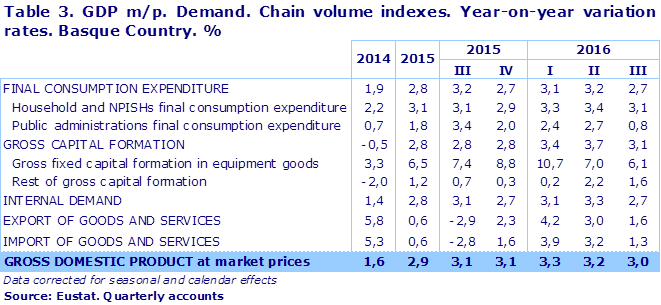
The overall performance of the Final Consumption Expenditure of Public Administrations combined with the Final Consumption Expenditure of Households led to an upturn of 2.7% in Final Consumption Expenditure. With regards to the previous quarter there was an upturn of 0.1%.
Gross Capital Formation (Investment) grew at a positive year-on-year rate of 3.1%, and at a quarter-on-quarter rate of 0.4%. Once again this overall performance of investment was based on two trends of different intensity. The variation of investment in capital goods showed a more positive trend, with a year-on-year growth rate of 6.1%, which equates to a quarterly increase of 3.1%. The rest of Gross Capital Formation, which is more closely related to trends in the construction sector, posted a year-on-year growth rate of 1.6%, with a decrease of 0.8% in the quarter-on-quarter rate.
With regards to employment (measured as Full-time Equivalent Jobs), there was an overall increase of 1.8% in year-on-year terms, which gives us the same annual rate as the previous quarter. This year-on-year rate means a 0.2% growth with respect to the second quarter of 2016.
Variation in the level of employment with respect to the same quarter of the previous year was positive in the Industry and Services sectors, negative in the Primary sector and steady in Construction. The Services sector stands out for its total volume of employment, whose annual rate grew by 2.0%. The Industry sector consolidated a year-on-year growth of a rate of 2.0%. It is also worth mentioning that it is the first year-on-year rate recorded in the Construction sector since the first quarter of 2008 that was not negative. The Primary sector, however, decreased by 1.4% in year-on-year terms.
As for the quarter-on-quarter rate, this once again underwent the same trend as the annual rate. Industry posted a positive rate of 0.9%, with Construction and Services also posting a positive rate, albeit of 0.1%. The Primary sector shrank by 3.6%.
Regarding variation in GDP by Province, Álava showed the largest growth in year-on-year terms, at 3.3%, while Gipuzkoa grew by 3.0% and Bizkaia by 2.8%. In quarter-on-quarter terms Álava was up by 1.1%, Gipuzkoa by 0.7% and Bizkaia by 0.4%.
For further information:
Eustat - Euskal Estatistika Erakundea / Instituto Vasco de Estadística
C/ Donostia-San Sebastián, 1 01010 Vitoria-Gasteiz
Press Service: servicioprensa@eustat.eus Tlf: 945 01 75 62
More press releases on the quarterly accounts of the Basque Country (CET)
Quarterly accounts of the Basque Country. Databank (CET)