Press Release 31/08/2016
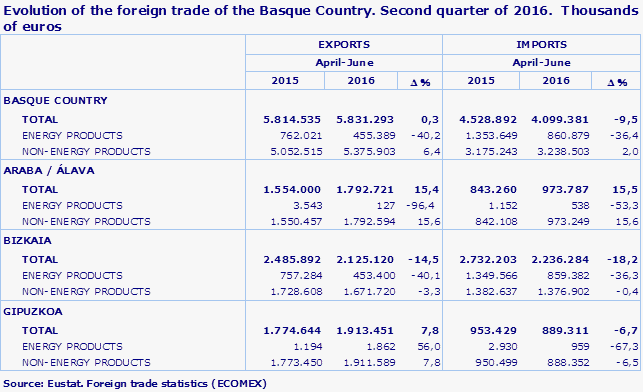
Total exports of goods from the Basque Country grew by 0.3% in the second quarter of 2016, and non-energy exports grew by 6.4%
Since the start of the crisis, exports of Metals & Manufactured lost ground whereas those of Transport Material grew
Exports of non-energy products from the Basque Country increased by 6.4% in the second quarter of 2016, whereas total goods exports were up 0.3%, according to data provided by EUSTAT. They totalled 5.831 billion euros compared to 5.815 billion in the same quarter of the previous year.
Imports of non-energy products from the Basque Country increased by 2.0%, whereas total goods imports declined by 9.5%, due to the 36.4% decrease in energy imports.
The net trade balance was positive and showed a trade surplus of 1.732 billion euros, with a coverage rate of exports over imports of 142.2%. If energy-related products are excluded, the non-energy trade balance generated a surplus of 2.137 billion, which is equivalent to a coverage rate of 166% for these products.
Exports destined for the European Union were up by 5%, representing 66.1% of the total exports. The main European destinations for these exports were Germany (7.9%) and France (3.4%), and the exports that saw the largest increases were those to Finland (263.2%), Romania (143.1%) and Poland (27.8%). On the other hand, those to Italy and the United Kingdom fell by 9.9% and 6.7%, respectively. Among exports to non-EU countries, Morocco (63.5%) and Japan (411.5%) saw the largest increases, and those to the United States saw the most significant decrease (15.0%).
Imports from the European Union were down 5% as a result, in large part, of the decreases in imports from the United Kingdom (-38.6%), the Netherlands (-24.5%) and France (-5.6%). On the other hand, there were increases in imports from Germany (9.8%), Portugal (35.1%) and Italy (13.1%), among others. There were also increases in other European countries such as Norway (65%) and Russia (31.1%), in clearly energy-related imports. As regards the rest of the world, imports from Nigeria, Iraq, Angola and Algeria were down, all of which were energy-related products. Those from the United States (63.4%), also energy-related, Japan (78.5%) and Brazil (111.8%) were up.
For customs duty sections, in terms of exports, there were significant increases in Transport Material (33.8%), accounting for almost a third of total exports, although there was also a noteworthy increase in Electrical Material (5.3%). These increases have essentially been cancelled out by the drops in Mineral Products (-40.6%) and in Metals and Manufactured (-13%). Looking at imports, it is worth noting the falls in Mineral Products (-36.1%), Metals and Manufactured (-11.4%) and Chemical Products (-16.6%), and the increases in Electrical Material (15.3%) and Transport Material (19.2%).
By province, Álava stands out with a 15.4% increase in exports, thanks to the strong growth in its main export product, Transport Material (+36.6%), which accounted for 57% exports for the quarter. Imports to Álava increased by 15.5% as a result of the upturns in Electrical Material (30.6%) and Transport Material (28.5%).
Exports in Bizkaia fell by 14.5% due to the drops in the exports of Metals & Manufactured (-19.3%) and Mineral Products (-40.7%). Growth in Electrical Material (8.8%), Transport Material (11.8%) and Plastics & Rubber (11.9%) exports offset this fall the most. Imports in Bizkaia saw an 18.2% reduction as a result of the significant drop in Mineral Products (-36.4%) and Metals & Manufactured (-9.9%). On the other hand, Electrical Material imports were up 27.1%.
In Gipuzkoa exports were up 7.8%. Transport Material (46.1%), Paper & Manufactured (16.9%) and Electrical Material (3.0%) were the sections that saw the largest growth. On the other hand, Metals & Manufactured and Plastics & Rubber suffered reductions of 7.4% and 17.1%, respectively. Imports to Gipuzkoa posted a negative fluctuation of 6.7%, the largest of which were in Metals & Manufactured (-16.8%) and Electrical Material (-8.3%).
Exports grew 1.3% overall in the first six months 2016, whereas imports were down 8.6%
In the accumulated rate for the first six months of 2016, exports from the Basque Country stood at 10.946 billion euros, 1.3% up on the first quarter of 2015. On the other hand, imports totalled 7.635 billion, which was a decrease of 8.6%.
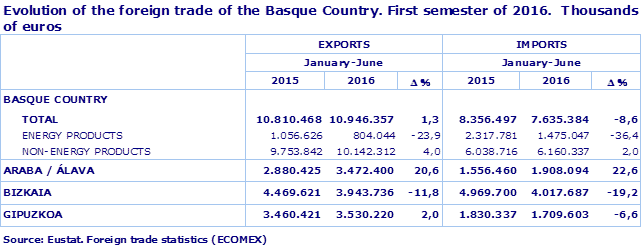
If we eliminate the energy component of both, we find growth of 4% in exports and 2% in imports.
The foreign trade balance for the first sixth months showed a surplus, with a positive trade balance of 3.311 billion, 857 million euros higher than the previous year. The non-energy foreign balance stood at 3.982 billion euros, which was an increase of 7.2%. The coverage rate of total exports over imports rose from 129.4% last year to 143.4% in 2016. The coverage rate of non-energy products was 164.6% for the first quarter of 2016 compared with 161.5% for the same period in the previous year.
Over the last eight years, since 2008, there has been a single significant change in the structure of Basque exports, a change which also occurs in the three provinces, but with different aspects: the decline in Metals & Manufactured, which went from 28.8% of total exports in 2008 to 21% in 2016 (a drop of 7.8 percentage points) was replaced with a larger share for Transport Material, which absorbed the decreases mainly in Cast Iron and Steel, going from 21.6% of total goods exports in 2008 to 29.5% in 2016 (gaining 7.9 points).
For further information:
Eustat - Euskal Estatistika Erakundea / Basque Statistics Institute
C/ Donostia-San Sebastián, 1 01010 Vitoria-Gasteiz
Press Service: servicioprensa@eustat.eus Tel: 945 01 75 62
Further press releases on Foreign Trade Statistics (ECOMEX) of the Basque Country
Databank on Foreign Trade Statistics (ECOMEX) of the Basque Country