Press Release 17/10/2016
The population of the Basque Country rated their satisfaction with life as high
There has been an improvement across all personal well-being indicators compared to the previous year
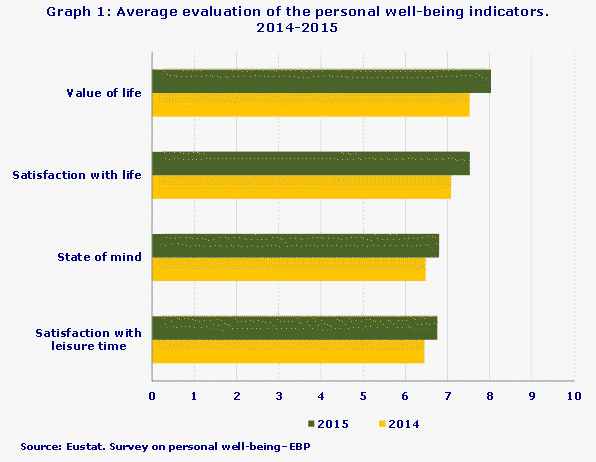
The population of the Basque Country scored "high" (7.5) for satisfaction with life in general compared with a figure of 7.1 for the previous year. This is according to Eustat data from the Survey on Personal Well-Being, an operation that provides information on the perception of well-being among the population of the Basque Country, and it does so through a series of questions that primarily measure aspects concerning quality of life aside from the material dimension.
The lowest score in the indicator for overall satisfaction with life (6.7) was recorded amongst unemployed people, even though there has been a significant increase from the figure of 5.9 for the previous year.
On the other hand, the highest score (7.8) obtained was for young people aged between 16 and 24, though this figure worsens with age. That said, the figure is on the up for those aged 65 and over, for whom the current score is 7.6.
No differences appeared between men and women, whereas at a provincial level, the best results were obtained from residents in Bizkaia (7.6) followed by residents of Gipuzkoa (7.5) and lastly residents of Álava (7.3).
Regarding place of birth, the lowest scores, below average, were given by people born in Álava (7.4) or abroad (7.2).
The Value of Life indicator received the highest score, 8
The value of one's own life, in other words the view that life is worthwhile, reached an average score of 8, with 70.7% rating it as “high”. This is higher than the figure of 56.1% for 2014, and contrasts to 1.9% of the population who considered it to be “low”.
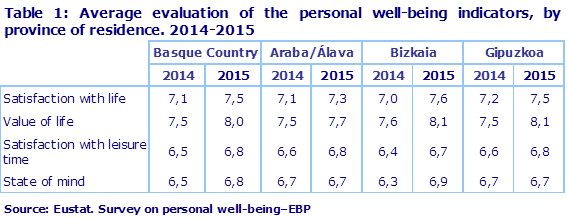
There were no differences between men and women in this instance either. Provincially speaking, however, Álava residents were the only people with a score (7.7) below the average, with Bizkaia and Gipuzkoa both scoring 8.1.
In terms of relation to activity, employed people and inactive people valued their life more (8.1), and unemployed people valued their life less (7.6).
State of mind amongst young people was better
The state of mind indicator, the average of which for the total population was 6.8, received a higher score among people aged between 16 and 24 (7), and was lower amongst unemployed people (6.3).
At provincial level, people resident in Bizkaia (6.9) had the highest score, as opposed to residents of Álava and Gipuzkoa, whose average reached 6.7. In terms of place of birth, once again it was people born in Bizkaia (6.9) who had a better state of mind, whereas those born abroad (6.6) had the lowest score.
The indicator obtained a higher score amongst men (6.9) than women (6.7).
Elderly people were the ones most satisfied with their leisure time
With an average Satisfaction with leisure time of 6.8, people aged 65 and over gave the highest score (7.9) whilst those aged 35 to 49 gave the lowest (6.1). Inactive people also gave a good score (7.6) compared with 6.1 for those in work.
There was no difference between men and women, although people residing in Bizkaia were slightly less satisfied (6.7) than people living in Álava and Gipuzkoa (6.8).
For further information:
Eustat - Euskal Estatistika Erakundea / Instituto Vasco de Estadística
C/ Donostia-San Sebastián, 1 01010 Vitoria-Gasteiz
Press Service: servicioprensa@eustat.eus Tel: 945 01 75 62
More press releases about the survey on personal well-being–EBP