Press Release 19/10/2016
The high technology sector accounted for 9.5% of added value generated in the Basque Country in 2014 and 8.6% of employed personnel
This sector accounts for 43.9% of companies and 66.7% of employed people who carry out R&D in the business sector
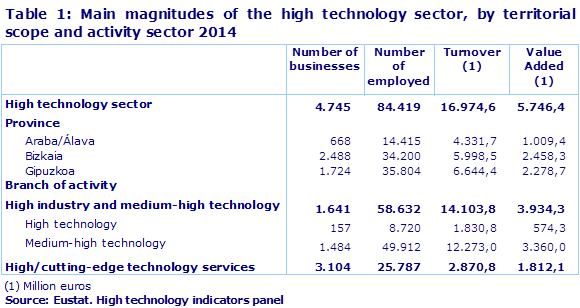
The high and medium-high technology sector, which covers all activities with a sound technological base and fast renewal of knowledge, comprised 4,745 companies with 84,419 jobs in the Basque Country in 2014, or 8.6% of the total Basque economy, according to data prepared by EUSTAT. Furthermore, it generated 9.5% of total added value (5,746.4 million), and posted a turnover figure of 16,974.6 million euros.
Compared with the previous tax year, the sector made up less of the economy as a whole in terms of employment (it accounted for 8.9% in 2013), even though the number of companies rose (by 27). This shows us that the average size of companies in this sector decreased, which, in 2014, amounted to 17.8 individuals. As for the turnover figure, it decreased by 1.2% in 2014 compared to the previous year.
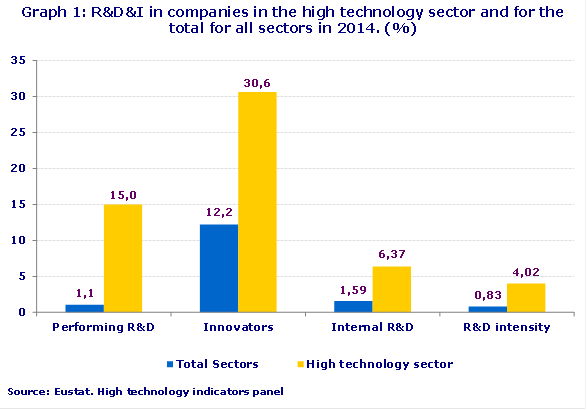
15.0% of companies in the high technology sector carried out R&D activities, a percentage that is far higher than the 1.1% of the total for all sectors. Furthermore, this sector, which represented just 3.1% of companies, accounted for 43.9% of those carrying out R&D and, with 670.7 million euros, it spent 69.3% of total expenditure on internal R&D in the business sector. This means that the proportion of total expenditure on this sector increased from 2014 by 0.4 percentage points.
With regards to people working in R&D in this sector, the figure for people in full-time work in 2014 stood at 8,986 (2,753 of whom were women), and 66.7% of these positions were provided by the business sector in R&D, or 48.5% if we take into account the positions provided by all the sectors. Going into further detail with regards to employment in this sector, there were 5,472 researchers in equivalent-to-full-time positions, of which 1,661 were women.
Regarding innovation, as with R&D, there were significant differences between the total for all sectors and for the high technology sector. In 2014, 30.6% of establishments in the high technology sector were innovators compared to 12.2% of the total for all sectors. If company size is taken into account, those with 10 or more employees recorded percentages of 54.3% in the first case and 27.5% for the total number of sectors.
Regarding expenditure on innovation, high technology establishments contributed 1,209.3 million euros, 48.9% of total expenditure. Of this expenditure, 1,081.6 million corresponded to establishments of 10 or more employees, which was 52.3% of the total spent by companies of this size.
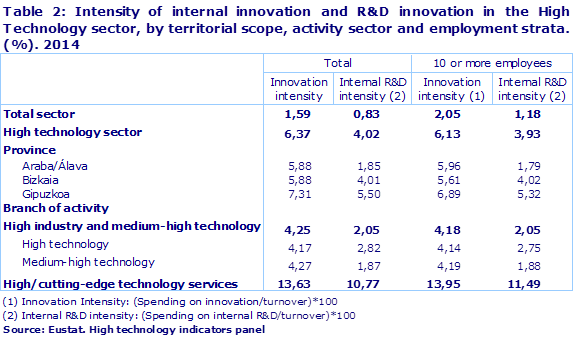
It was also clear that the high technology sector allocated a greater proportion of resources towards R&D&I than the other sectors upon observing the innovation and internal R&D intensity ratios, i.e. the amounts that this sector spends compared to the turnover figure. Specifically, innovation intensity in this sector was 6.37 compared to 1.59 over the economic sectors as a whole. In the case of internal R&D, the ratio was 4.02 for the high technology sector and 0.83 for the economy as a whole.
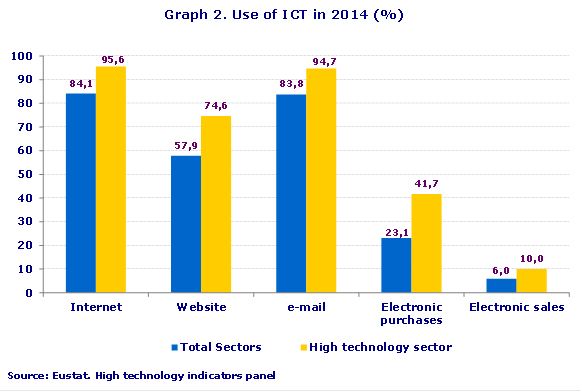
Whereas the use of ICT technology is extremely commonplace amongst the companies in this sector, e-commerce, although more developed than in all the other sectors, continued to have a modest implementation, above all in terms of sales. The establishments that made purchases via this method in the high technology sector accounted for 41.7% and those that carried out sales accounted for 10.0% compared to 23.1% and 6.0% respectively for the total of all sectors.
On the other hand, the impact of the high technology sector on the foreign trade of goods was not very significant. Whilst exports accounted for 843.6 million euros out of a total of 22,512.6 million, imports stood at 582.2 million out of the 17,135.6 million of total imports, accounting for 3.7% and 3.4% respectively.
Amongst the most common products in these exchanges, Machinery and Mechanical Equipment (47.4%), Electronic Material and Equipment (13,9%) and Manufacture of Aircraft and Spacecraft (13.0%) stood out in exports; and Electronic Material and Equipment (29.6%), Manufacture of Aircraft and Spacecraft (18.5%), Scientific Instruments (14.1%) and Machinery and Mechanical Equipment (13.4%) in imports.
Lastly, if we compare high technology sector data for the Basque Country with Spain as a whole, differences can be seen in the indicators observed. Thus, the percentage of innovating companies, intensity in innovation, the percentage of staff in R&D and the proportion of R&D expenditure are higher for this sector in the Basque Country, whilst in the use of ICT technologies, the percentages obtained are very similar.
Methodological note:
The sectors that belong to high technology are those that, given their degree of complexity, require a continuous effort of research and a sound technological base. The activities included in this sector, according to the CNAE 2009, are listed on the Eustat Website. Methodology file: High technology scoreboard
For further information:
Euskal Estatistika-Erakundea / Basque Statistics Institute
C/ Donostia-San Sebastián, 1 01010 Vitoria-Gasteiz
Press Service: servicioprensa@eustat.es Tel. 945 01 75 62
Further press releases on the High technology scoreboard