Press Release 28/10/2016
The Basque Country is at the same level as countries with high innovation according to the Innovation Union Scoreboard EIS 2016
For the first time in the dimension relating to the Research System, of the Basque Country is above the European average
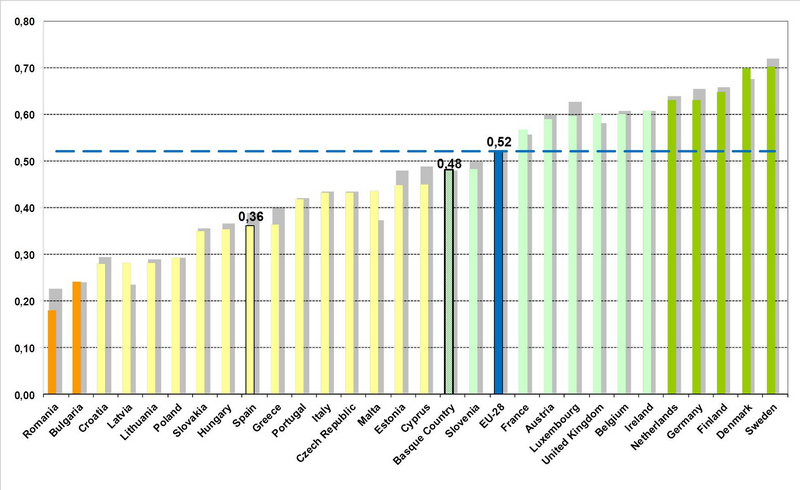
The European Innovation Union Scoreboard (EIS) 2016 - previously the Innovation Union Scoreboard (IUS) - stood at 0.482 for the Basque Country, according to data prepared by Eustat, meaning that it is at the same level as the group of countries with high innovation.
The EIS scoreboard is continuously revised - both its component indicators and its calculation formula - as every year the most up-to-date data on the countries is incorporated, requiring the entire series to be recalculated.
According to the EIS 2016, the Basque Country increased the value of its indicator in the last year (from 0.478 in 2015 to 0.482 in 2016), approaching the EU-28 average, and it maintains a gap of four hundredths, whilst beating Spain by twelve hundredths.
Graphic 1. European Innovation Union Scoreboard EIS 2016. Basque Country and EU-28
Source: Eustat and the European Commission
Note: The grey columns correspond to the values of the previous year, calculated according to EIS 2016
The EIS 2016 Innovation Union Scoreboard attempts to measure the extent to which countries' economies have the capacity to develop innovation activities. The EU-28 countries are grouped into four categories, according to the rating scored and their position in relation to the European average. In the first group, innovation leader countries, were those countries that scored a rating more than 120% of the average: they were Sweden (0.70), Denmark (0.70), Finland (0.65), Germany (0.63), and the Netherlands (0.63), although the country that was at the forefront of innovation in Europe was Switzerland (0.79).
In the second group, countries with high innovation, were those that achieved a rating of between 90% and 120% of the European average. In this case, in descending order, were Ireland, Belgium, the United Kingdom, Luxembourg, Austria, France and Slovenia, with scores between 0.61 and 0.48. The Basque Country, with a rating of 0.482, would be placed in this group, reaching 92.4% of the EU-28 average.
Following these, the third group, countries with moderate innovation (between 50% and 90% of the average) included Cyprus, Estonia, Malta, Czech Republic, Italy, Portugal, Greece, Spain and six other countries, with ratings between 0.45 and 0.28. Lastly, in the fourth group, countries with low innovation (under 50% of the average) were Bulgaria and Romania, obtaining 0.24 and 0.18 points respectively.
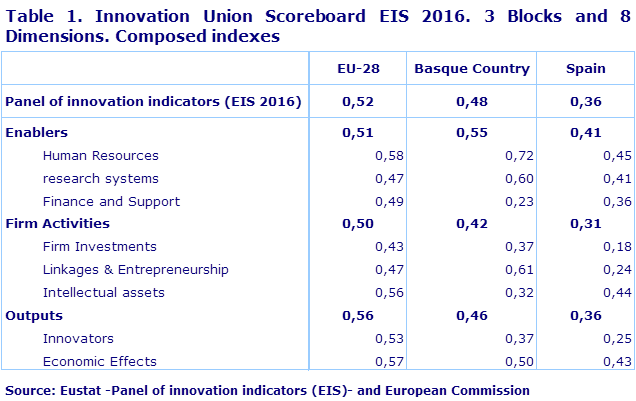
The EIS 2016 Innovation Union Scoreboard is structured into three main blocks, with eight dimensions, for a total of 25 indicators.
The Basque Country stands out in three of these dimensions compared to the European average; in two of those it was already standing out in previous editions - Human Resources and Linkages & Entrepreneurship - and for the first time it is clearly above average in Research Systems.
In Human Resources, a dimension that measures the availability of highly qualified and trained individuals as key information for innovation, in the Basque Country all three indicators stood out with respect to the European average: the “New doctorate graduates aged 25-34” stood at 2.02 per thousand in the Basque Country, while in the EU-28 it was 1.84 per thousand; the percentage of the "Population aged 30-34 with tertiary education" stood at 48.9%, with the community average standing at 38.5%; and the percentage of "Young people aged 20-24 with at least upper secondary education", was 86.7% for the Autonomous Region and 82.6% for the EU-28.
Regarding the level of openness, excellence and attractiveness of the Research System, a dimension that measures the international competitiveness of the scientific framework, the number of "International scientific co-publications per million inhabitants" stood out - 1,302 in the Basque Country compared to 459 in Europe - as did the percentage of "Scientific Publications most cited internationally" (excellent), 10.53% for the Basque Country and 10.51% for the EU-28. On the other hand, figures were lower for the indicator "Non-EU doctorate students amongst the total of doctorate students in the country", 14.9% in the Basque Country and 17.8% in the EU-28.
Regarding Linkages & Entrepreneurship, which takes into account the entrepreneurial efforts and collaboration in innovation with other companies and institutions, in the Basque Country the indicators that recorded the percentage of "SMEs with internal innovation" stood out, reaching 32.1% compared to 28.7% in the EU-28, and the percentage of "Innovating SMEs that collaborate in innovation" was 14.6% in the Autonomous Region compared to 10.3% in the European Union.
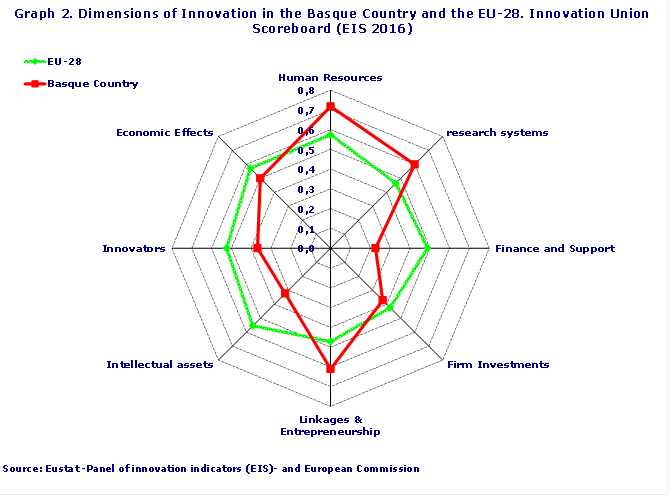
In two other dimensions, "Firm Investments" and "Economic Effects", the Basque Country has similar, though slightly lower, figures.
As far as Firm Investments is concerned, a dimension that measures spending on R&D and Innovation in the business sector, the “Private spending on R&D as a percentage over GDP” stood out, with 1.45% for the Basque Country and 1.30% for the European average. On the other hand, the “Non-R&D innovation expenditure” as a percentage of turnover stood at 0.41% in the Basque Country whilst in the EU-28 it stood at 0.69%.
For its part, in Economic Effects, a dimension that records the economic success of innovation on employment, exports and sales due to innovation activities, the Basque Country obtained better results than the European average in "Sales of new-to-firm and new-to-market innovations". However, the other indicators of this dimension, "Employment in knowledge-intensive activities" "Medium and high-tech product exports", "Knowledge-intensive services exports" and "Licence and patent revenues from abroad" registered lower figures in the Basque Country.
In the two remaining dimensions, Finance & Support and Intellectual & Innovative Assets, the rating was clearly lower than the European average. Nevertheless, the indicator "SMEs with product or process innovations" performed well, as here the Basque Country obtained a better result. In the rest, "Public Expenditure on R&D", "Availability of Risk Capital", “PCT Patent Applications”, "EU Trademarks", “EU Designs” and "SMEs with marketing or organisational innovations" the values obtained were lower than the European average.
European Innovation Scoreboard, EIS 2016
http://ec.europa.eu/growth/industry/innovation/facts-figures/scoreboards/index_en.htm
For further information:
Eustat - Euskal Estatistika Erakundea / Instituto Vasco de Estadística
C/ Donostia-San Sebastián, 1 01010 Vitoria-Gasteiz
Press Service: servicioprensa@eustat.eus Tlf: 945 01 75 62
Further press releases on Panel of innovation indicators (EIS)