Press release 27/09/2016
The population of the Basque Country was up by 3,362 individuals in 2015 due to migrations
The foreign migratory balance was again positive
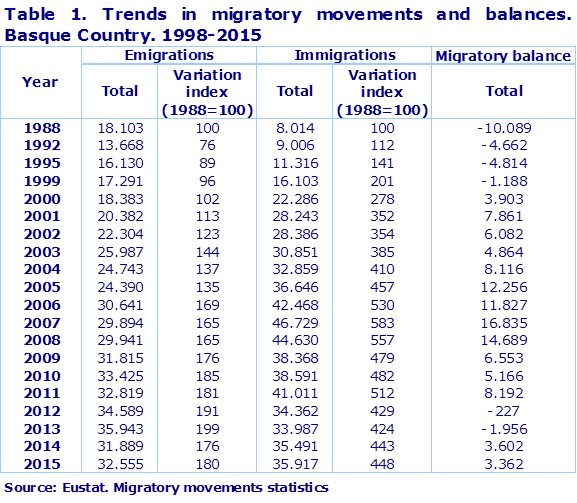
In 2015 a positive migratory balance was posted in the Basque Country. To be precise, 3,362 more people came than left, a slightly lower figure than the 3,600 in 2014, according to Eustat data.
By province, Gipuzkoa, which gained 1,782 people, recorded a higher migratory balance in absolute figures; Bizkaia had a positive balance of 941 people and Álava gained 639 people due to migration. The municipality of Bilbao had a migratory balance of 1,090 people, Vitoria-Gasteiz of 766 and San Sebastián of 547 people.
With regards to movements between the Basque Country and the other Autonomous Communities, in 2015 the positive trend that started in 2008 continued, with a positive balance of 947 people. However, nationality produces different trends: if we take into account Spanish nationals, the migratory balance was negative by 440 people; on the other hand, if we refer to foreign nationals, the migratory balance was positive by 1,387 people.
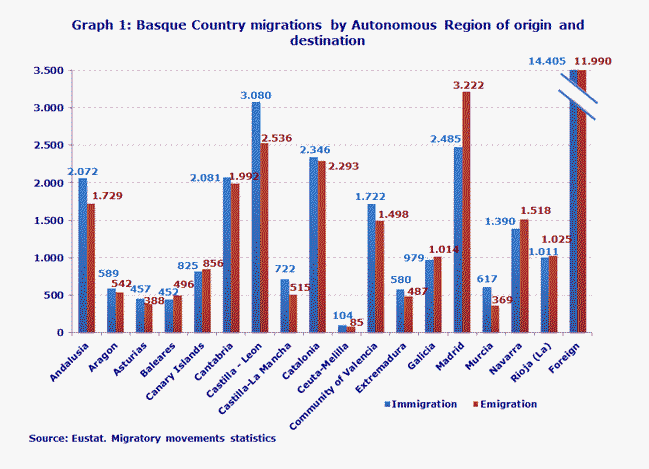
The balance with foreign countries was positive, by 2,415 people, i.e. there were more cases of immigration to the Basque Country from abroad registered than of emigration to foreign countries. The previous year the balance had been negative, by 2,207 people. Once again, the nationality variable played an important role: the balance of Spanish nationals in foreign countries was negative by 1,285, whilst that of other nationalities was positive by 3,700.
Emigration rates continued to be relatively low
In 2015 external or extra-community geographical mobility involved 32 per thousand inhabitants of the Basque Country and was 5 points below the other Spanish Autonomous Communities, where 37 inhabitants per thousand moved on average. By provinces, Álava reached 36.9‰, Gipuzkoa stood at 31.7‰ and Bizkaia fell to 29.9‰.
With the exception of the Autonomous Communities of La Rioja, the Canary Islands, Galicia, the Balearics and Madrid, with which the Basque Country maintained a negative migratory balance, the others contributed more population to the Basque Country than they received from it.
The Communities that contributed the most immigrants were, in first place, Castilla y León, followed by Madrid, Catalonia, Cantabria, Andalusia and Comunidad Valenciana.
The Autonomous Communities that attracted the emigrants from the Basque Country were as follows, in order: Madrid, Castilla y León, Catalonia, Cantabria, Andalusia and Navarra. Between them they received 65% of the people who left this Community for other Autonomous Communities.
The average age of the emigrants (36.4 years old) was slightly higher than that of the immigrants (33.5 years old). In both cases half of the migrations were by the 20-39 age group.
If gender is taken into account, 51% of immigrants were men and 49% women, whilst the difference between the sexes was higher in the case of emigrants: 54% men and 46% women.
Half of all immigrants and more than a third of emigrants were foreign nationals
The immigration of foreign nationals was registered at 18,709 in 2015 and, of those, 6,947 arrived in the Basque Country from other Autonomous Communities, primarily from Catalonia, Madrid, Andalusia, Comunidad Valenciana, and Castilla y León, and another 11,762 came directly from abroad.
The emigration of foreign nationals rose to 13,622. Almost half of those who left this Community were foreign nationals: specifically 42% of all emigrants. The destination for 59% of them was abroad.
Almost 70% of the changes of residence among the Basque population occurred within the Autonomous Community of the Basque Country itself
9.9% of the Basque population changed their place of residence in 2015, with the mobility on 68% of the occasions being within the Basque Country, whilst in the other cases the mobility was extra-community. These figures are almost identical to those from 2014.
In total, 215,929 changes of normal places of residence were recorded in the Basque Country. Of these, 97,219 were changes of address within the same municipality. Intra-community mobility, in other words, where the origin and destination are different municipalities of the Basque Country, increased to 50,238 movements.
There were also 35,917 cases of extra-community or external immigration, which are those that have their origin outside the Autonomous Community and where the destination is the Basque Country. Of these cases, 14,405 came from abroad.
Finally, there were 32,555 cases of external or extra-community emigration; in other words, residential variations originating in a municipality of the Autonomous Community and with the destination outside it. 11,990 of these were to destinations abroad, meaning a decrease of 20% with respect to the 2014 figures, even though, as previously indicated, the foreign migratory balance was again positive.
For further information:
Eustat - Euskal Estatistika Erakundea / Instituto Vasco de Estadística
C/ Donostia-San Sebastián, 1 01010 Vitoria-Gasteiz
Press Service: servicioprensa@eustat.es Tlf: 945 01 75 62
Online press releases about migratory movements statistics iin the Basque Country
Databank on migratory movements statistics in the Basque Country