Press Release 31/05/2016
A third of the working population states that they have great difficulty balancing work with caring for children and dependents
Even so, a third of employed individuals also enjoyed a flexible timetable for leaving work
One in three working people in the Basque Country (32%) state that they have great difficulty balancing work with caring for dependants and a similar percentage (31.2%) with looking after young children, according to Eustat data. This high degree of difficulty is also perceived by 4.4% of working people when it comes to reconciling work with carrying out personal activities.
Furthermore, it should be pointed out that men experience greater difficulty in balancing work with caring for children, since 72.7% state having a medium or high degree of difficulty as opposed to 62.8% of women.
Women who work outside the home and have children under the age of 15 dedicate 4.5 hours per day to their care, whereas men in the same situation only spend 2.9 hours per day. This difference is less pronounced in the case of caring for dependents, an activity to which men dedicate 1.5 hours per day and women, 2.1 hours, whenever they are responsible for a dependent.
Half of working women dedicate a greater number of hours, 5 or more, to caring for children.. Up to 14.7% dedicate the same time to caring for dependents. In turn, and on the contrary, almost half of working men collaborated with 2 hours or less looking after their children.
In comparison with data from 2010 it is apparent that the percentage of women who dedicate a large number of hours - 5 or more - to caring for their children is maintained, whereas the percentage corresponding to dependent persons has fallen from 36.6% in 2010 to 14.7% in 2015.
The distribution of domestic tasks amongst working men and working women in the Basque Country is also imbalanced: nine out of ten men -91.3%- dedicate 2 hours or less to those tasks, whilst three out of ten women -28.3%- dedicate 3 hours or more.
This uneven distribution of functions means that a significant percentage of working women (14.9%) are very unsatisfied with the collaboration offered by their spouse or partner in carrying out domestic tasks. On the other hand, a large majority of working men (70.4%), were, by contrast, very satisfied with the housework done by their partners.
However, it is worth mentioning that working women expressed greater satisfaction from looking after their children -60% expressed a high level of satisfaction - and even from household tasks - 44.9% claimed a high level of satisfaction - than working men, who dropped in the first case to 49.2% and in the second to 41.3%.
A significant part of the working population has to dedicate more hours to work then those established or planned: 20.1% sometimes and 17.5% nearly always. This prolongation of the working day affects men more than women, since 21.1% of men in work sometimes extend their working day and 19.6% nearly always do so, whereas for women in work these percentages are 18.9% and 15%, respectively.
The flexible timetable for leaving work, another supplementary solution for improving conciliation, is enjoyed by a third of working people. As regards working from home, 7.9% of working people work sporadically from home and 4% at least half of the time.
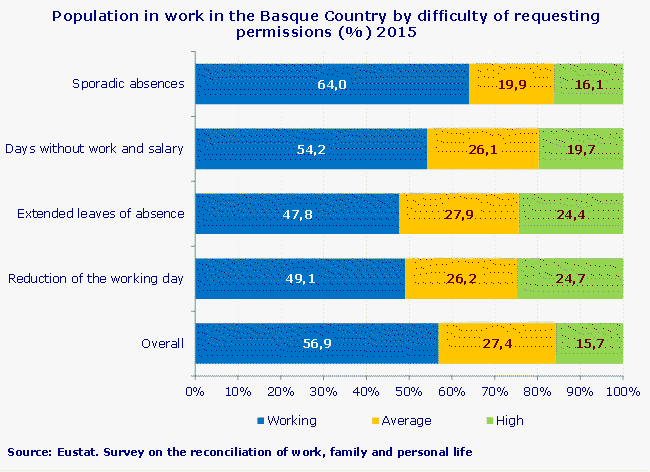
Within the various methods that could make the conciliation of work, family and personal life easier, short-term leave was within reach of the large majority of the working population, followed by the possibility of requesting unpaid days leave, possible for 54.2%. Furthermore, approximately half of the working population states that they encounter little difficulty in obtaining extended leaves of absence or a reduction in working hours.
The fear that requesting leave or reduced hours would affect career options was slightly greater amongst women than amongst men (29.1% and 27.6% respectively). Notwithstanding, maternity could create promotion inequalities for 18.9% of working women, whilst just 8.8% of men were of the opinion that paternity could seriously affect them. Nevertheless, one in five working men believed that it would be highly detrimental to their professional career to request paternity leave.
In relation to the work preferences of the working population, salaried positions are preferred (83.1%) to being self-employed (16.9%), whilst the choice is more balanced between large (56.5%) and small (43.5%) companies and between the public (52.9%) and private (47.1%) sectors.
15% of working women as opposed to 2% of working men care sporadically for their youngchildren during working hours
In households where both partners worked, looking after children outside the working hours of the father or mother corresponded in 97.3% of occasions to both of them; however, the father took responsibility in just 0.2% of these cases, whereas this figure rose to 2% for occasions when the mother took sole responsibility.
In these same households, the sporadic care of children when, during working hours, they have to be taken to the doctor, are ill or do not have school, corresponds to both parents on 61.1% of occasions, on 20.2% to unpaid family members and on 14.6% to the mother; only on 1.8% of occasions does the father take responsibility for their care.
For further information:
Eustat - Euskal Estatistika Erakundea / Instituto Vasco de Estadística
C/ Donostia-San Sebastián, 1 01010 Vitoria-Gasteiz
Press Service: servicioprensa@eustat.es Tlf: 945 01 75 62
Further press releases on Survey on the reconciliation of work, family and personal life (CVL)
Databank on the Survey of reconciliation of work, family and personal life in the Basque Country (CVL)