Press release 07/03/2016
INTERNATIONAL WOMEN'S DAY. 2016
In the Basque Country, women dedicate twice as much time to domestic tasks as men
The average personal income for men is 10,000 euros higher than that of women
One way of seeing gender differences in the Basque Country is to look at the development in the use of men and women's time in the main groups of activity carried out over one day.
Eustat has recently released a publication on this topic in digital format, the objective of which is to offer an analysis of the most important social changes that have taken place in the Basque Country in the last two decades. The study was based on the Surveys on Time Budgets carried out by Eustat every five years between 1993 and 2013, and provides a range of data from the gender perspective.
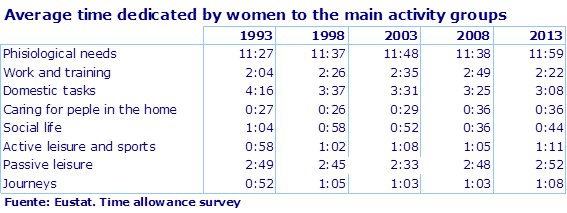
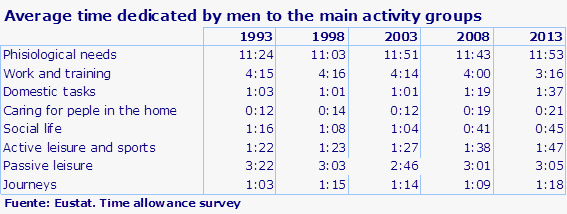
If the main activity groups carried out in one day are analysed, the greatest difference lies in the time spent on domestic tasks, as women dedicated more time than men both in 1993 and twenty years later. The data show that in 1993 women spent 3 hours and 13 minutes more than men, and in 2013, the difference was 1 hour and 31 minutes.
More specifically, in 1993, for every hour that men spent on domestic tasks, women spent four, whereas in 2013 women spent twice as much time. The main reasons for this development are the decrease in the amount of time that women spend on this activity and the increase in the number of men who carry out domestic tasks.
In any case, although the change is significant, in 2013 the time that women dedicated to domestic tasks was still double that of men.
If we look at the amount of time spent at work and in education, we find that in 1993 women spent half the amount of time men did on this activity, whereas in 2013 it reached three quarters. The social time dedicated to this activity experienced an opposite trend among men and women, since whilst the former increased the time spent on this activity in the period 1993-2013 (by 2 hours and 4 minutes to 2 hours and 22 minutes), the latter decreased it (from 4 hours and 15 minutes to 3 hours and 16 minutes).
Furthermore, the amount of time dedicated to caring for people in the home also clearly showed that gender differences exist and remain. In this case, the key is the time spent on this activity in 2013: 36 minutes for women and 21 minutes for men.
Distribution of income
The distribution of income between men and women was uneven in the Basque Country in 2013. Men earned a total average income of 24,414 euros, whereas for women this was 14,526 euros, i.e. men earned a personal income of 9,888 euros more than women.
The greatest difference between the personal income of men and women was amongst those aged 60-64, where the average income of men exceeded that of women by 17,892.
On the other hand, for the population aged 18 and over as a whole, the highest total personal income was obtained between the ages of 55 and 59, and stood at an average of 25,897 euros. However, the situation was different if gender was taken into account: in the case of women the highest income was obtained between the ages of 50 and 54 (with an average of 19,116 euros), whilst for men it was earned between 55 and 59 years of age and was considerably higher (33,311 euros).
Furthermore, we may speak of a “gender gap” in family income in 2013, since there were inequality in terms of family incomes depending on whether the main earner was male or female. Where it was a man, the families had an average income of 44,384 euros, with the majority of families being concentrated in the intermediate and high strata, whereas if the main receiver was a woman the average income stood at 33,430 euros and was concentrated in the lowest income strata.
This difference should be qualified by considering the difference in size between families, as in 2013 households headed by a woman had an average of 1.8 members, compared to 2.2 in the case of households where the main income provider was a man.
Unpaid domestic work carried out by women
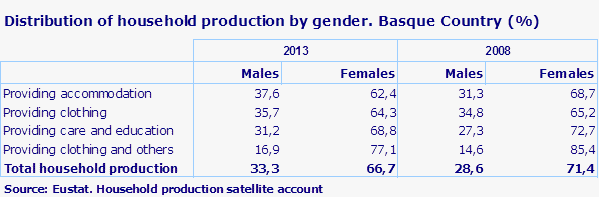
On the other hand, the value of household production in the Basque Country increased to 21.342 billion euros in 2013, which constituted 32.4% of the Gross Domestic Product (GDP). With regards to its distribution by gender, 66.7% of the domestic production value was created by women and 33.3% by men.
These data are provided by the Household Production Satellite Account, the basic objective of which is to create an overall picture of the productive activities that households carry out, and to estimate their economic value. In the majority of cases, this economic value is not recorded in GDP estimates. The main activities are: provision of accommodation, care and education, provision of food and clothing-related tasks.
The trend over the last 20 years shows that, although men have increased by almost 13 points in terms of their participation in domestic work (from 20.7% in 1993 to 33.3% in 2013), women still double the percentage of men in 2013 (79.3% in 1993 and 66.7% in 2013).
In any case, the increase in men's participation is considerable, which grew by around five percentage points over the last five years, going from 28.6% in 2008 to 33.3% in 2013.
By function, it was in Provision of clothes and other (77.1%) and Care and education (68.8%) where we see the greatest rate of female participation in 2013, followed very closely by the function of Provision of food (64.3%) and Provision of accommodation (62.4%). As for men, the greatest rate of participation was in Provision of accommodation (37.6%) and the lowest in Provision of clothes and other (16.9%).
For further information:
Eustat - Euskal Estatistika Erakundea / Basque Statistics Institute
C/ Donostia-San Sebastián, 1 01010 Vitoria-Gasteiz
Press Service: servicioprensa@eustat.eus Tel: 945 01 75 62