Press Release 16/02/2016
The number of students enrolled in non-university education in the Basque Country increased 1.5% in the 2014-15 academic year
31.4% of students received some type of grant or public aid for their studies and the amounts increased 2.5%
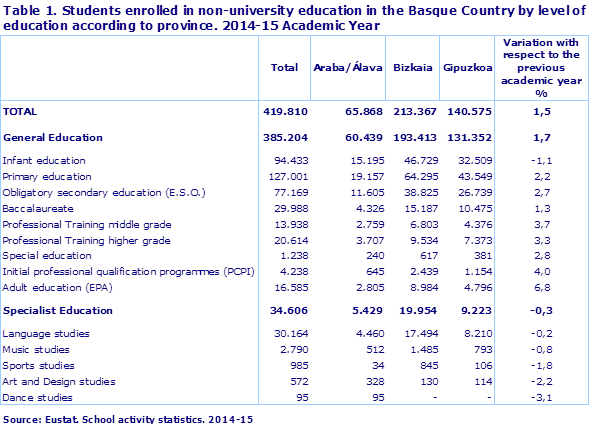
There were 419,810 students enrolled in non-university education in the Basque Country over the 2014-15 academic year with an increase of 1.5% compared to the previous academic year, according to data prepared by Eustat. 92.2% of them took General Education courses, which saw an increase of 1.7%, while the other 8% were enrolled in Specialised Education, with a decrease of 0.3%.
Students were distributed between Biscay (51%), Gipuzkoa (33%) and Álava (16%). This distribution was also seen in all of the General Education courses but not in Specialised Education courses, where a provincial specialisation was observed in Sports Education, with an 86% concentration of students in Bizkaia, in Art and Design, with 57% in Álava, and Dance studies, which was only offered in Álava.
In General Education, students were distributed equally between public and private centres, except for Professional Training studies where six of every ten enrolments was at a public centre, and Adult Education (EPA), where almost all enrolments (9.8 out of 10) were at public centres. For Specialised Education, more students were registered at public centres: 100% in language and dance, and 70% in the other courses.
After 18 years of continued increase, the enrolment levels in Infant Education dropped for a second consecutive year (-1.1%). Infant Education was the only level of education with negative growth. On the other hand, levels of compulsory education rose as a result of the previous years’ increases in Infant Education with Primary Education up 2.2% and Compulsory Secondary Education up 2.7%. Upper Secondary education rose slightly by 1%, similar to the previous academic years.
The greatest increase in enrolments was observed in Adult Education (6.8%) and Initial Professional Qualification Programmes (4%).
The increase in the number of young people who chose Professional Training, both in intermediate (3.7%) and advanced (3.3%) levels should be mentioned. However, with fluctuations, this trend has remained stable over the last six academic years.
Girls preferred Languages and Upper Secondary education while boys were split between Upper Secondary education, Advanced level Professional Training and Languages
From a gender perspective, differences have been observed in the choice of non-obligatory studies, specifically, Languages and Professional Training. The proportion of male and female students in Upper Secondary education is roughly equal.
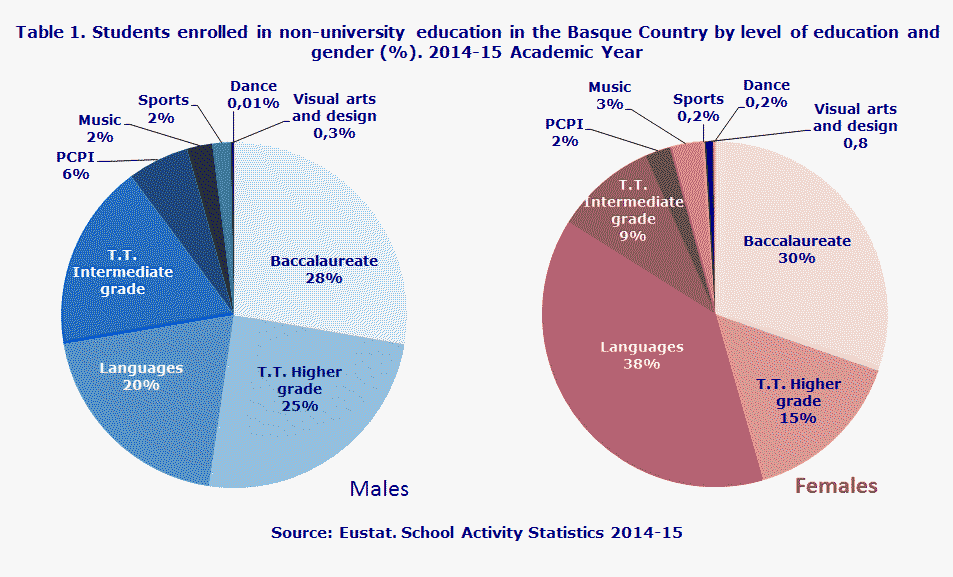
Male students preferred Professional Training with 42% enrolling, compared to only 25% of female students. In addition, differences also have appeared in the choice regarding the type of training: 60% of male students chose more technical specialisations such as mechanical manufacturing, electricity and electronics, and information technology and communications, while a similar percentage of female students chose more social or managerial training with the highest numbers enrolled in courses such as health, socio-cultural services and the community, and administration and management.
38% of female students chose language studies compared to 20% of male students.
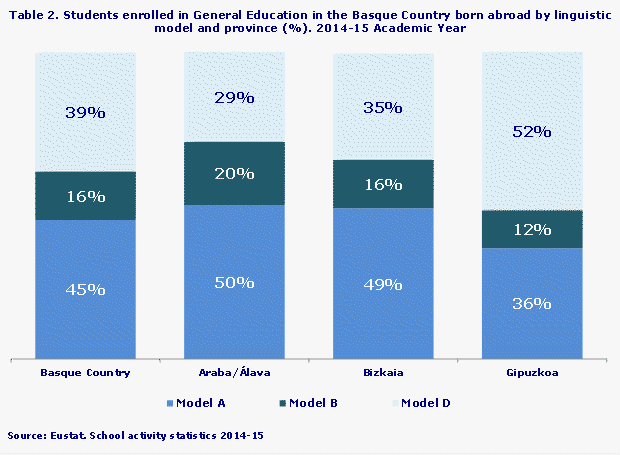
In Gipuzkoa, the majority of foreign students followed model D
In the 2014-15 academic year, 31,977 foreign students (8% of the total) were enrolled in General Education in the Basque Country. The proportions of foreign students were largely similar in Bizkaia (7.5%) and Gipuzkoa (7.6%) while Álava had a higher percentage (12%).
The courses with the highest proportion of foreign students enrolled were the Initial Professional Qualification Programmes (PCPI) (32%) and Adult Education (39%). The proportion fluctuated between 6% and 9% for the other courses.
With regard to the linguistic integration, Gipuzkoa topped the list with the highest percentage of foreign students enrolled in model D (52%) followed by Bizkaia (35%) and Álava (29%).
�
31.4% of students were awarded some kind of grant
In the 2014-15 academic year, the amount of grants and aid awarded by the Public Administration of the Basque Country increased to 55.2 million euros, 2.5% more than the previous year, and benefited a total of 126,621 students, 31% of the total.
The highest number of grants were awarded in Primary Education and Secondary Education with 43% of students receiving some type of aid. It should also be mentioned that 47% of students in Initial Professional Qualification Programmes and 28% of those in Upper Secondary education were awarded grants. However, in specialised education the number of students receiving grants was lower.
For further information:
Eustat - Euskal Estatistika Erakundea / Instituto Vasco de Estadística
C/ Donostia-San Sebastián, 1 01010 Vitoria-Gasteiz
Press Service: servicioprensa@eustat.eus Tlf: 945 01 75 62
Further press releases on School activity statistics of the Basque Country
Database on School activity atatistics of the Basque Country