Press release 23/02/2016
The migratory balance of the Basque Country gained a surplus of 107,300 individuals in the 2000-2014 period
Immigrations from abroad totalled 43.3%, and emigrations abroad totalled 32%
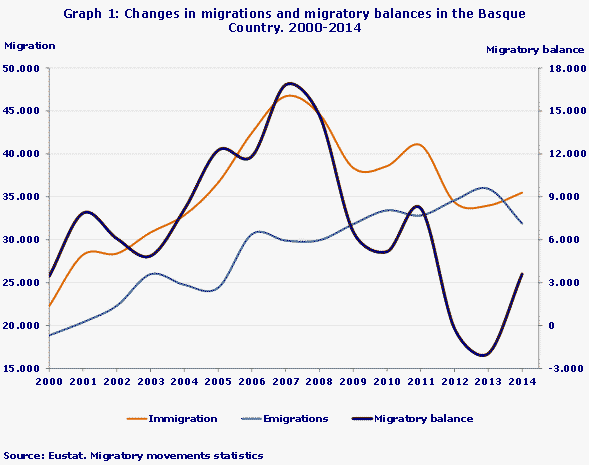
The total number of immigrations from outside the Basque Country between 2000 and 2014 rose to 534,908, whilst emigrations outside the region came to 427,608. This gives us a positive migratory balance of 107,300 individuals according to Eustat data.
The fourteen years in the series saw very uneven changes in immigration numbers, which went from 22,286 in 2000 to 35,491 in 2014, reaching a peak of 46,729 in 2007. Emigration numbers increased more consistently, and went from 18,846 at the start of the period to 35,943 in 2013, though emigrations fell to 31,889 in 2014.
Immigrants from abroad made up 43.3% of the total number of immigrants, with their lowest proportion being in 2000 (33.6% of total immigrants) and their highest proportion being in 2006 (56.8% of total immigrants). These numbers eventually levelled off at around 35% during the last three years.
The proportion of emigrants leaving Spain was slightly less for the period in question as a whole - 32% to be precise. However, the proportions for each year of the period were a lot more heterogeneous. This is because in 2000, emigrants leaving Spain made up only 3.5% of total emigrations, whereas in 2012 and 2013, they made up nearly 50% of total emigrations.
During the fifteen years as a whole, Álava made up nearly 25% of the total migratory balance, even though its population constitutes just over 14% of the Autonomous Region altogether. Even in years such as 2000 and 2009, Álava accounted for over 40% of the positive migratory balance.
Bizkaia constituted 42% of the external migratory balance for this period when its population made up 53% of the Basque Country's population, and in 2000 this proportion was at its lowest point at only 21%. Gipuzkoa's performance reflected its population more. This is because it made up 33.7% of the total migratory balance, which is similar to the proportion it makes up of the population of the Autonomous Region as a whole - approximately 32.5%.
During the last three years of the period, immigration numbers and emigration numbers were rather varied, which led to a negative rate in two of the years: just 227 individuals in 2012, and 1,956 in 2013. In 2012, Álava registered a negative balance of 1,707 inhabitants - something which has not happened since 1995, which was in turn joined by Bizkaia's negative balance. This, however, only constituted 601 people. The negative balance in 2012 was due solely to Bizkaia, which had 3,040 fewer people, despite the fact the positive balance for Álava was only 41 people. In 2014, external migratory balances for the three provinces were positive again, though Bizkaia only contributed 9.6% to the total.
Methodological note
Different sources of information (especially census information) were used to recalculate the 2000 to 2014 period for Migratory Movements Statistics.
For further information:
Eustat - Euskal Estatistika Erakundea / Instituto Vasco de Estadística
C/ Donostia-San Sebastián, 1 01010 Vitoria-Gasteiz
Press Service: servicioprensa@eustat.es Tlf: 945 01 75 62
Online press releases about migratory movements statistics iin the Basque Country
Databank on migratory movements statistics in the Basque Country