Press Release 10/12/2015
The most numerous foreign residents in the Basque Country are those with nationality of Latin American countries
59 municipalities have a proportion of people born abroad that exceeds the proportion for the Basque Country as a whole
Residents in the Basque Country with nationality of Latin American countries accounted for 36.3% of the total of foreign residents, whereas in Spain as a whole this figure barely reached 23% according to Eustat data. The countries with the most representation in this group, all from South America, were Bolivia, Colombia, Nicaragua and Paraguay, making up 19% of the total number of foreign residents, and 52% of the Latin American residents. Foreign residents totalled 186,080 individuals, 8.6% of the total population on 1 January 2015.
In contrast, Europeans residents in the Basque Country made up 27.5% compared to 46.4% in Spain. In this group Romanians are worthy of special mention, who accounted for almost 11% of the total number of foreigners, whilst in Spain the figure was 16%; furthermore, Romanians made up 43.3% of Europeans, 9 percentage points more than Spain as a whole. The Portuguese, although lower in number than Romanians, had a significantly higher weighting in the Basque Country than in Spain, accounting for 17.6% and 4.5% of Europeans, respectively.
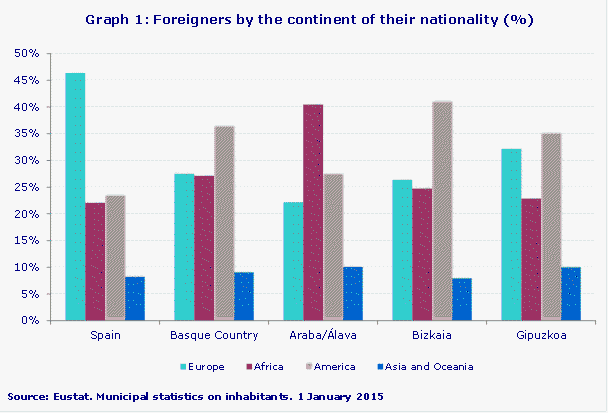
Nationals from African countries provided a slightly higher proportion than the proportion for Spain as a whole; that is, 27.1% compared to 23.3%. However, it is noteworthy that in Spain, Moroccans made up 72% of all African nationals, whereas in the Basque Country this figure was below 49%. The second nationality of this group in terms of importance in the Basque Country was Algerian, with 14.6% against 6% in Spain.
Chinese and Pakistani nationals had a presence amongst foreigners of 7%, one percentage point higher than in Spain, with it being particularly noteworthy that in the Basque Country they were practically the only representatives of the Asian nations, given that they made up 79%, whilst in Spain as a whole they made up 69%.
The distribution of nationalities by continents was different in the three provinces. In Álava, Africans were the majority group, and Latin Americans were the majority group in Bizkaia, with both groups exceeding 40%. In Gipuzkoa, there were some proportions amongst Europeans and Latin American that were more alike, though the proportion of Latin Americans was greater.
In Bizkaia, Bolivians and Colombians made up 41% of residents of Latin American nationality, whereas the distribution in Gipuzkoa was more disparate. In Álava fewer than 28% of residents had Latin American nationality, of which over a quarter were Colombians.
The notable French presence amongst residents of Gipuzkoa has caused the weighting of European nationals to be greater there than in other provinces. Romanians made up the majority of Europeans in Bizkaia, at nearly 57%, whilst in Álava and Gipuzkoa they accounted for about 31%.
In Gipuzkoa, residents with nationality of African countries had the lowest proportion of the three provinces, with nearly 60% of them Moroccan. In Álava and in Bizkaia, Moroccans also accounted for the majority of Africans, although they did not reach the level in Gipuzkoa (47% and 43.5%, respectively). The next most numerous nationalities in Bizkaia and Gipuzkoa were Algerians and Senegalese, though the order was the opposite in the two provinces: in Bizkaia, the Senegalese came first at 14.5%, and in Gipuzkoa it was the Algerians, at 15.2%. In Álava, these two groups made up 20.5%, though in this instance, Nigerians came third at 13.4%.
The Chinese had a significant presence in Bizkaia, at 60% of Asians; followed by Pakistanis, at 16.6%; whilst in Gipuzkoa and Álava Pakistanis had the highest percentage, especially in Álava where they reached 60.3%.
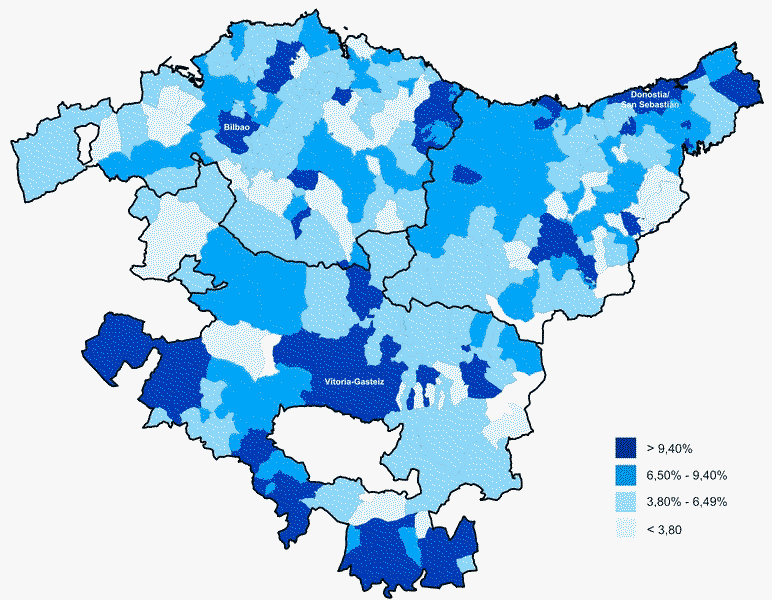
59 municipalities have a proportion of people born abroad greater than that of the Basque Country as a whole, 22 of which are in Álava and, of those, 15 exceed 10%, the majority being from the region of Rioja Alavesa. However, there are only four municipalities that exceed the percentage for Spain as a whole, and they are Navaridas, which exceeds 26%, with Berriatura way behind at 14.5%, then Ordizia (13.9%) and Markina-Xemein (13.6%).
�
Graph 2. People born abroad by municipality (%)
Source: Eustat. Municipal statistics on inhabitants. 1 January 2015
On the other hand, there are five municipalities that have practically no resident population born abroad, that is, they have a percentage under 2%. Two of these municipalities are in Gipuzkoa (Beizama and Elduain), and two are in Álava (Lagrán and Harana/Valle de Arana). Garai is the only Municipality in Bizkaia with these characteristics and, with 311 residents, it is the municipality with the highest population.
The percentage of the population born abroad was higher in the provincial capitals than the Basque Country as a whole, with the highest proportion being in Vitoria-Gasteiz, where it stood at 11.8%; in Bilbao it stood at 10.2% and in San Sebastián it reached 9.6% of the total population.
For further information:
Eustat - Euskal Estatistika Erakundea / Instituto Vasco de Estadística
C/ Donostia-San Sebastián, 1 01010 Vitoria-Gasteiz
Press Service: servicioprensa@eustat.eus Tel: 945 01 75 62
Further press releases on municipal inhabitants statistics of the Basque Country
Municipal inhabitants statistics of the Basque Country databank