Press Release 10/11/2015
The number of admissions to Basque hospitals increased by 2.6% in 2014
Cataracts, with an 8% increase in admissions, made diseases affecting the nervous system and the sense organs the main cause for hospital care
Hospitals in the Basque Country registered 320,761 discharges of people that were admitted in 2014, which was 2.6% up on the previous year, according to Eustat data. This increase was 3.3% in public hospitals (where 78% of the discharges took place) and 0.4% in private hospitals.
97.4% of hospitalised individuals lived in the Basque Country (49.3% in Bizkaia, 32.5% in Gipuzkoa and 15.6% in Álava), 2.4% lived in other provinces (Burgos, Cantabria and Navarra and La Rioja being the most common) and 0.1% lived abroad.
Most of these people were women, at 51.2%, with men at 48.8%. However, if we discount admissions for childbirth and pregnancy, women would make up 47.5% of total admissions, and men 52.5%. The number of patients admitted over the age of 65 is continuing to grow. They made up 46.5% of discharges in 2014, with people aged 78 being most commonly hospitalised that year.
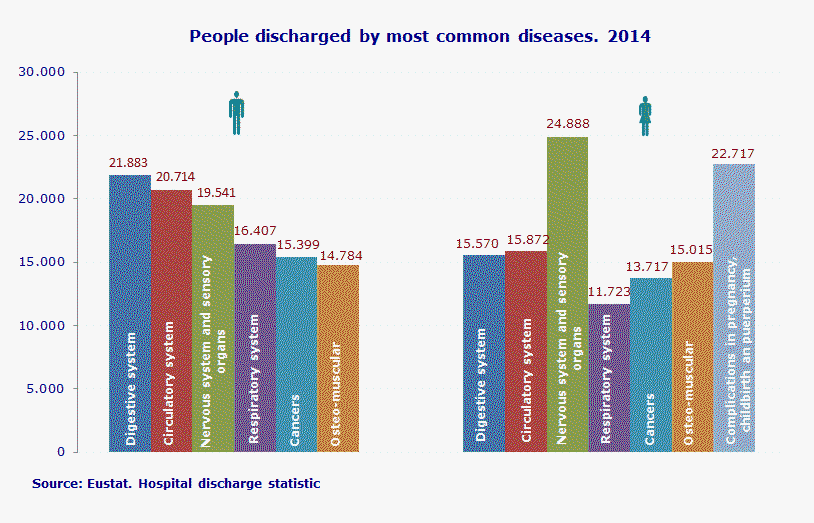
According to the standardised classification of diseases, the most common cause of hospitalisation were diseases affecting the nervous system and the sense organs (13.9%). This was because of cataracts, which, with 25,000 cases treated, was the most commonly diagnosed disease.
The most common diseases, at similar percentages, were those of the digestive system and the circulatory system in second (11.7%) and third (11.4%) place respectively, followed by musculoskeletal disorders (9.3%), tumours (9.1%) and respiratory diseases (8.8%).
This order varies according to gender and age. For women, hospital admissions due to pregnancy, childbirth and postnatal issues came second (13.8%) after diseases of the nervous system and diseases affecting the sense organs (14.7%). Women were mainly admitted for diseases linked to age: cataracts and osteoarthritis.
The two main reasons for which men were admitted to hospital were diseases of the digestive system (14%) and diseases of the circulatory system (13.2%). Inguinal hernias were the most common disease of the digestive system, whilst heart failure and arrhythmias were the most common circulatory diseases. Respiratory diseases, such as chronic bronchitis and pneumonia, also gained prominence, and came in fourth position.
Tumours, which accounted for 30,000 hospital admissions, were the main cause of death in hospitals. Of these, tumours of the bladder, colon, breast and prostate were the most significant causes.
The average stay in hospital stood at 5.7 days in 2014. The longest stays corresponded to mental disorders (13.6 days on average), then perinatal diseases (10.6 days), infectious diseases (8.7 days) and tumours (7.7 days).
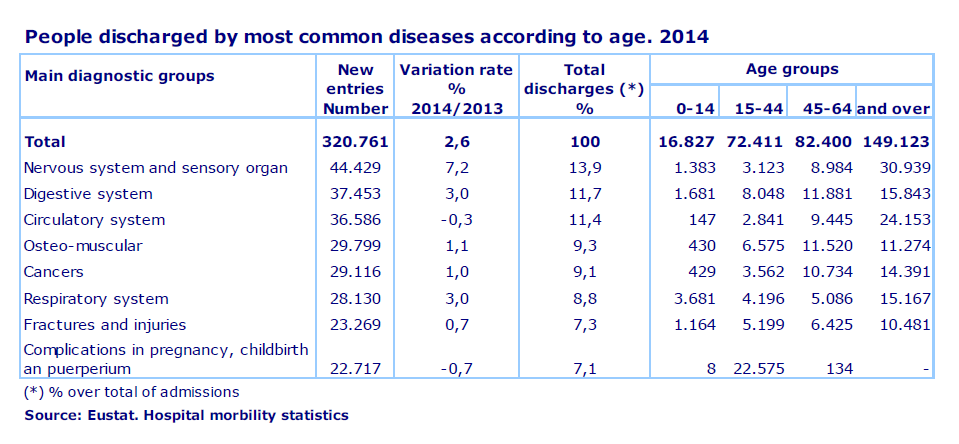
Note: The data refers to hospitals providing acute care. Conventional hospital admissions were considered, with stays of at least one night or those who were discharged the same day. To calculate the average stay, stays lasting one day were not factored in.
For further information:
Eustat - Euskal Estatistika Erakundea / Instituto Vasco de Estadística
C/ Donostia-San Sebastián, 1 01010 Vitoria-Gasteiz
Press Service: servicioprensa@eustat.eus Tel: 945 01 75 62
Further press releases on Hospital discharge statistics
Hospital discharge statistics databank