Press release 23/08/2015
The migratory balance of the Basque Country was positive and was recorded at 3,600 people in 2014
All of the Autonomous Regions contributed more population to the Basque Country than they received
In 2014 a positive migratory balance was posted in the Basque Country. To be precise, 3,602 more people came than left, 63% of whom were concentrated in the three Basque capitals, according to Eustat data.
By province, Gipuzkoa, which gained 2,195 people, recorded a higher migratory balance in absolute figures; Álava had a positive balance of 1,326 people and Bizkaia gained 82 people due to migration. As for the three capitals, they had positive balances: in Vitoria-Gasteiz it was 1,446 people, in San Sebastián 510 and in Bilbao 298 people.
With regards to movements between the Basque Country and the other Autonomous Regions, in 2014 the positive trend that started in 2008 continued, with a positive balance of 5,809 people, 83% of whom were foreign nationals. On the other hand, the balance with foreign countries was negative, by 2,207 people, i.e. more cases of emigration to foreign countries were registered than of immigration to the Basque Country from abroad.
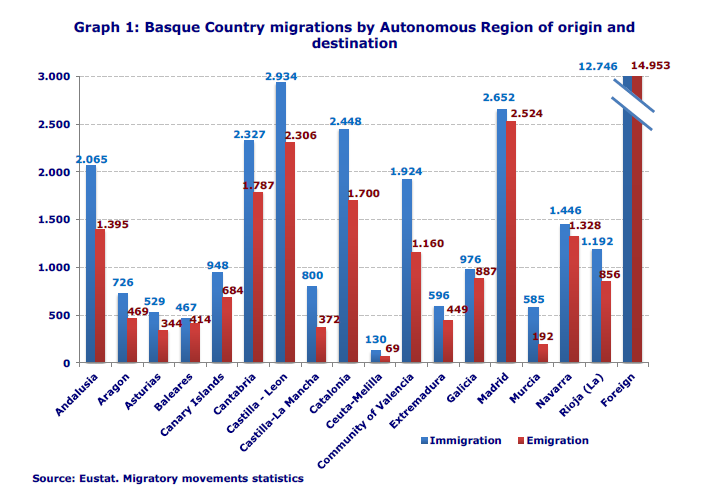
In 2014 external or extra-community geographical mobility, which involved 31 per thousand inhabitants of the Basque Country (Álava 37.8‰, Bizkaia 28.6‰ and Gipuzkoa 31.9‰), was 5 points below the other Autonomous Regions, where 36 inhabitants per thousand moved on average.
All of the Autonomous Regions, without exception, contributed more population to the Basque Country than they received from it. Those that contributed the most immigrants were, in first place, Castilla y León, followed by Madrid, Catalonia, Cantabria, Andalusia and Comunidad Valenciana.
The Autonomous Regions that attracted immigrants from the Basque Country were, in order, Madrid, Castilla y León, Cantabria, Catalonia, Andalusia and Navarra and these six received 65% of the people leaving the Basque Country for other Autonomous Regions in Spain.
The immigration of foreign nationals was registered at 18,602 in 2014 and, of those, 8,022 arrived in the Basque Country from other Autonomous Regions, primarily from Catalonia, Madrid, Comunidad Valenciana, Andalusia and Castilla y León, and another 10,580 came directly from abroad.
The emigration of foreign nationals rose to 14,332, and almost one in two people leaving our Region, specifically 45% of emigrants, were foreign nationals, with 78% of them leaving to go abroad.
The average age of the emigrants (36.0 years old) was slightly higher than that of the immigrants (33.1 years old). If the gender of the population in question is taken into account, 52% of immigrants were men and 48% women, whilst the difference between the sexes was higher in the case of emigrants: 54% men and 46% women.
Almost 70% of the changes of residence among the Basque population occurred within the Autonomous Region itself
9.9% of the Basque population changed their place of residence in 2014, with the mobility on 69% of the occasions being within the Basque Country, whilst in the other cases the mobility was extra-community. These figures are almost identical to those from 2013.
In total, 214,810 changes of normal places of residence were recorded in the Basque Country. From this figure, 97,021 were changes of address within the same municipality. Intra-community mobility, in other words, where the origin and destination are different municipalities of the Basque Country, increased to 50,409 movements. There were also 35,491 cases of extra-community or external immigration, which are those that have their origin outside the Autonomous Region and where the destination is the Basque Country. Of these cases, 12,746 came from abroad. Finally, there were 31,889 cases of external or extra-community emigration, in other words, residential variations originating in a municipality of the Autonomous Region and with the destination outside it, 14,953 of which were to destinations abroad; meaning a decrease of 16% with respect to the 2013 figures.
For further information:
Eustat - Euskal Estatistika Erakundea / Instituto Vasco de Estadística
C/ Donostia-San Sebastián, 1 01010 Vitoria-Gasteiz
Press Service: servicioprensa@eustat.es Tlf: 945 01 75 62
Online press releases about migratory movements statistics iin the Basque Country
Databank on migratory movements statistics in the Basque Country