Press Release 22/07/2015
The population in work was up by 8,400 individuals and the unemployment figure was down to 15.1% in the second quarter of 2015 in the Basque Country
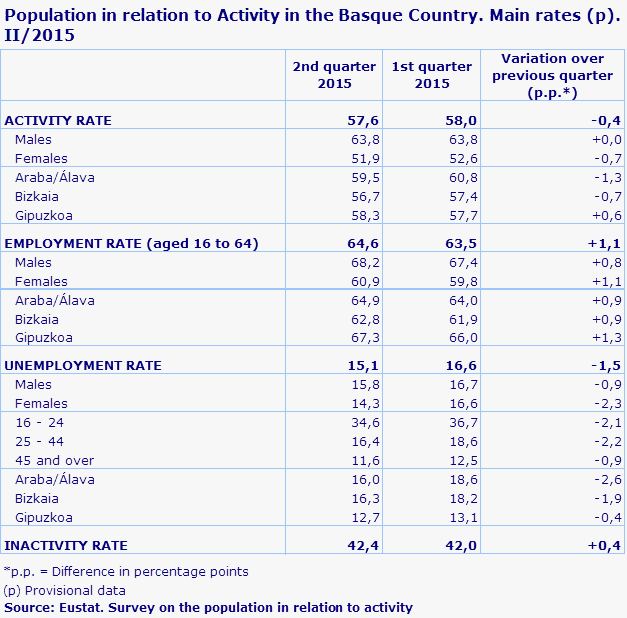
The activity rate stood at 57.6%
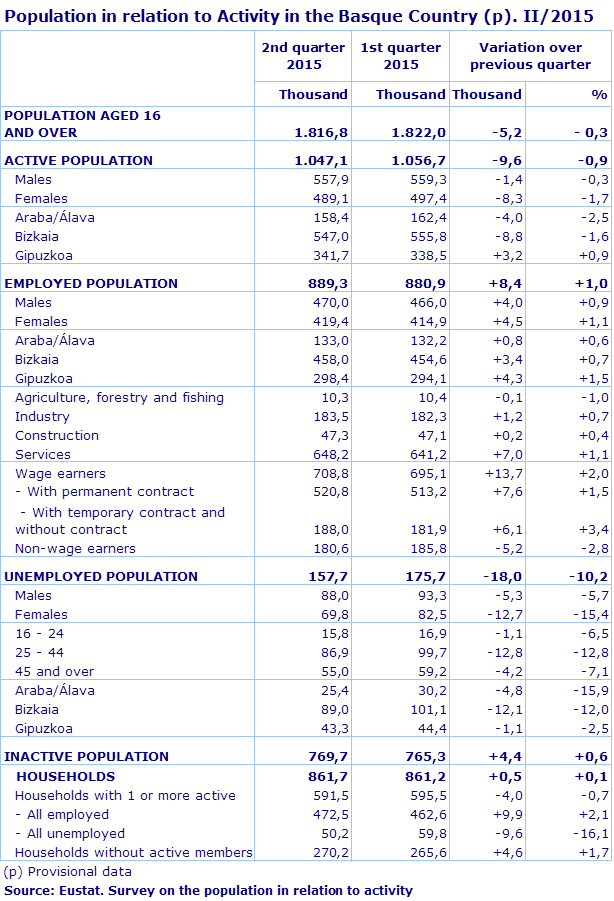
The data from the labour market in the Basque Country from the second quarter of 2015 showed that there were 889,300 people in work, which was a net increase of 8,400 compared with the previous quarter (+1%), according to Eustat data. Furthermore, the unemployment rate of the Basque Country fell by 1.5 percentage points and stood at 15.1%.
As a result of the change in the working and unemployed population, the activity rate was 57.6% in the second quarter of 2015, four tenths of a percentage point below that of the previous quarter.
As far as gender was concerned, the rise in employment had a greater effect on women, with 4,500 more in work than in the previous quarter, whilst the number of men in work increased by 4,000. Gipuzkoa was the province where employment rose the most, with 4,300 more people employed, followed by Bizkaia with 3,400 more, and lastly Álava, where the number of people employed rose by 800.
The population employed in services, industry and construction increased
The working population was up by 7,000 in the services sector, by 1,200 in industry and by 200 in construction, whilst in the primary sector it fell by 100.
The employment rate, the percentage of people in work aged 16 to 64 over the total for these ages, was up by 1.1 percentage points compared to the previous quarter, standing at 64.6%. This figure stood at 68.2% for men and 60.9% for women.
By province, the highest employment rate turned out to be that of Gipuzkoa, with 67.3% and an increase of 1.3 percentage points compared to the previous quarter; this was followed by Álava, with a rate of 64.9% and an increase of 0.9 points; lastly, Bizkaia had the lowest rate, with 62.8% and an increase of 0.9 percentage points in the last quarter.
The number of salaried individuals with a permanent contract rose by 7,600, and stood at 520,800, whilst the number of people on a temporary contract or without a contract increased by 6,100, bringing this total for this group up to 188,000.
In 472,500 households, all active individuals were employed
In the second quarter of 2015 it was estimated that there were 861,700 households in the Basque Country (500 more than the previous quarter), a third of which did not have any active individuals. In just over half of households, all of the active individuals were in work, 9,900 families less than the previous quarter; furthermore, households where all active individuals were unemployed stood at 50,200, 9,600 fewer households than in the second quarter.
The unemployment rate fell to 15.1%
The unemployed population in the Basque country, that is, individuals who are available for work, actively making enquiries and seeking employment, was estimated to be 157,700 in the second quarter of 2015, 18,000 down from the previous quarter. The number of unemployed men, 88,000 individuals, decreased by 5,300, whilst the number of unemployed women decreased by 12,700, reaching a total of 69,800 in the quarter.
The data for the second quarter of 2015 revealed an unemployment rate of 15.1%, 1.5 points less than the previous quarter. The male unemployment rate fell to 15.8% (0.9 percentage points down) and the female rate was down 2.3 points, reaching 14.3%. The youth unemployment rate continued to be the highest, and stood at 34.6%, affecting 15,800 active young people between the ages of 16 and 24, although it has decreased by a little more than two percentage points in comparison with the first quarter of 2015.
By province, the greatest decrease in the number of people out of work was in Bizkaia (-12,100 individuals) where the unemployment rate stood at 16.3%. In Álava, with 25,400 individuals out of work, the number of unemployed fell by 4,800, with the unemployment rate standing at 16%. In Gipuzkoa, there were 1,100 fewer unemployed individuals than the previous quarter and the unemployment rate stood at 12.7%.
According to EUROSTAT, the Statistical Office of the European Union, in May 2015 the overall unemployment rate of the European Union-28 stood at 9.6% and that of Spain stood at 22.5%.
RECONCILIATION OF EMPLOYMENT MARKET SOURCES
In the second quarter of 2015 Eustat has published data from the Survey on Population in Relation to Activity (PRA) after including several methodological improvements, within the continuous improvement processes of all statistical operations produced by Eustat.
One of the main objectives of the methodological change of the PRA is the reconciliation of employment market information sources regarding the unemployment rate registered by Lanbide and those in active employment affiliated to the Social Security system with the PRA. The reconciliation with administrative sources relating to the employment market is understood as the explanation of the differences between the survey and the corresponding administrative records with regard to measuring employed and unemployed workers according to the definitions established by the International Labour Organization (ILO).
The PRA is a survey following the characteristics established by the ILO for a Labour Force Survey, ensuring international comparability and therefore following the same methodology as other Eurostat labour force surveys and those of the official statistics offices.
Registered unemployment and employment statistics are official State statistics but are not approved on an international level. This does not mean that these statistics do not fit the purpose for which the administrative records were created, but for a correct statistical use when analysing the employment market it is necessary to qualify what they do and do not measure.
As we have already pointed out, one of the main challenges of the PRA is to enable the reconciliation of these employment market sources and these are the main results for the second quarter of 2015:
Reconciliation ILO OCCUPATION (Eustat)-ACTIVE EMPLOYMENT (Social Security)
1. In the second quarter of 2015, 892,733 people are affiliated to the Social Security system on average, of which 815,600 are affiliated on average as residents of the Basque Country, totalling 91.4 %. This difference is due to the fact that the Social Security system includes people employed within the Basque Country although they reside elsewhere and people affiliated more than once due to the fact that they have two or more posts. The PRA only includes residents of the Basque Country and they are only counted once.
2. Of the 815,600 residents affiliated on average, 98.5 % are employed according to ILO and PRA methodology criteria and of the remaining 12,300 people, 1.5 % are unemployed or inactive.
3. Amongst the ILO and PRA employed workers, there are 78,300 residents who are not affiliated to the Social Security system. They include people affiliated to schemes for civil servants such as the Benefit Society for State Civil Servants (MUFACE), the Benefit Society for Employees within the Judicial Administration (MUGEJU) and the Benefit Society for Members of the Armed Forces (ISFAS) and people employed according to the ILO but that are not affiliated to the Social Security system in the Basque Country.
Reconciliation UNEMPLOYMENT ILO (Eustat)-REGISTERED UNEMPLOYMENT (Lanbide)
1. According to the SISPE (Public Employment Service Information System) methodology, 161,951 workers are registered as unemployed in Lanbide on average in the second quarter of 2015, of which, 148,800 or 91.9 % are on average residents registered as unemployed.
2. Of the 148,000 unemployed residents registered in Lanbide, 69.9 % are considered as unemployed according to ILO methodology, 24.4 % are inactive and 5.8 % are occupied.
This data confirms the sporadic study carried out by Eustat in the first quarter of 2009 in contrast with PRA unemployment data and the unemployment data registered by the Public Employment Service (INEM) following the SISPE methodology.
3. Furthermore, there are 49,100 unemployed workers according to ILO methodology which according to the PRA, for different reasons, are not registered on Lanbide's SISPE methodology unemployment lists.
�
METHODOLOGICAL NOTE
Eustat has included several methodological changes in the PRA which, besides maintaining the PRA's main objectives focused on analysing the evolution of the employment market, aim to fulfil other specific objectives: reconciliation with administrative sources, coherence with other statistical sources of the Basque Statistics Institute and gathering regional data regarding the three Basque capitals and people of foreign nationality.
These methodological changes in the statistical operations, and specifically in the PRA, are in line with the 15 principles of the European Statistics Code of Best Practices to which the Basque Statistics Institute must adhere. These changes are based on the following indicators, amongst others:
- Information collection, data entry and coding are regularly controlled and revised when necessary
- Appropriate editing and imputation methods are used, which are regularly analysed and are revised and updated when necessary
- Revisions follow standard, consolidated and transparent procedures
- The production potential of communications and information technologies are used to streamline data collection, data processing and dissemination
- Proactive efforts are made to improve the statistical potential of administrative data and limit the use of direct surveys
- Procedures are in place to consult users, control the relevance and use of existing statistics with regard to specific needs and to consider new needs and priorities
- Priority needs are satisfied and reflected in the employment programme
- The periodic control and systematic follow-up of user satisfaction is carried out
- Users are kept informed of the methodology of statistical processes, including the use of administrative data
These methodological changes involve drawing up new series of data which break away from the old series, therefore, comparisons are not made with regard to data published in the first quarter obtained from the previous PRA, but rather they refer to the new PRA, for reasons of homogeneity. As for all statistics undergoing methodological changes, in the following months the available retrospective series will be published including the methodological innovations.
The main modifications included in the different phases of the PRA include:
1. Probability sampling stratified according to Provinces is maintained, but stratification according to region is included, as well as the three Basque capitals.
2. The sample has been divided into 13 weeks understood as periods of 7 consecutive days, to improve the calculation of the employed population and coherence between the number of hours worked and the productive activity of the companies carrying out the activity.
3. The probabilistic sample has been balanced according to the Cube Method (Déville and Tillé, 2004) for a better representation of the populational universe with regard to the following characteristics: affiliation to the Social Security system, registered as an unemployed worker in Lanbide, nationality (Spanish and foreign), sex, age groups and family size.
4. The sample size has been increased to 6,344 households, without substitution.
5. A web application has been introduced enabling online response and more complex validations.
6. The direct response of employed and unemployed workers is required, rather than through a family respondent for these two groups.
7. The answers provided by those surveyed are checked at the time of the survey, in order to establish coherence with administrative sources.
8. With regards to calibration, along with age groups and sex according to the Provinces of the previous PRA, distribution by capitals and the rest of the territory, the week and survey order, family size and the number of people of an active age and presence in administrative records have also been taken into account.
9. Marginal calibration from administrative sources refers to the calculation of people affiliated to the Social Security system or people registered as unemployed in Lanbide made by the actual survey, taking into account that the administrative files include data of non-residents on the reference date who are, therefore, excluded from the collection of marginals, because the PRA universe comprises the main households, i.e., those of residents.
10. The existence of a relation variable between those surveyed and Social Security records enables the production of analysis tables indicating how many of those affiliated to the Social Security system are employed in the PRA reference week in accordance with ILO criteria and how many ILO employed workers are not registered as such in the Social Security Contribution Accounts in the Basque Country, as they could be in other Autonomous Regions, in other administrative sources such as MUFACE, MUGEJU and ISFAS or in none due to the fact that they work occasional odd jobs or family assistance jobs. Comparably, there is a characteristic indicating if those surveyed are registered as unemployed in Lanbide, so it is possible to ascertain how many are unemployed according to the ILO definition and how many of those not registered in Lanbide or registered as unemployed in categories that are not accounted for fulfil ILO requirements to be considered as unemployed.
A more comprehensive explanatory note has been included on the web page regarding the changes introduced in the 2015 PRA.
For further information:
Eustat - Euskal Estatistika Erakundea / Instituto Vasco de Estadística
C/ Donostia-San Sebastián, 1 01010 Vitoria-Gasteiz
Press Service: servicioprensa@eustat.eus Tlf: 945 01 75 62
Further press releases on survey on the population in relation to activity in the Basque Country (PRA)
Databank on survey on the population in relation to activity in the Basque Country (PRA)