Press Release 26/05/2015
The average income of the population of the Basque Country fell by two percent between 2011 and 2013
Average family income in 2013 stood at 40,179 euros, 2,000 less than in 2011
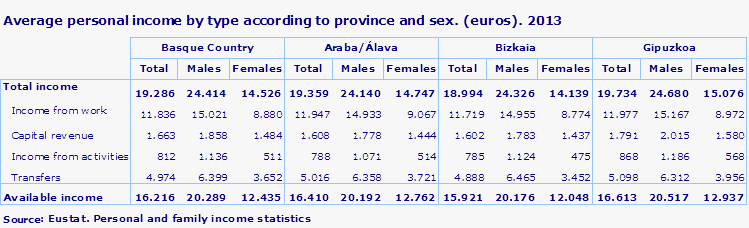
The average family income of people aged 18 and over residing in the Basque Country stood at 19,286 euros in 2013, 2.2% less than in 2011, according to the Personal and Family Income Statistics prepared by Eustat, in collaboration with the Provincial Councils of Álava, Bizkaia and Gipuzkoa. Gipuzkoa was the province with the highest personal income, 19,734 euros, followed by Álava with 19,359 euros and, in third place, Bizkaia with 18,994 euros. If we analyse the provincial trends since 2011, Bizkaia had the best performance with a decrease of 1.0%, compared to Gipuzkoa and Álava, which posted drops of 3.2% and 3.9% respectively.
The average personal income in the capitals of the three provinces exceeded the average for the Basque Country. In first place was Donostia-San Sebastián with 22,260 euros, followed by Bilbao with 19,647 euros and lastly, Vitoria-Gasteiz with 19,604 euros.
Regarding the distribution of income amongst the population, nearly 1.6 million individuals aged 18 and over received some type of income, that is, 86.5%, whilst 13.5% of the population did not receive any type of income during 2013. Furthermore, 59.7% of individuals received an income below the Basque Country average, including those who did not receive any income; on the other hand, 12.3% had an income that was double the average, that is, slightly over 38,570 euros.
61.4% of personal income originated from work
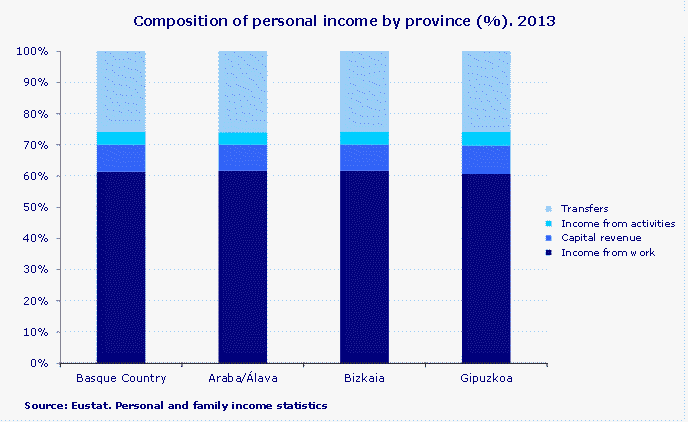
Regarding the composition of total personal income received by residents of the Basque Country in 2013, 61.4% of it came from work, with an average of 11,836 euros; the rest was distributed between transfers and social provisions, averaging 4,974 euros (25.8%); economic activities, averaging 812 euros (4.2%); and capital gains, both moveable and immoveable, with an average of 1,659 euros (8.6%).
These data, when compared with those from 2011, show that transfers rose by 2.1 percentage points, whilst income from work fell by 1.3 points, capital gains were down by 0.6 points and income from economic activities dropped by 0.2 points as a percentage of total income.
The average personal income for Basque women is 10,000 euros below that of men
The distribution of income between men and women was uneven. Men in the Basque Country obtained an average total income of 24,414 euros, whilst women, for their part, earned an average of 14,526 euros; that is, the personal income of men was 9,888 euros higher than that of women.
The greatest difference between the personal income of men and women was amongst those aged 60-64, where the average income of men exceeded that of women by 17,892.
For the population aged 18 and over as a whole, the highest total personal income was obtained between the ages of 55 and 59, and stood at an average of 25,897 euros. However, the situation was different if gender was taken into account: in the case of women the highest income was obtained between the ages of 50 and 54 (with an average of 19,116 euros), whilst for men the maximum average income was earned between 55 and 59 years of age and was considerably higher (33,311 euros).
Average family income in the Basque Country stood at €40,179 in 2013
Average family income in the Basque Country stood at 40,179 euros in 2013, although half of all families had an income below 32,416 euros. The total family income is obtained as an aggregation of the personal incomes of all members of the family over the age of 18. As in the case with personal income, Gipuzkoa was the province with the highest family income, 40,823 euros, followed by Bizkaia with 40,242 euros and, lastly, Álava with 38,589 euros. The average income for families overall in the Basque Country exactly corresponded to 2.1 times the average personal income.
The average income of families in the Basque Country fell by 4.8% between 2011 and 2013. By province, Álava showed the largest decrease, at 7.5%; in Gipuzkoa family income fell by 6.3% and Bizkaia saw the smallest decrease, of 3.0%, due both to the aforementioned drop in personal income and to the reduction in family size and, consequently, in the number of earners.
62.0% of families received an income below the Basque Country average or did not receive any income. 2.5% of families received no type of income in 2013. On the other hand, almost 9% of families, specifically 77,553, had an income above twice the average, that is, just over 80,300 euros.
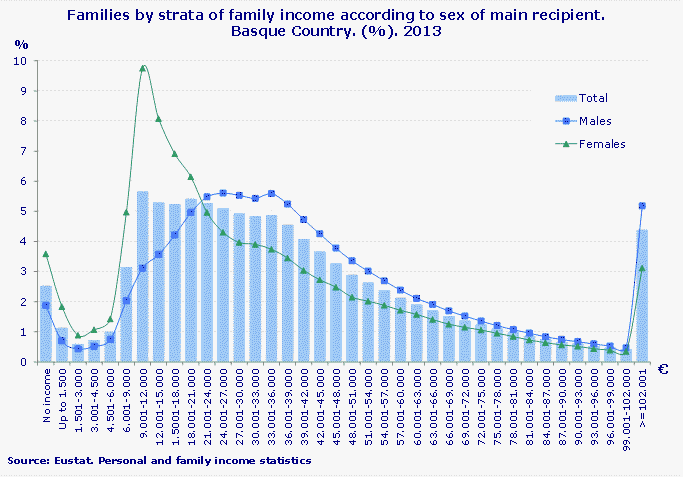
We may speak of a “gender gap” in family income, due to the existence of inequalities regarding family income depending on whether the main earner was male or female; if he was a male, the families had an average income of 44,384 euros, with the majority of families being concentrated in the intermediate and high strata, whereas if the main earner was a woman the average income stood at 33,430 euros and was concentrated in the lowest income strata. This difference should be qualified by considering the difference in size between families, as households headed by a woman had an average of 1.8 members, compared to 2.2 in the case of households where the main income provider was a man.
Donostia/San Sebastián was the capital with the highest family income
Donostia-San Sebastián, with 45,987 euros, was the capital with the highest family income, followed by Bilbao, with 40,806 euros and Vitoria-Gasteiz, with 38,617 euros.
Amongst the remaining municipalities Laukiz (€69,647), Garai (€68,381) and Barrika (€65,098), all three in Bizkaia, occupy the top positions and Lanciego/Lantziego (€23,571), Elvillar/Bilar (€24,367) and Villabuena de Álava/Eskuernaga (€24,679), in Álava, the lowest positions.
Regarding the regional distribution, there were also differences between the twenty regions of the Basque Country. Of these, eight obtained family incomes above the average of the Basque Country, amongst which the following stood out: Estribaciones del Gorbea in Álava (48,299 euros), Plentzia-Mungia in Bizkaia (47,849 euros) and Goierri in Gipuzkoa (42,164 euros). On the other hand, the twelve remaining regions had family incomes below the average, including: Bajo Bidasoa, in Gipuzkoa, with 37,185 euros; Encartaciones, in Bizkaia, with 34.541 euros; and Rioja Alavesa, with 30,314 euros.
For further information:
Eustat - Euskal Estatistika Erakundea / Instituto Vasco de Estadística
C/ Donostia-San Sebastián, 1 01010 Vitoria-Gasteiz
Press Service: servicioprensa@eustat.eus Tlf: 945 01 75 62
Further press releases on Personal and family income statistics of the Basque Country
Database on Personal and family income statistics of the Basque Country