Press Release 31/03/2015
The Basque primary sector improved its ICT equipment in 2013 although it was still a long way behind the other sectors due to its excessive atomisation
Establishments with 10 or more employees, however, obtained ICT equipment in 2013 that was similar to the other activity sectors
ICT - Information & Communications Technology - equipment improved in the primary sector of the Basque Country during the period 2009 to 2013, according to data prepared by EUSTAT. Despite this trend, the sector still had low utilisation percentages due to the small size of most establishments (96.2% were of 2 employees or less), which made it difficult for many of them to get access to this equipment.
Hence, the percentage of primary sector establishments in which these technologies were available still lagged far behind the other sectors of the Basque economy. Basic equipment was still scarcely implemented as, with the exception of the mobile telephone (71.7%), both the availability of computers (18.6%), and access to the Internet (16.8%) and e-mail (15.8%) was less common than in other sectors. Only 2.7% of all companies had an online presence through a website.
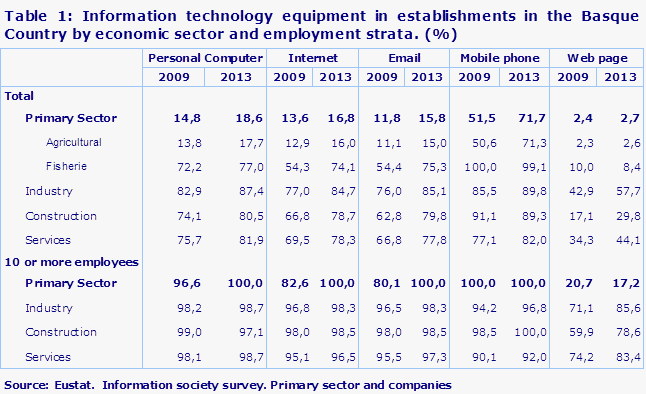
This situation varied a great deal if the size of the establishments was taken into account. In those with 10 or more employees, average equipment reached 100% for those that had both a computer, as well as Internet, e-mail or a mobile telephone. For this size, only the percentage of those that had a website (17.2%) lagged far behind the other sectors of activity.
Fishing businesses had more ICT equipment than agricultural ones
It should be noted that within the primary sector there were very different percentages obtained by agricultural and fishing companies, the latter reaching far higher percentages for equipment. However, fishing companies had almost no impact upon the total for the primary sector, as in terms of numbers they only accounted for 1.4%.
In the agricultural sector the availability of these technologies reached 71.3% for mobile telephones, 17.7% for computers, 16.0% for Internet and 15.0% for e-mail; whereas in the case of fishing companies these percentages rose to 99.1% for mobile telephones, and 77.0% also had computers, 74.1% were connected to the Internet and 75.3% had access to e-mail. Regarding Websites, 2.6% of agricultural establishments had one, compared to 8.4% of fishing ones.
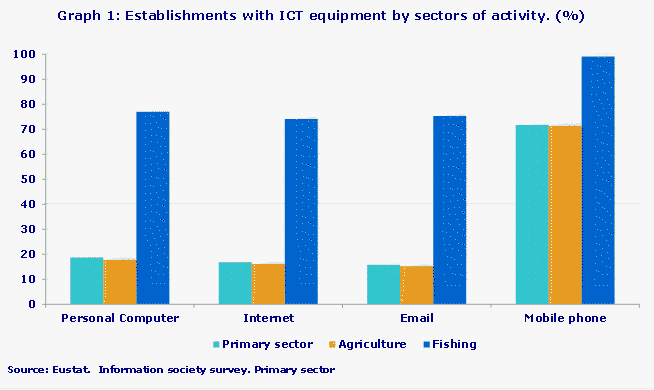
It should be taken into account that these differences were not just due to differences in activity, as the size of the holdings continued to have an impact. Whilst in the agricultural sector almost all establishments had 10 or more employees, in the fishing sector there was a greater distribution between companies with fewer than 10 employees and those with 10 or more.
Regarding the establishments with access to the Internet, as in other sectors, most fixed connections used ADSL lines, 69.1%. This was followed by the use of a modem, at 10.7%, cable (fibre optic) at 4.4%, ISDN at 3.8% and other fixed connections at 11.1%. In this latter category the use of new longer-range wireless technologies stood out, such as Wimax connections, for improved access in rural areas, and satellite connections in the fishing sector.
In the primary sector, 42.2% of establishments with Internet access had mobile connections; 37.6% of them through a mobile telephone and 19.0% of them through a broadband modem.
For further information:
Eustat - Euskal Estatistika Erakundea / Instituto Vasco de Estadística
C/ Donostia-San Sebastián, 1 01010 Vitoria-Gasteiz
Press Service: servicioprensa@eustat.eus Tel: 945 01 75 62
Further press releases on the information society survey. Primary sector in the Basque Country