Press Release 26/09/2014
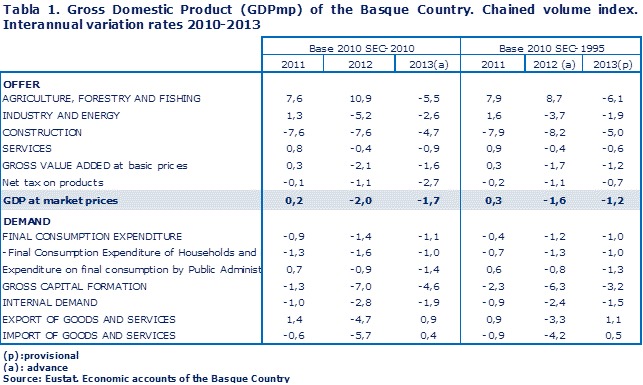
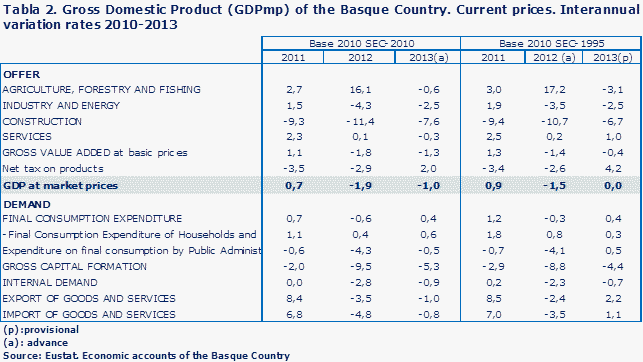
ECONOMIC ACCOUNTS OF THE BASQUE COUNTRY 2010-2013(a)
The Economic Accounts of the Basque Country have been developed according to the new european methodology, ESA 2010
Series for the main macromagnitudes have been remeasured to the base year, 2010
Eustat has estimated the Economic Accounts of the Basque Country giving final data for 2010-2012 years serie and the advance estimation for 2013. This has been done using the new methodology for the European Union, the European System of National and Regional Accounts of 2010 (ESA 2010), compulsory for the member states from september 2014.The aim is to offer a set of estimates fully comparable to those offered by the other economies. This is why, in line with the main statistics offices of the European Union Member States, has applied the new methodology of the European System of National and Regional Accounts of 2010 (ESA 2010) in the preparation of the Economic Accounts and Input-Output (MIO) of the Basque Country. This methodology was adopted via Regulation (EU) No 549/2013 of the European Parliament and of the Council of 21 May 2013. It substitutes that which was used until now, ESA-1995.
Moreover, historical series of the set of estimates are required for any type of temporal analysis, and it is therefore necessary to re-estimate all macro-magnitudes for previous years, following this new methodology. In this moment a re-estimated series is offered up to 2010. In a second stage, the re-estimations of previous years will be circulated.
As in the other European economies, the adoption of the new methodology ESA-2010, alongside the usual improvements introduced in the estimation systems from re-estimating previous years, has resulted in a higher level of GDP. Compared to the definitive estimates made by Eustat for the Basque Country, the GDP for 2010 is 3.8% higher than the estimate made with the previous methodology, that of 2011 is 3.6% higher, that of 2012 is 3.2% and that of 2013 is 2.1% higuer.
The main methodological changes introduced in the new ESA-2010 are detailed below. Those with the greatest impact are the capitalisation of expenditure in Research and Development and the obligation to include the Illegal Economy in the calculation of Added Value.
Capitalisation of expenditure in Research and Development (R&D)
In ESA-95, R&D expenditure was recorded as intermediate consumption. In ESA-2010, on the other hand, R&D expenditure is considered to contribute to economic growth in subsequent financial years, whereby it is to be treated as an investment in capital. Thus, both the external expenditure and the internal production of R&D must be recorded as the gross formation of fixed capital in the year in which purchases or production occurs. In subsequent years the corresponding consumption of fixed capital is recorded.
This methodological change has resulted in an increase in the level of GDP in the Basque Country of 1.5% in 2010.
�
Illegal Economy
ESA-1995 recommended that the estimate of illegal activities, such as organised prostitution and the production and trafficking of drugs, be included within the limits of Production. The European Commission, upon a prior request by the European Court of Auditors, made this recommendation obligatory as of September 2014. The aim is to obtain better comparability of GDP estimates between EU Member States, regardless of divergences in the definition of illegal activities between countries.
The inclusion of illegal activities in the estimate of Added Value has led to a 1.1% increase in GDP in 2010.
Other methodological changes that were introduced to satisfy ESA-2010, but whose unit impact on the GDP of the Basque Country was less significant, will now be enumerated. The combined effect of these methodological changes, along with the effects derived from improving the estimates of various activities (due to new or improved sources of information and estimation processes, etc.), gave rise to a 1.2% increase in the level of GDP for 2010.
Treatment of Insurance Companies
The new ESA-2010 introduces two substantial innovations in the treatment of insurance companies whose impact on GDP is positive or negative and to varying degrees, according to the year:
1. Reinsurance activities of companies, which was previously consolidated with insurance companies, must now be described separately.
2. The measurement of insurance production units varies. In ESA-1995, production corresponded to the margins generated by the insurers; in other words, the premiums collected minus the claims paid, as well as income derived from investing their stock. In ESA-2010, on the other hand, when calculating production, the compensations paid are substituted by anticipated or expected payments. This produces variations in the added value of insurers from year to year according to the difference between the number and quantity of claims observed and those expected.
Treatment of Production for own final use
In ESA-1995, production for own final use was evaluated as the sum of production costs in the market sectors. In ESA-2010 the capital costs incurred are added, generating a slight positive impact on the level of GDP.
Specification of the Public Administrations sector
The new ESA-2010 contains a chapter specifically dedicated to Public Administration Accounts. On the basis of accumulated experience, a guide employing wider criteria than ESA-1995 is provided for the identification of public administration units as well as for a greater specification of the market and non-market rule.
In addition to the usual concepts of expenditure that had been included in ESA-1995 (intermediate consumption, remuneration of employees, consumption of fixed capital and other taxes on production), ESA-2010 includes net expenditure for interests within production costs.
The application of these new criteria means that the number of bodies included within the Public Administrations sector increases in comparison with the previous series, positively impacting the estimated level of GDP.
For more information:
Eustat - Euskal Estatistika Erakundea / Basque Statistics Office
C/ Donostia-San Sebastián, 1 01010 Vitoria-Gasteiz
Press Service: servicioprensa@eustat.eus Tlf: 945 01 75 62
Press releases about Economic Accounts of The Basque Country