Press Release 19/09/2014
The GDP of the Basque Country registered 0.4% quarter-on-quarter growth in the second quarter of 2014
This growth was underpinned by the Internal Demand, while the foreign sector evolved more moderately
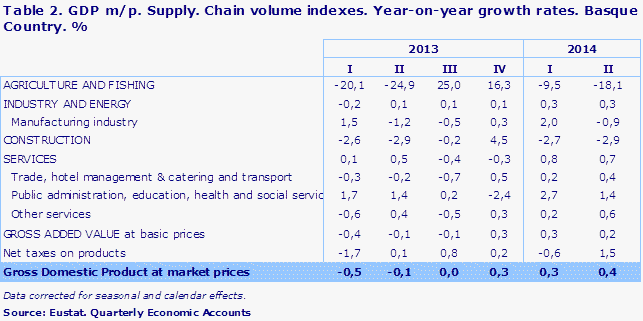
In the second quarter of 2014, the GDP of the Basque Country registered a positive quarter-on-quarter variation of 0.4%, an improvement of one tenth on the previous quarter, according to data drawn up by Eustat. This variation was two tenths tower than that registered by the Spanish economy as a whole (0.6%).
With respect to the same quarter of the previous year, GDP in the Basque Country rose by 0.9%. This was the second positive performance after nine negative year-on-year rates. This year-on-year growth was three tenths lower than that registered by the Spanish economy (1.2%), but exceeded that of the Eurozone-18 by two tenths (0.7%).
From the point of view of supply, the year-on-year increase in GDP is the combined result of various trends in the four large activity sectors. Both the primary and industrial sectors and the global performance in the services sector showed positive variations in their levels of activity, whilst the construction sector once again posted negative growth for added value.
The Primary sector registered a 7.7% growth in year-on-year terms.
In this second quarter the Industry sector registered a growth rate of 0.7%, which meant an improvement of zero point two percent over the year-on-year figures of the first quarter, and the third consecutive quarter with positive year-on-year growth rates. This figure for year-on-year performance corresponds to a growth of three tenths in quarter-on-quarter terms, which has meant an extra quarter in which the sector has achieved a positive quarter-on-quarter variation.
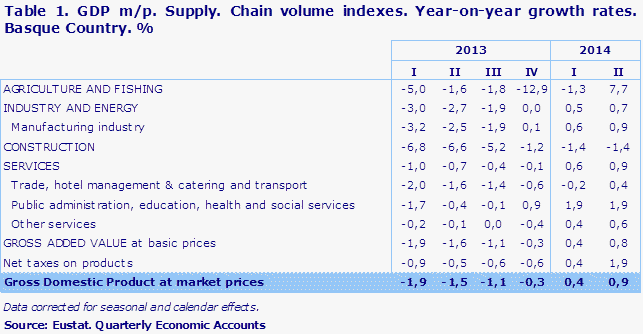
The Construction sector once again showed signs of contraction in year-on-year terms with a fall of 1.4%, the same rate as the previous quarter. The growth rate compared to the previous quarter was also negative, at -2.9%.
Global activity within the Services sector recorded positive variations in both year-on-year terms and quarter-on-quarter terms: 0.9% and 0.7% respectively.
The year-on-year rise of nine-tenths in Services is the result of trends of varying intensity within its sub-sectors: the Public Administration, Health and Social Services branch registered the best performance, with 1.9% growth, while the so-called Other Services - including, among other things, professional activities, finance and security - grew at a rate of 0.6%, and the activity rate ofTrade, Hotel Management & Catering and Transport rose by 0.4%.
Regarding quarter-on-quarter variation, the positive growth of all subsector activities was noteworthy. It was once again those services related to Public Administration, Health and Social Services that showed the greatest quarter-on-quarter growth, at 1.4%. Other Services grew by 0.6% and the Trade, Hotel Management & Catering and Transport sector grew by 0.4%.
The aggregated performance by sector has given rise to a positive evolution of Added Value of 0.8% in year-on-year terms, the second positive growth figure for added value in 2014 after nine consecutive quarterly downturns. This is an improvement of four-tenths over the year-on-year figure of the previous quarter. There was also a 0.2% rise in the quarter-on-quarter rate, for the third consecutive quarter.
From the point of view of Demand, there are two significant issues. The first is a relative consolidation of the positive evolution in Internal Demand, at one percent, confirming the positive figure of the previous quarter. Secondly, this positive evolution in Internal Demand is counteracted by a more moderate evolution in foreign trade, which implies a slightly negative contribution of the latter to GDP growth. There was a slight upturn in import levels combined with a more moderate variation in export levels.
Final Consumption Expenditure of Households (Private Consumption) confirmed the positive evolution that began in the first quarter of the year. Growth in this second quarter was 1.4%, one point two percent higher than the previous quarter. The quarterly rate was 1.2%.
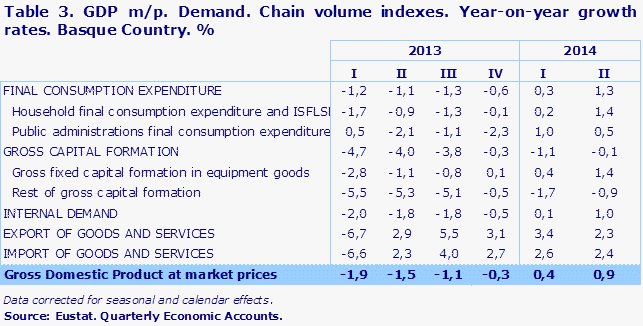
Public Consumption (Final Consumption Expenditure of Public Administrations) continued to show moderate performance with a year-on-year growth of 0.5%, five tenths lower than the previous quarter, producing a 4.7% fall in the quarter-on-quarter rate.
The overall performance of the Final Consumption Expenditure of Public Administrations combined with the Final Consumption Expenditure of Households led to a upturn of 1.3% in Final Consumption Expenditure. With regards to the previous quarter there was also a downturn, 0.1%.
Gross Capital Formation (Investment) continued to fall in year-on-year terms (-0.1%), although this moderate year-on-year fall produced a quarterly rise of 0.5%. Once again this overall performance of investment was based on two opposite trends. The evolution of investment in capital goods had positive results with a year-on-year growth rate of 1.4%, which also meant a positive quarterly rate, of 2.0%. On the other hand, the rest of Gross Capital Formation, which is more closely related to the evolution of the construction sector, posted negative results, both in the year-on-year rate (-0.9%) and quarter-on-quarter (-0.2%).
Internal Demand, composed of Final Consumption Expenditure and Gross Capital Formation, posted a positive variation in year-on-year terms of 1.0%. It is significant that this figure is nine-tenths better than that of the previous quarter.
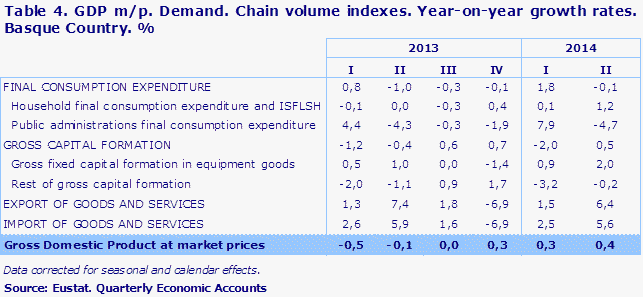
The contribution of the Foreign Sector to the evolution of GDP was slightly negative. The evolution of the foreign balance in relation to the evolution of Internal Demand occurs with year-on-year positive performance of 2.3% within Exports of goods and services, compared to growth in Imports of 2.4%.
In relation to employment levels (measured in Full-Time Equivalent Jobs), it is worth noting that after more than five consecutive years of quarterly falls, this second quarter produced a year-on-year growth of 0.1%. This year-on-year rate means a 0.5% growth with respect to the first quarter of 2014.
The evolution of the level of employment in relation to the same quarter of the previous year was negative in Industry and in Construction but not in the other sectors of activity. The Services sector stands out for its total volume of employment whose annual rate grew by 0.9%. The Primary sector also grew at a rate of 0.7%. The greatest year-on-year downturn occurred once again in Construction, which fell by 2.7%. Similarly, the loss of employment in Industry was 1.8%.
In quarter-on-quarter terms, both the Primary sector and Services showed positive evolutions: 7.4% in the Primary sector and 0.8% in Services. Industry and Construction dropped in relation to the first quarter, by 0.8% and 0.4% respectively.
Regarding the evolution of GDP by Province, in year-on-year terms Gipuzkoa showed the largest growth, at 1.1%, while Bizkaia grew by 0.8% and Álava by 0.7%. In quarter-on-quarter terms Álava was up by 0.1%, and Bizkaia and Gipuzkoa by 0.4%.
For further information:
Eustat - Euskal Estatistika Erakundea / Instituto Vasco de Estadística
C/ Donostia-San Sebastián, 1 01010 Vitoria-Gasteiz
Press Service: servicioprensa@eustat.eus Tlf: 945 01 75 62
More press releases on the CET - Quarterly Economic Accounts of the Basque Country
Quarterly Economic Accounts of the Basque Country databank