Press Release 30/05/2014
Eustat incorporated interactive pyramids on its website that allow one to view the Basque population from 1976 to 2026
With these interactive population pyramids, the population can be viewed over time by geography, age groups and sex
In 2026 the Basque Country will have a population of 2,077,333 inhabitants of which 51.7% will be women and 48.3% men. If we look back at the past, in 1976 the Basque population reached 2,071,778 inhabitants, of which 50.4% were women and 49.6% men.
All of these data can be viewed in the Interactive Population Pyramids, a new tool hosted on the Eustat website that allows the user to learn, in a graphic and dynamic way, about the evolution of the population resident in the Basque Country over the period from 1976 to 2026.
This visualisation can be displayed according to sex, age or province. This tool can therefore be used to view what occurred in the past as well as what will predictably occur in future.
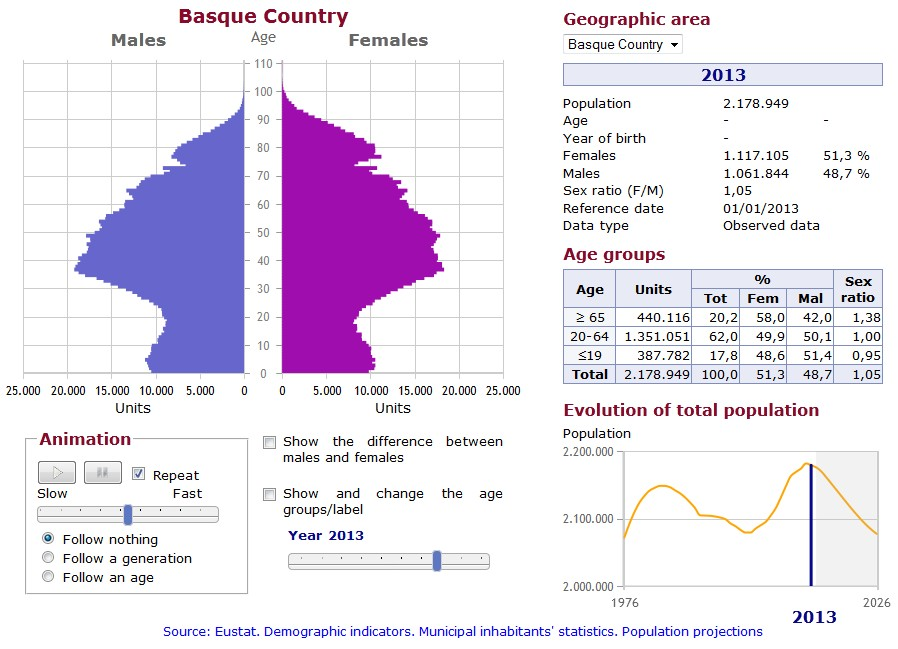
Continuing with the example of the year 2026, of the total population of the Basque Country in that year, 1,073,136 will be women and 1,004,197 men. Moreover, by age groups, 26.5% will be aged 65 or over, 55.7% will be between the ages of 20 and 64, and 17.8% will be aged 19 or younger.
How many young people aged 14 will there be in 2026? It's also possible to view the situation of the population at specific ages. Thus, we can see that in that year, 1.0% of the Basque population (20,950) will be 14 years old, that the population of 85-year-olds will make up 0.60% of the total (13,157 people), or that 1.10% (23,542) will be 40 years old.
For this reason the Interactive Population Pyramids are a powerful tool that allow for planning in areas such as education, health, social services, and in all those areas in which the public Administration requires reliable data over time on the population in general and on certain specific groups. It is also useful to any person who wishes to conduct studies and research, whether in the sphere of business or academia.
The tool has an option called "select geographical area" which allows the user to view data for the Basque Country or for the three Provinces: Araba/Álava, Bizkaia and Gipuzkoa. Using this tool, a second box allows one to view data relating to the period 2010-2013 on all municipalities of the Province in question.
If we select the year 2013, we can see that in that year Álava had 316,287 inhabitants (50.9% women and 49.1% men), Bizkaia had 1,150,792 inhabitants (51.7% women and 48.3% men) and Gipuzkoa had 707,891 inhabitants (51.0% women and 49.0% men).
Descending to the municipal level, of the three Basque capitals, Bilbao had the largest population (347,769 inhabitants), followed by Vitoria-Gasteiz (238,911) and Donostia-San Sebastián (181,026). In this case it's also possible to view data according to sex and age groups.
The distribution of the overall population can be viewed in three age groups, through a table (totals, percentages and sex ratio). These age groups can be modified by users.
Regarding animation options, the monitoring selector is particularly interesting. It allows one to view the evolution of the population in general, or of a generation or specific age, according to one's selection.
The pyramid also has an option that can show the difference between men and women; in other words, the ages or age groups for which the male population exceeds the female population and vice versa.
For further information:
Eustat - Euskal Estatistika Erakundea / Instituto Vasco de Estadística
C/ Donostia-San Sebastián, 1 01010 Vitoria-Gasteiz
Press Service: servicioprensa@eustat.eus Tlf: 945 01 75 62