Press Release 20/05/2014
68% of the population were Internet users in the Basque Country in 2014, up 2.4 percentage points
The region of Plentzia-Mungia had the highest percentage, 73.5%, and Montaña Alavesa the least, at 55.4%
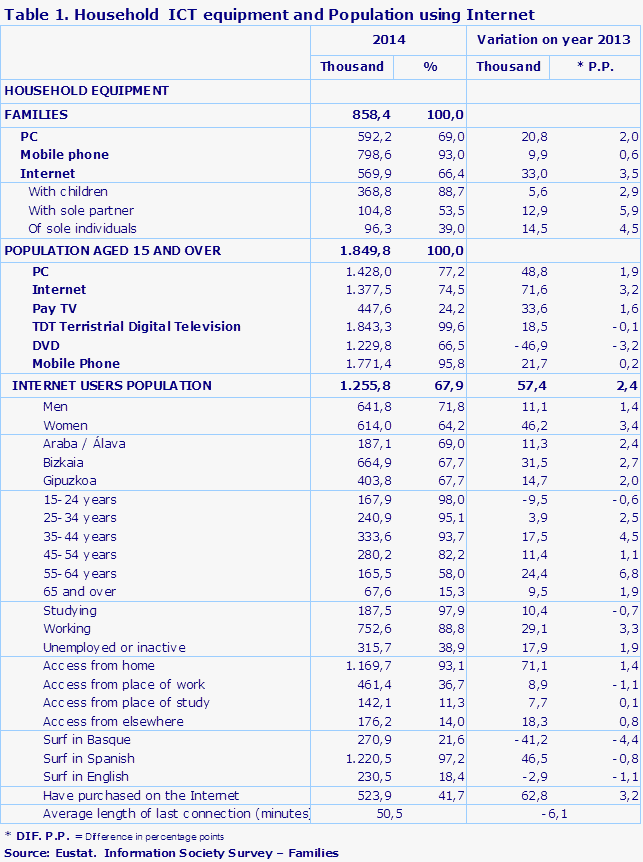
The number of Internet users aged 15 and over in the Basque Country stood at 1,255,800 in the first quarter of 2014, 67.9% of the overall Basque population in this age group, according to data prepared by Eustat. As regards the same period in the previous year this percentage was up 2.4 percentage points.
Bizkaia was the province with the greatest increase in the percentage of users (2.7 percentage points), and occupied second place in the Basque Country along with Gipuzkoa, where 67.7% of people were internet users and where there had been an increase of 2 points with respect to the same period of the previous year. Álava, for its part, continued to head the list, with 69% of the population aged 15 and over being Internet users, following an increase of 2.4 points.
Regarding the three Basque capitals, Vitoria-Gasteiz, with 69.7% of individuals aged 15 and over who were Internet users, stood in first place, followed by Donostia-San Sebastián, with a percentage of 67.9%, whilst Bilbao was in third position, with 66.5% of the population connected to the Internet.
At the regional level, Plentzia-Mungia (73.5%) in Bizkaia, Estribaciones del Gorbea (71.2%) in Álava and Bajo Bidasoa (70.5%) in Gipuzkoa were the areas with the greatest percentage of population who used the Internet in the three provinces.
On the other hand, Bajo Deba (64.1%) in Gipuzkoa, Gernika-Bermeo (64.4%) in Bizkaia, and Montaña Alavesa (55.4%) in Álava were the regions that registered the lowest percentages of Internet users in their respective provinces.
In terms of age, practically the whole of the population of young people in the Basque Country between the ages of 15 and 24 (98%) were Internet users. The increase of 6.8 percentage points in users in the 55-64 age group is worthy of a mention, followed by that for individuals aged between 35 and 44, which rose by 4.5 points.
The gender gap amongst the population that use the Internet decreased slightly
The so-called gender gap, which in 2013 stood at 9.7 percentage points, decreased to 7.6 points in the first quarter of 2014. Thus, with respect to the population aged 15 and over, male Internet users represented 71.8% of the male population, whereas female users accounted for 64.2% of the female population. Of the total number of individuals using the Internet in 2012, 51.1% were men compared to 48.9% of women.
In relation to activity, 97.9% of the student population were Internet users, whereas amongst the population in work this figure stood at 88.8%, and amongst inactive and unemployed individuals it stood at 38.9%. The greatest increase with respect to 2013 occurred amongst people in work (3.3 percentage points).
The preferred location for accessing the Internet continued to be the private home, with 93.1% of users connecting from their houses. Internet access from education centres and other places increased slightly, with a rise of 0.1 and 0.8 points, respectively. However, access from the workplace, for its part, was down 1.1 points compared to the first quarter of the previous year.
There was an increase in the number of Internet users purchasing products or services online
The percentage of individuals using the Internet who made online purchases experienced an increase of 3.2 percentage points in 2014 compared to 2013. Whilst in the first quarter of 2014, 41.7% of the population who use the Internet made a purchase online, in 2013 this figure stood at 38.5% of web users.
The presence of CIT equipment continues to increase in Basque households
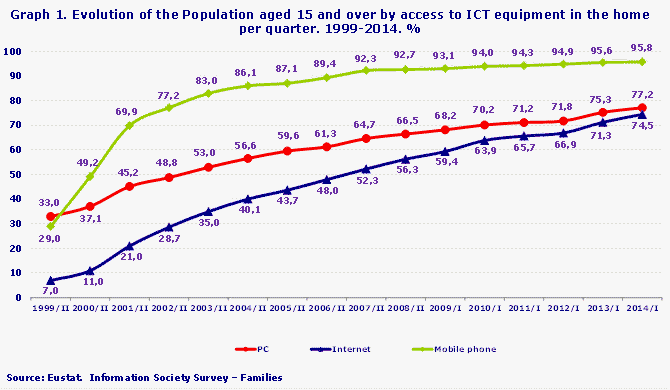
The presence of Communication and Information Technology continues to grow throughout Basque households. In the first quarter of 2014, 69% of households in the Basque Country had a computer. For the population aged 15 and over the figure was 77.2%.
As regards Internet access, nearly 570,000 families, or 66.4%, had this service in their homes, with 33,000 new families (3.5 points) connected to the Internet compared to the same period of 2013. In turn, the population aged 15 and over with Internet access was up by 71,600 (3.2 points) since the first quarter of 2013, and stood at 74.5%. For its part, the mobile telephone was present in 93% of households. If we refer to the population aged 15 and over, the percentage with a mobile telephone rises to 95.8%.
�
Methodological note
As from 2014 the results of the Survey on the Information Society for Families prepared by Eustat are calculated using the new 2026 Population Projections. Eustat updates the Population Projections every five years and those of 2026 use the 2011 Population and Housing Censuses as a population base. Next June all of the information of the period 2006-2013 will be updated with the new population base.
For further information:
Eustat - Euskal Estatistika Erakundea / Instituto Vasco de Estadística
C/ Donostia-San Sebastián, 1 01010 Vitoria-Gasteiz
Press Service: servicioprensa@eustat.eus Tlf: 945 01 75 62
Further press releases on Information Society Survey of the Basque Country - Families
Databank on Information Society Survey of the Basque Country - Families