Press Release 19/05/2014
Industrial activity registered general downturns in almost all Basque regions in 2012
Nineteen of the twenty regions showed negative evolutions in the number of people employed in the extraction and manufacturing industry
The evolution of net sales in the extraction and manufacturing industry was negative for seventeen of the twenty regions in the Basque Country, according to Eustat data. Only the regions Encartaciones (+5.6%), Goierri (+1.6%) and Cantábrica Alavesa (+0.2%) presented a positive evolution with respect to 2011.
The Basque extraction and manufacturing industry as a whole registered a fall in sales of 6.0%. By province, Bizkaia presented the worst evolution with a drop of 7.7%, followed by Álava which was down 7.0% and Gipuzkoa, where sales fell by 2.8%.
Distribution of net sales in the extraction and manufacturing industry by regions. 2012. Thousands of euros
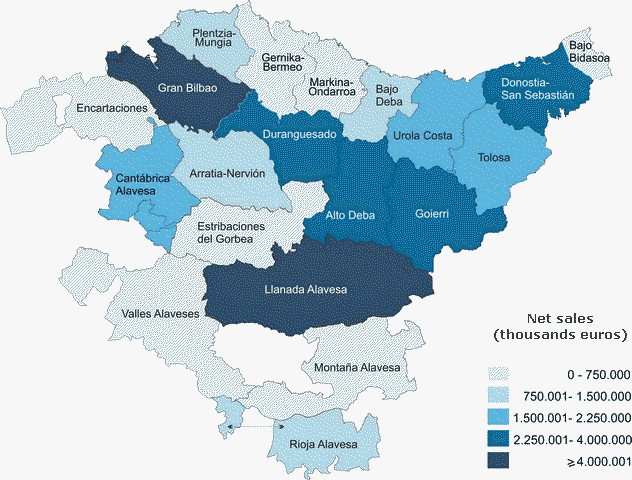
Source: EUSTAT. Industrial Statistics of the Basque Country
�
In Álava, only one region posted a positive growth rate, Cantábrica Alavesa, with 0.2%. On the other hand, there were significant falls in sales in Estribaciones del Gorbea and Montaña Alavesa, with reductions of16.7% and 16.3%, respectively. The region of Llanada Alavesa, whose sales account for 64% of those of the province, saw its sales drop by 8.5%.
Also in the Province of Bizkaia, where sales were down 7.7%, only one region, Encartaciones, posted a positive growth rate of 5.6%. The steep drop in Gernika-Bermeo is noteworthy, with a rate of -34.5% with respect to 2011.
In Gipuzkoa the average fall was 2.8%. Bajo Bidasoa was the region with the greatest fall in sales, of 11.9%, while Goierri was the only region where values were up on the previous year, by 1.6%.
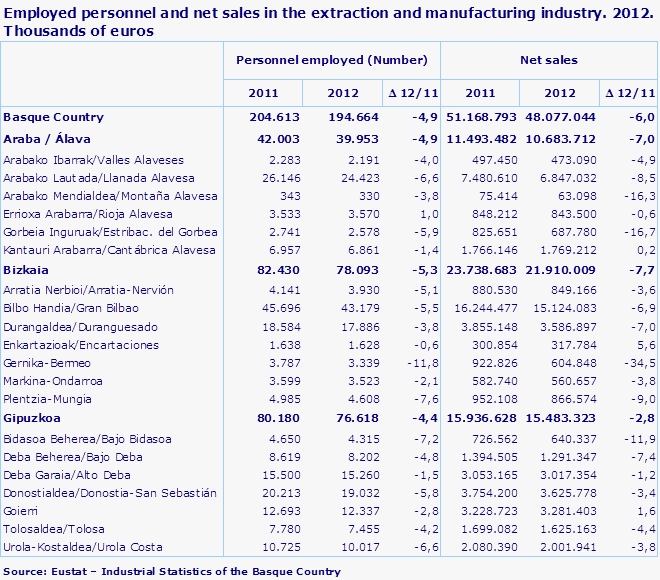
The number of people employed also evolved poorly, as nineteen of the twenty regions posted negative rates. The Autonomous Region saw an average drop of 4.9%, with a relatively homogenous provincial performance, but with a slightly steeper downturn in Bizkaia (-5.3%) than in Álava (-4.9%) and in Gipuzkoa (- 4.4%).
�
In Álava there was growth in employment only in the region of Rioja Alavesa, where it was up by 1.0%. The fall in employment in Llanada Alavesa (-6.6%) is noteworthy because of its relative importance, as 61% of the personnel in those sectors are employed in that region.
In Bizkaia, all regions saw a reduction in the number of people employed. There was a significant negative evolution of employment in the region Gernika-Bermeo, where it fell by 11.8%, while the least negative rate was seen in Encartaciones (-0.6%).
The situation in Gipuzkoa was the same as in Bizkaia, with a negative evolution in employment in all regions. The region of Bajo Bidasoa lost the most employment, with a fall of 7.2%, while Alto Deba lost the least, at 1.5%.
Methodological note:
The sectorisation used is the National Classification of Economic Activities (CNAE-2009), with the B (extractive industries) and C (manufacturing industries) being the only sections included in this disaggregation by regions.
For further information:
Eustat - Euskal Estatistika Erakundea / Instituto Vasco de Estadística
C/ Donostia-San Sebastián, 1 01010 Vitoria-Gasteiz
Press Service: servicioprensa@eustat.eus Tel: 945 01 75 62
Further press releases on Industrial Statistics of the Basque Country
Industrial Statistics of he Basque Country databank